Aging gene effects partly match from yeast to human cells
Two yeast lifespan measures shared regulators 1.7-fold more often than expected, but the direction of their effects agreed only 50% of the time.
Our read
Mechanisms- Studied:
- Preprint: computational study of yeast, nematodes, fruit flies, mice, and human cells
- What changed:
- Human-cell effects matched lifespan effects for 82% of cleanup/protein-upkeep genes, against 51–54% of cell-division-arrest and inflammatory-secretion genes
- The catch:
- Human cells were assessed for senescence, while whole organisms were assessed for lifespan
Editor of record: Boris Djordjevic · AgingResearch.News
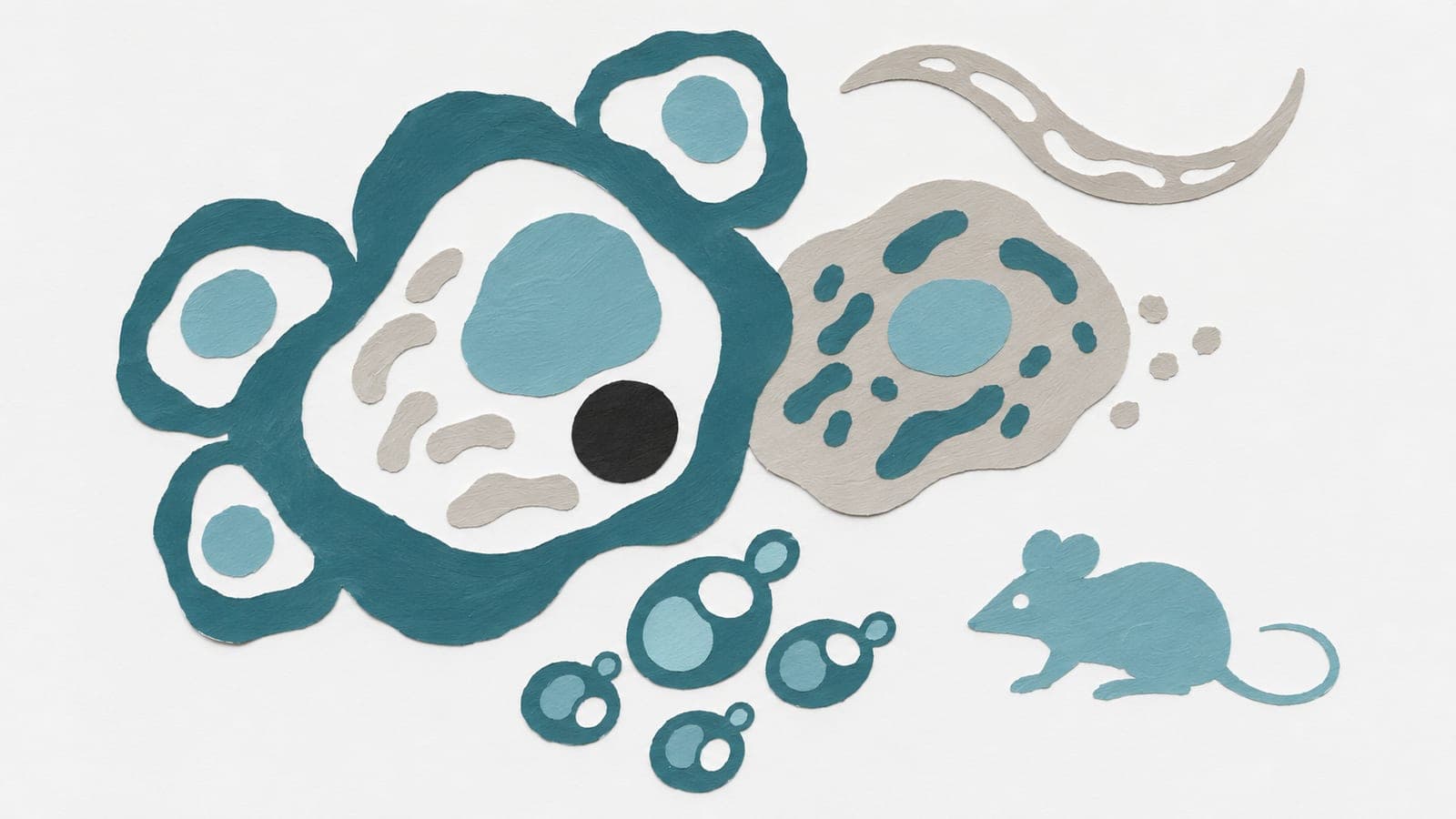
Yeast, nematodes, fruit flies, mice and human cells featured in a computational analysis of 4,771 controlled genetic alterations. The researchers compared whether corresponding genes had matching effects on lifespan or human-cell senescence, a state in which cells stop dividing.
For yeast lifespan measured by cell divisions, gene effects matched the direction of animal lifespan effects for 67% of genes. For yeast survival without dividing, agreement was 50%. When at least two non-mammalian organisms agreed, mice matched their direction for 13 of 14 genes, compared with 61% for evidence from one organism. In human cells, agreement with lifespan results reached 82% for genes involved in cellular cleanup and protein upkeep. Agreement was only at chance, at 51–54%, for genes involved in stopping cell division and inflammatory secretions.
Why it matters
Lifespan research may use agreement across organisms to prioritize genes for testing. The authors nominated 180 untested candidates using agreement across at least two non-mammalian organisms.
Caveats
The computational analysis identified candidates rather than testing their effects; the 180 nominated genes remain untested. The work is a preprint, not yet peer-reviewed.
Where the evidence stands
Autophagy
- 466 independent labs in 48 countries
- 85 findings against
- 1 trial
- Funders: National Natural Science Foundation of China and others
- 127 of 1,712 findings with company ties
Cell cycle regulation
- 195 independent labs in 42 countries
- 15 findings against
- Funders: National Institutes of Health and others
- 23 of 273 findings with company ties
The paper
Rocky Institute of Biotechnology
Research Square, Nov 13, 2026, Open access, Preprint, not yet peer-reviewed


Comments
Be the first to comment.