Tree shrew liver and spleen share human aging patterns
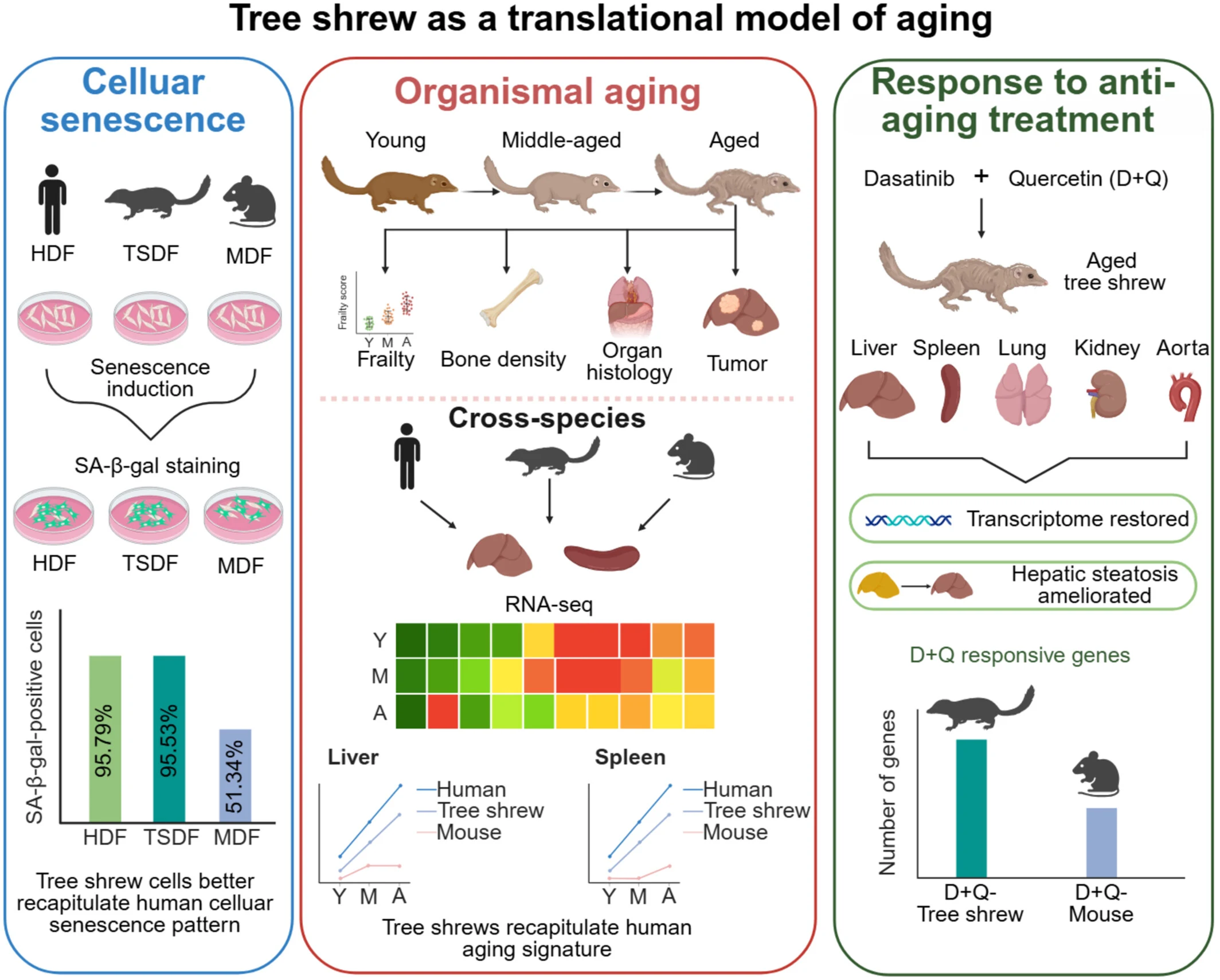
An experiment involving 44 tree shrews found that liver and spleen gene activity followed human aging patterns more closely than mouse patterns.
Our read
Interventions- Studied:
- Cross-sectional study of tree shrews across age groups, against mice
- What changed:
- Tree shrews shared more human midlife liver gene-expression patterns than mice: 24.1% against 6.7%
- The catch:
- Less complete tree shrew genome annotation limits cross-species gene-expression comparisons
- In the record:
- One of 329 papers on Dasatinib + quercetin on record: 55 with results in people, 180 in animals.
- Why it’s aging research:
- An intervention with evidence on lifespan or healthspan.
Editor of record: Boris Djordjevic · AgingResearch.News
Forty-four tree shrews (Tupaia belangeri chinensis) were studied in an animal experiment comparing age groups and testing two drugs. The groups were aged 1–2, 3–4 or 6–8 years. Older animals showed greater frailty, metabolic problems and tissue scarring. Liver and spleen gene activity followed aging patterns shared with humans, while mice showed markedly different patterns.
Ten animals aged 6–8 years received oral dasatinib at 5 milligrams per kilogram and quercetin at 50 milligrams per kilogram twice weekly for three months. Ten age-matched controls received the drug-free liquid. The drugs reversed key age-related gene-activity changes and reduced liver fat accumulation and scarring. Blood markers of organ function did not significantly improve.
Why it matters
Models that reflect human aging biology may help connect laboratory findings with clinical research. The authors proposed tree shrews as a model for that role.
Caveats
The cross-species comparison assessed similarities in gene activity, not whether drugs produce the same health benefits in people. The drug experiment involved 10 treated and 10 control tree shrews aged 6–8 years.
Where the evidence stands
Dasatinib + quercetin
- 126 independent labs in 25 countries
- 28 findings against
- 18 trials, 1 with no results posted
- Funders: National Institute on Aging and others
- 79 of 680 findings with company ties
- 1 of 18 trials sponsored by its developers
Cellular senescence
- 854 independent labs in 75 countries
- 515 findings against
- 51 trials, 15 with no results posted
- Funders: National Natural Science Foundation of China and others
- 663 of 9,839 findings with company ties
- 49 of 51 trials sponsored by developers of drugs aimed at it
- Dasatinib + quercetin
- Cellular senescence
- Extracellular matrix remodeling
- Hepatic steatosis
- Metabolic dysfunction
- T. belangeri
The paper
State Key Laboratory of Genetic Evolution & Animal Models
Aging Cell, Nov 3, 2026, Open access, CC BY
Comments
Be the first to comment.