Obesity and inactivity linked to highest osteoarthritis risk
Obesity and inactivity together were linked to 92.16 extra cases per 100,000 person-years beyond what the sum of their separate associations would suggest.
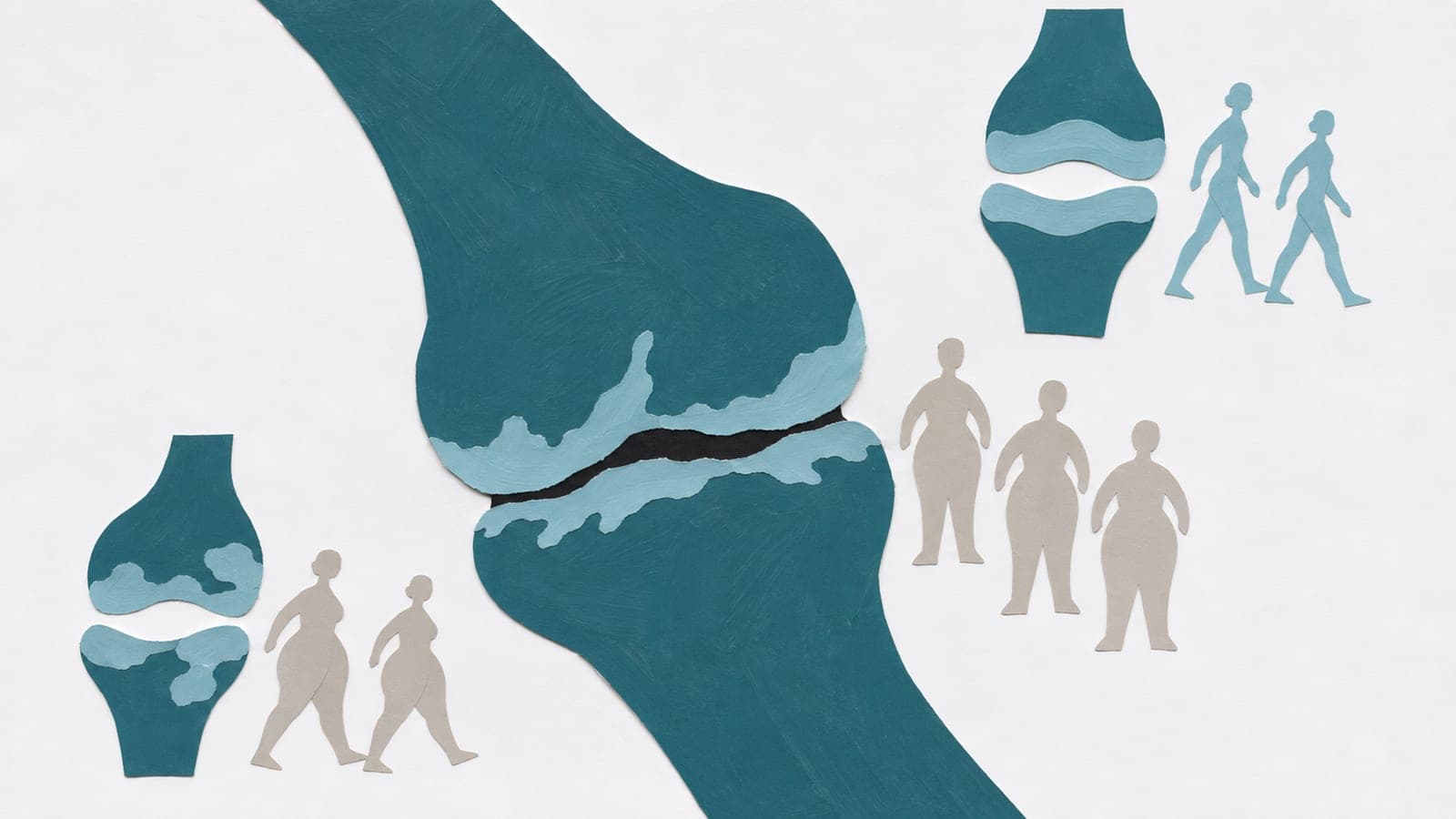
Our read
Populations- Studied:
- Preprint: cohort study of 422,584 UK Biobank participants (Dose-response)
- What changed:
- Obesity with inactivity had the highest osteoarthritis risk, with 92.16 additional cases per 100,000 person-years beyond their separate effects
- The catch:
- Self-reported activity at baseline risks inaccurate classification of long-term activity patterns
- In the record:
- The 305th paper on physical inactivity with results in people; 568 on record in all.
- Why it’s aging research:
- A leading disease of aging, its risks or menopause.
Editor of record: Boris Djordjevic · AgingResearch.News
UK Biobank participants aged 40–69 without osteoarthritis at entry were followed in a prospective observational cohort study of 422,584 people. Osteoarthritis is a joint disease. Researchers measured height and weight at entry and assessed physical activity through questionnaires.
During follow-up, 62,203 participants developed osteoarthritis. Overweight and obesity were linked to higher risk than normal or below-normal weight. Inactivity was linked to modestly higher risk than regular activity. Participants with both obesity and inactivity had the highest risk, with a combined association greater than the sum of their separate associations. Physical activity did not fully offset the higher risk associated with elevated body mass index, a measure of weight relative to height.
Why it matters
Osteoarthritis is an age-related joint disease. The work addresses whether body weight and physical activity have separate or combined links to its development.
Caveats
Activity was self-reported at entry, and early joint symptoms may have influenced how active people were. The preprint has not been peer-reviewed; the cohort excluded people outside ages 40–69 and those with existing osteoarthritis.
Where the evidence stands
Physical inactivity
- 212 independent labs in 55 countries
- 8 findings against
- Funders: National Institute on Aging and others
- 7 of 328 findings with company ties
Physical activity
- 1,011 independent labs in 89 countries
- 448 findings against
- Funders: National Institutes of Health and others
- 190 of 4,081 findings with company ties
From the paper
- Participants
This prospective cohort study included 422,584 participants from the UK Biobank.
- Result
Compared with participants with normal and below weight, those with overweight and obesity had higher OA risks (HR = 1.34, 95% CI: 1.32–1.37; HR = 2.01, 95% CI: 1.97–2.06, respectively).
Quoted word for word from the full text on researchsquare.com.
The paper
Harbin Medical University
Research Square, Nov 3, 2026, Open access, Preprint, not yet peer-reviewed


Comments
Be the first to comment.