Activity’s link to knee and hip arthritis varied with weight
A cohort study following 85,196 people for a median 10.11 years linked moderate activity to the lowest arthritis risk among overweight and obese participants.
Research Square
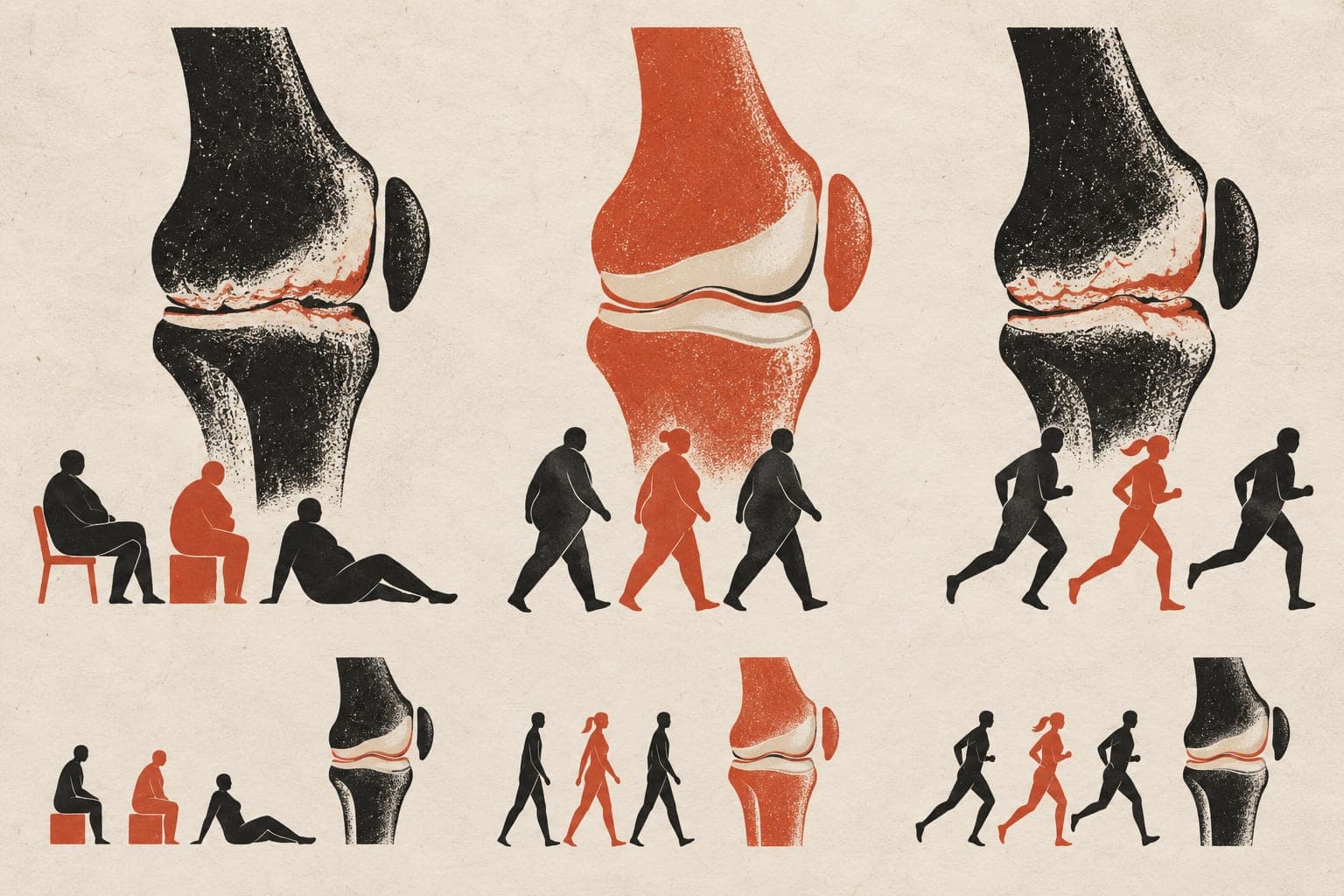
A prospective observational cohort study followed 85,196 UK Biobank participants to examine links between activity and knee or hip osteoarthritis, a disease in which joint tissues break down. Participants wore wrist activity monitors for seven days. The researchers grouped them by body mass index, a measure of weight relative to height. Over a median follow-up of 10.11 years, they identified 5,017 cases.
Moderate levels of moderate-to-vigorous activity were linked to the lowest risk among overweight and obese participants, compared with low and high levels. Among underweight and normal-weight participants, the three activity categories had comparable risks. At the same activity level, risk did not differ significantly between people concentrating at least half their activity into one or two days and those spreading it out.
Why it matters
For joint health in later life, the study bears on whether advice about physical activity should account for body weight.
Caveats
This observational study cannot show that activity caused differences in risk. Activity was measured over seven days, and the findings are from a preprint that has not been peer-reviewed.
- Light physical activity
- Moderate-to-vigorous physical activity
- Moderate-to-vigorous physical activity + light physical activity
- Overweight
- Obesity
- Humans
The paper
Zheng C, Chen J, Zhu C et al.
Research Square · 6 Oct 2026 · Preprint, not peer-reviewed