Age, obesity and manual work linked to shoulder replacement
Each decade of age was associated with more than twice the risk of arthritis-related shoulder replacement in a cohort of 494,203 people.
Our read
Populations- Studied:
- Cohort study of 494,203 UK Biobank participants, mean 13.7 years, against people with healthy BMI
- What changed:
- People with obesity had higher risk of osteoarthritis-related shoulder replacement than those with healthy BMI (hazard ratio 3.08)
- The catch:
- Excluding reverse shoulder replacements missed cases, particularly among older women
- In the record:
- One of 4 papers on manual work on record: 1 with results in people.
- Why it’s aging research:
- A leading disease of aging, its risks or menopause.
Editor of record: Boris Djordjevic · AgingResearch.News
An observational study followed 494,203 UK Biobank participants, aged 40–69 at enrollment, for an average of 13.7 years. Researchers used hospital records to identify 652 shoulder replacements related to osteoarthritis, a disease that damages joints. They used these operations as a measure of end-stage shoulder osteoarthritis.
Obesity was associated with higher risk than healthy weight. More frequent heavy manual work was also linked to higher risk. Vigorous physical activity was associated with higher risk only at the highest levels. At the highest levels of manual work and vigorous activity, the associations were stronger for shoulder replacement than for hip or knee replacement.
Why it matters
Disabling shoulder osteoarthritis poses a concern as people age. The authors suggested weight loss programs and job designs that reduce strain on the arms as possible ways to address potentially modifiable risk factors.
Caveats
This observational study could not establish cause and effect, and shoulder replacement was a proxy for end-stage disease rather than a measure of all shoulder osteoarthritis. The analysis excluded people with prior shoulder replacement, rheumatoid arthritis, psoriatic arthritis or lupus.
From the paper
- Participants
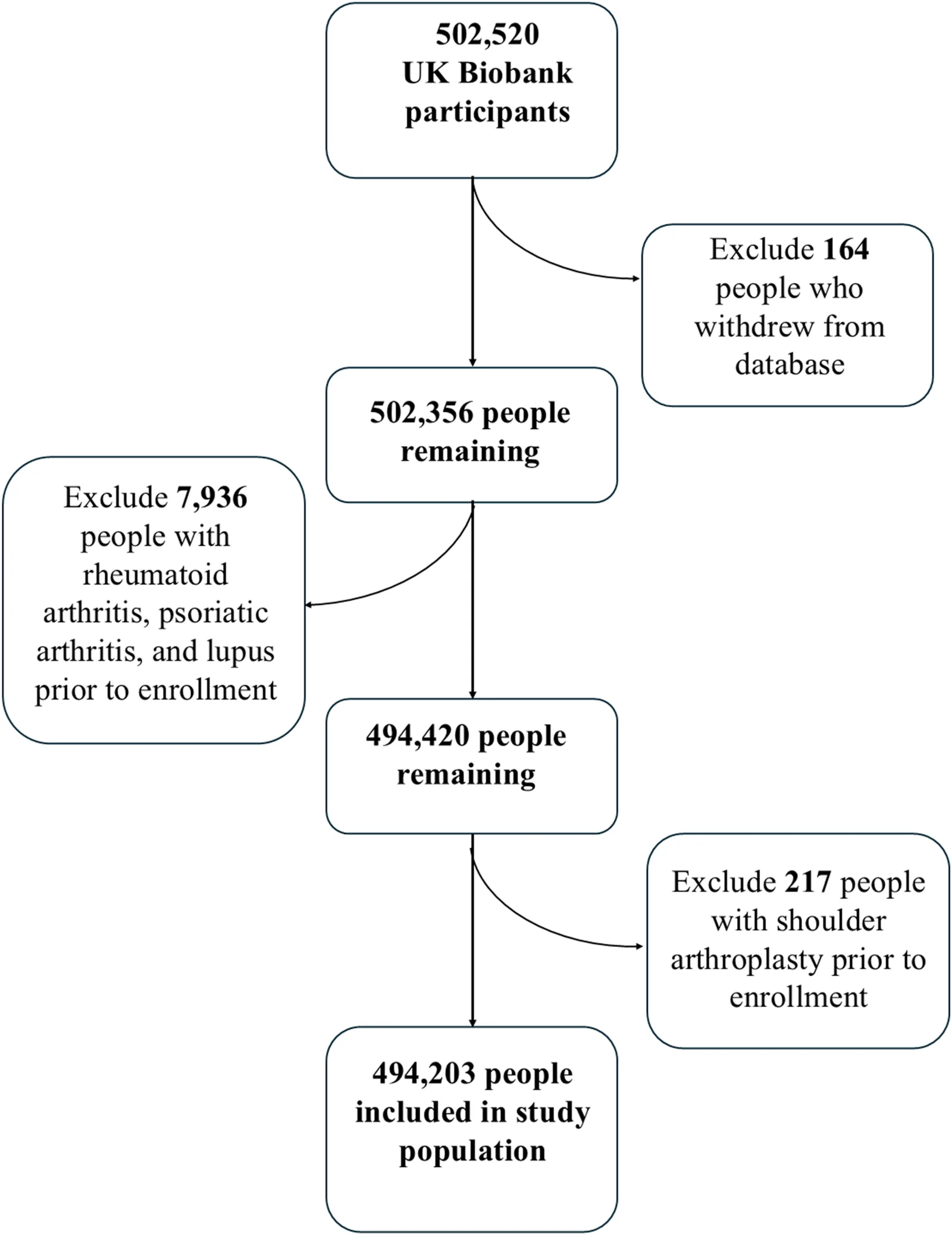
After exclusions, 494,203 participants were included in the analytic sample with a mean follow-up period of 13.7 years (ranging from 1 to 17 years).
- Result
In age-adjusted Cox regression analyses, increasing age was associated with 2.7 times the risk of OA-related SA per decade (HR 2.71, 95% CI 2.40–3.06), and men had half the risk of OA-related SA compared to women (HR 0.50, 95% CI 0.43–0.59; ).
Quoted word for word from the full text on PubMed Central.
The paper
Non-genetic risk factors associated with glenohumeral osteoarthritis-related shoulder arthroplasty
Washington University in St. Louis
Osteoarthritis and Cartilage Open, Aug 22, 2026, Open access


Comments
Be the first to comment.