Recent grip strength change and subsequent cognition after accounting for body mass index and waist circumference
Abstract
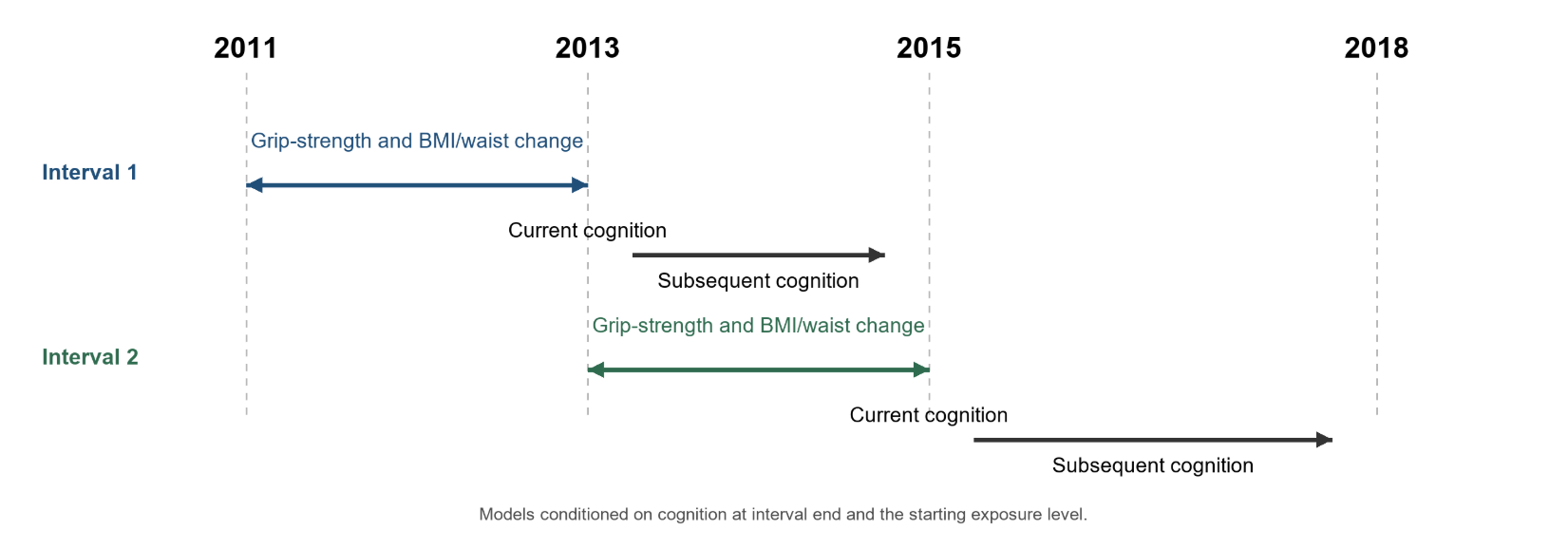
Grip strength and cognition often decline together in later life, but it remains unclear whether recent change in strength provides information about subsequent cognition beyond current cognitive status and concurrent body-size change. We analysed 2,405 adults aged 60 years or older from the China Health and Retirement Longitudinal Study, contributing 3,594 person-period observations across two temporally ordered intervals. Generalized estimating equations related 2-year grip-strength change to cognition at the following wave while adjusting for cognition at the end of the change interval, starting grip strength, body mass index (BMI) level and change, and demographic, clinical and behavioural covariates. Each 5-kg greater grip-strength change was associated with a 0.149-point higher subsequent cognitive score (95% CI 0.046–0.252). Estimates were similar when waist circumference replaced BMI, under strict repeated-measurement quality criteria, after excluding absolute changes > 15 kg, and with inverse-probability weighting. There was no clear effect modification by sex or age. The association was modest and should be interpreted as a longitudinal marker rather than evidence of a causal effect or clinical screening threshold.
From the paper
- Participants
The source cohort comprised 7,290 respondents who participated in the 2011 baseline survey and were aged 60 years or older.
- Result
When grip-strength change was standardized within sex and observation period, the association remained evident (beta = 0.224 cognitive points per SD, 95% CI 0.072–0.377; P = 0.004).
Quoted word for word from the full text on researchsquare.com.
The paper
Hubei University of Medicine; Xiang Yang No.1 People's Hospital
Research Square, Oct 16, 2026, Open access, Preprint, not peer-reviewed