Social participation diversity and cognitive trajectories in older adults with hypertension and diabetes: a longitudinal cohort study
7 years, dose-response
Abstract
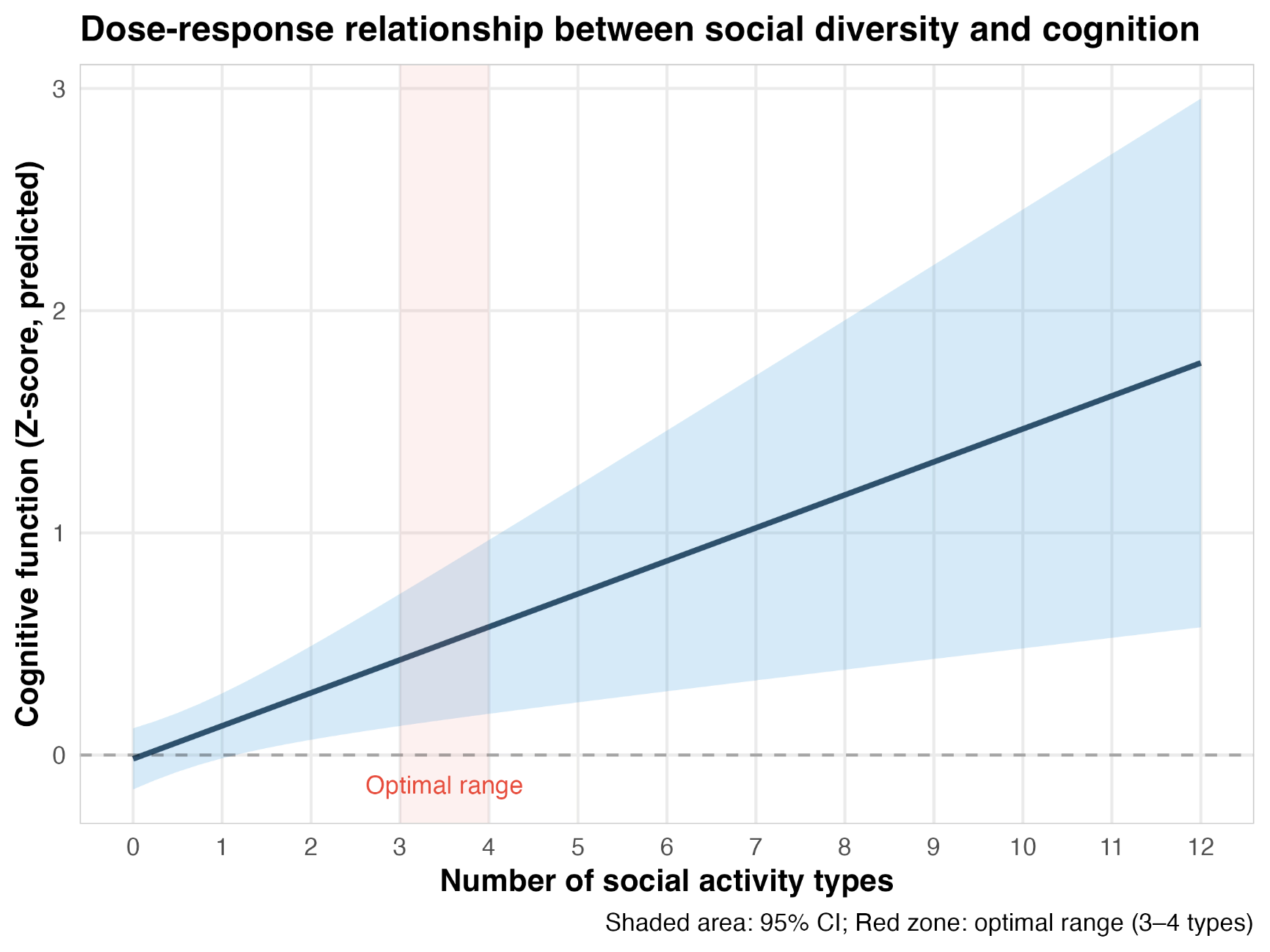
Background Cognitive decline is a major concern among older adults with hypertension and diabetes, two common chronic conditions associated with an elevated risk of dementia and functional impairment. Although physical activity is widely promoted for cognitive health, the long-term contribution of social participation, particularly the diversity of social engagement, remains insufficiently understood in chronically ill older populations. This study examined the longitudinal associations of social participation diversity and physical activity with cognitive function and explored potential dose-response relationships. Methods Data were obtained from three waves (2011, 2015, and 2018) of the China Health and Retirement Longitudinal Study (CHARLS). A total of 547 adults aged 60 years and older with self-reported physician-diagnosed hypertension and/or diabetes were included, contributing 1,472 observations over 7 years of follow-up. Social participation was assessed as the number of different types of social activities engaged in during the previous month (range: 0–12). Physical activity was measured using weekly metabolic equivalent (MET) minutes derived from vigorous-intensity activities. Cognitive function was evaluated using a standardized composite Z-score based on episodic memory, orientation, calculation, and figure drawing tests. Linear mixed-effects models with random intercepts were used to estimate longitudinal associations after adjustment for age, sex, education, and disease subtype. Dose-response relationships were examined using polynomial regression models. Results Greater diversity of social participation was independently associated with better cognitive function over time. Each additional type of social activity was associated with a 0.147-point increase in cognitive Z-score (β = 0.147, 95% CI: 0.045–0.249, p = 0.005). A significant nonlinear dose-response relationship was observed (p = 0.004), with the largest cognitive benefits occurring between one and four activity types, followed by a plateau at higher levels of participation. In contrast, vigorous physical activity was not significantly associated with cognitive function (β = 0.064, p = 0.693) and did not significantly modify cognitive trajectories over time (p = 0.673). Educational attainment was the strongest covariate associated with cognitive performance (p < 0.001). No significant effect modification by disease subtype was identified (all interaction p > 0.05). Conclusions Greater diversity of social participation was associated with better long-term cognitive maintenance among older adults with hypertension and/or diabetes. The observed dose-response pattern suggests that engagement in approximately three to four different types of social activities may provide the greatest cognitive benefit. These findings highlight diverse social engagement as a potentially important and practical component of cognitive health promotion and chronic disease management in later life.
From the paper
- Participants
A total of 547 adults aged 60 years and older with self-reported physician-diagnosed hypertension and/or diabetes were included, contributing 1,472 observations over 7 years of follow-up.
- Result
Each additional type of social activity was associated with a 0.147-point increase in cognitive Z-score (β = 0.147, 95% CI: 0.045–0.249, p = 0.005).
- Limitation
First, exposure variables relied on self-reported lifestyle information, which might introduce recall bias.
Quoted word for word from the full text on researchsquare.com.
- Social participation diversity
- Vigorous physical activity
- Hypertension
- Diabetes
- Cognitive composite z-score
- Humans
The paper
Guangzhou Sport University
Research Square, 12 Oct 2026, Open access, Preprint, not peer-reviewed