A Bounded Agentic In Silico Framework for Age-Aware Molecular Candidate Prioritization in Breast Cancer
Abstract
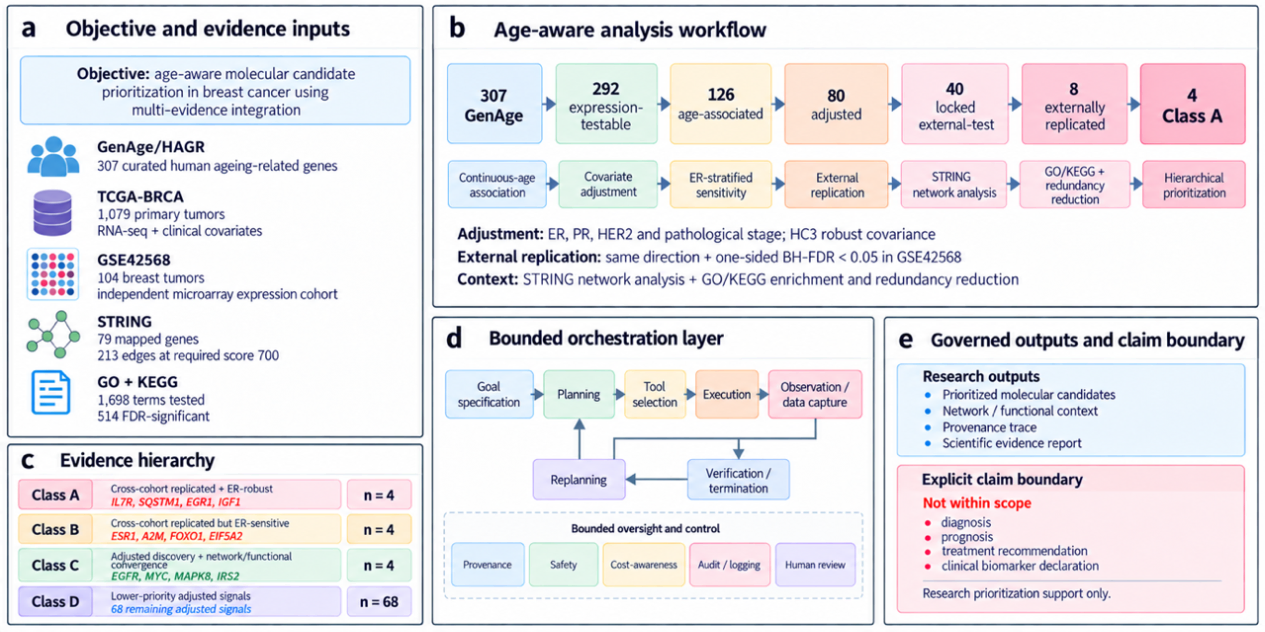
Age-related molecular heterogeneity in breast cancer complicates the prioritization of reproducible research candidates across heterogeneous molecular resources. We developed a bounded agentic in silico framework integrating curated ageing genes, The Cancer Genome Atlas Breast Invasive Carcinoma (TCGA-BRCA), the independent GSE42568 cohort, STRING protein-protein associations, and Gene Ontology and Kyoto Encyclopedia of Genes and Genomes enrichment. Of 307 curated human ageing-related genes, 292 were expression-testable in 1,079 TCGA-BRCA primary tumors. Continuous-age screening identified 126 genes at a false discovery rate below 0.05, and 80 remained significant after adjustment for estrogen receptor, progesterone receptor, human epidermal growth factor receptor 2, and pathological stage. Among 40 prespecified candidates tested in GSE42568, eight replicated directionally; IL7R, SQSTM1, EGR1, and IGF1 were both cross-cohort replicated and robust across estrogen-receptor strata. Stratified age-label permutation supported the overall discovery signal (empirical P = 0.001996). STRING hub rankings were stable across interaction-confidence thresholds (Spearman rho = 0.81–0.90), and 514 significant functional terms were reduced to 30 representative modules. A 760-scenario process-aware benchmark compared static, goal-planning, adaptive, and bounded controllers. The bounded controller achieved 1.000 for policy conformance, feasible-goal completion, action appropriateness, safety conformance, provenance conformance, and escalation conformance, with resource stewardship of 0.988. The framework provides a reproducible computational route for molecular candidate prioritization and hypothesis generation while explicitly excluding autonomous diagnosis, prognosis, treatment recommendation, and clinical biomarker declaration.
The paper
South China Normal University; Harbin Institute of Technology
Research Square, 13 Oct 2026, Open access, Preprint, not peer-reviewed