Higher aerobic capacity is associated with a more favorable circulating redox profile: potential implications for cardiovascular health
Registered NCT03197363
Abstract
Background Disturbances in redox homeostasis may precede the clinical manifestation of cardiovascular disease. However, relationships between systemic redox status, objectively measured aerobic capacity, and habitual physical activity in apparently healthy individuals remain insufficiently understood. This study examined associations of aerobic capacity and self-reported leisure-time physical activity with systemic redox biomarkers, clinical and biochemical parameters, and body composition. Methods This cross-sectional analysis included 70 participants from the Białystok PLUS study (Polish Longitudinal University Study), which was registered at ClinicalTrials.gov (Indentifier: NCT03197363). Aerobic capacity was assessed by cardiopulmonary exercise testing. Systemic redox status was evaluated using total antioxidant status (TAS), total oxidant status (TOS), and the activities of superoxide dismutase (SOD), glutathione peroxidase (GPx), and catalase (CAT). The oxidative stress index (OSI) was calculated as the TOS-to-TAS ratio. Plasma growth differentiation factor 15 (GDF-15), a stress-responsive biomarker, was also measured. Body composition was assessed using dual-energy X-ray absorptiometry (DXA), and standard anthropometric measurements were performed. Associations between body-mass-normalized maximal oxygen uptake (VO₂max/kg) and redox biomarkers were examined using sequential linear regression models: unadjusted, adjusted for age and sex, and fully adjusted for age, sex, smoking status, and the lean mass-to-fat mass ratio (LM/FM). Results In the fully adjusted model, higher VO₂max/kg was independently associated with higher TAS, greater GPx, SOD, and CAT activities, and lower OSI. Participants reporting at least 2 h/week of leisure-time physical activity had higher VO₂max/kg, VO ₂ max normalized to lean mass, TAS, GPx and SOD activities, and LM/FM than those reporting less than 2 h/week. They also had lower waist-to-hip ratio, body fat percentage, OSI, and GDF-15. Conclusions These findings indicate that higher aerobic capacity and at least 2 h/week of self-reported leisure-time physical activity were associated with a more favorable systemic redox balance, potentially benefiting cardiovascular health. However, because of the cross-sectional design, causality, the underlying mechanisms, and clinical significance cannot be established. Longitudinal and intervention studies are needed to determine whether improving aerobic capacity or increasing physical activity enhances redox homeostasis and whether these changes translate into improved cardiovascular health. Clinical Trial Registration The manuscript reports data from the Białystok PLUS study, which was registered at ClinicalTrials.gov (Indentifier: NCT03197363).
From the paper
- Participants
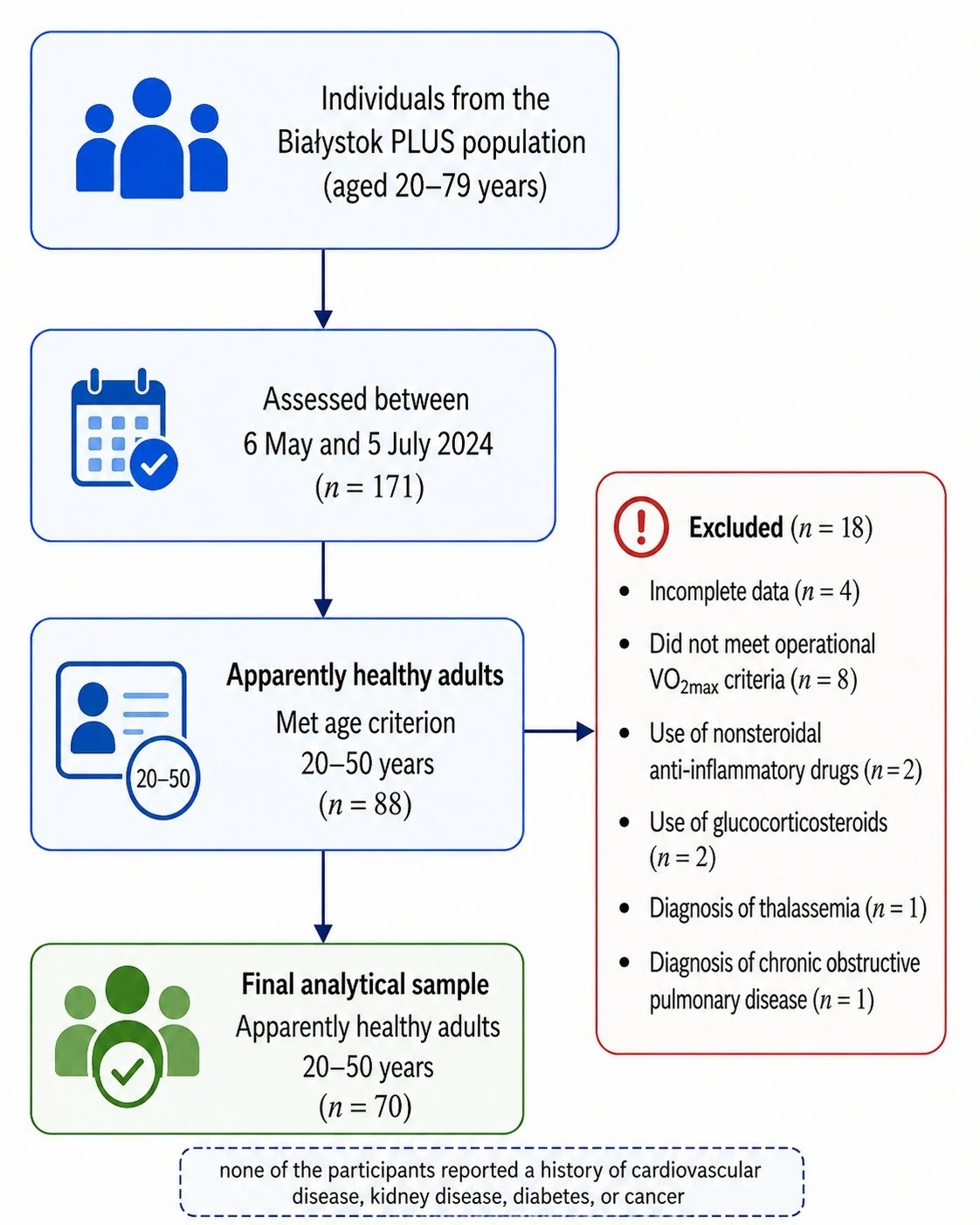
This cross-sectional analysis included 70 participants from the Białystok PLUS study (Polish Longitudinal University Study), which was registered at ClinicalTrials.gov (Indentifier: NCT03197363).
- Limitation
The cross-sectional design precludes causal inference, and the relatively small sample may limit the generalizability of the findings.
Quoted word for word from the full text on researchsquare.com.
- Physical activity
- Cellular homeostasis
- Oxidative stress and ROS signalling
- Body fat percentage
- Catalase
- Humans
The paper
Medical University of Białystok
Research Square, 14 Oct 2026, Open access, Preprint, not peer-reviewed