High-sensitivity cardiac troponin I predicts major adverse cardiovascular events in patients with type 2 diabetes without coronary heart disease: a retrospective cohort study
Abstract
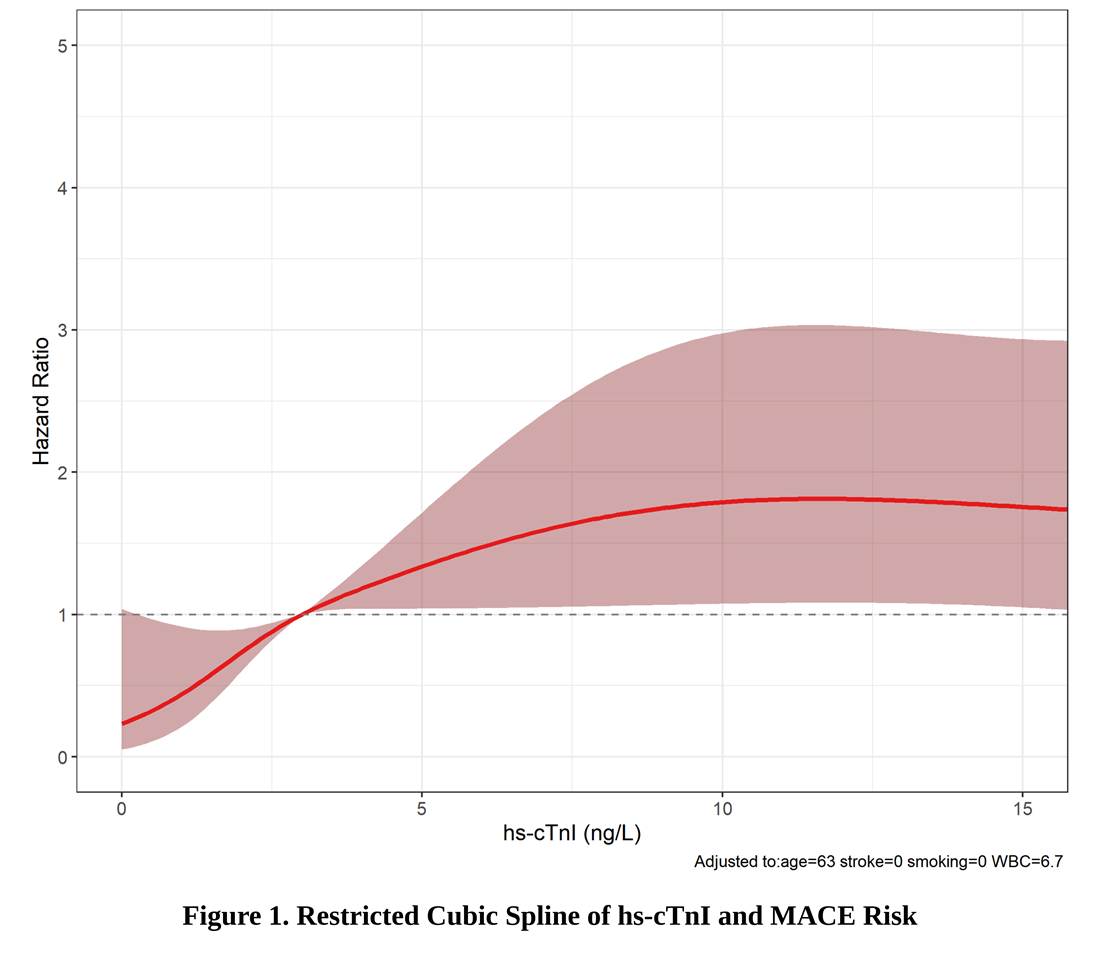
Background To investigate whether baseline high-sensitivity cardiac troponin I (hs-cTnI) predicts major adverse cardiovascular events (MACE) in patients with type 2 diabetes mellitus (T2DM) without documented coronary heart disease (CHD). Methods This single-center retrospective cohort study included 657 hospitalized patients with T2DM without documented CHD. Patients admitted between October 2016 and December 2020 were followed until death or October 31, 2022. The primary endpoint was MACE, defined as a composite of acute coronary syndrome (ACS) and all-cause death. Results During a median follow-up of 1,295 days (interquartile range, 1,033–1,683 days), 107 patients (16.3%) experienced MACE, including 75 all-cause deaths and 57 ACS events; some patients experienced both outcomes. The area under the receiver operating characteristic curve for baseline hs-cTnI was 0.732 (95% confidence interval [CI], 0.684–0.780), with an optimal cut-off of 3.5 ng/L. MACE occurred in 29.0% of patients with hs-cTnI > 3.5 ng/L and 7.1% of those with hs-cTnI ≤ 3.5 ng/L (P < 0.001). In the multivariable Cox model, hs-cTnI > 3.5 ng/L was associated with a higher risk of MACE (hazard ratio, 2.35; 95% CI, 1.43–3.89; P < 0.001). The final model had an apparent C-index of 0.776 and a bootstrap-corrected C-index of 0.758. Conclusions Baseline hs-cTnI within the sex-specific reference range was independently associated with MACE in patients with T2DM without documented CHD.
- Cardiac troponin I
- TNNI3
- Major adverse cardiovascular events
- Type 2 diabetes
- Acute coronary syndrome
- Humans
The paper
Second Affiliated Hospital of Guangzhou Medical University
Research Square, 11 Aug 2026, Open access, Preprint, not peer-reviewed