Within-Year PM2.5 Exposure Structure Provides Mortality-Predictive Information Beyond the Annual Mean
Abstract
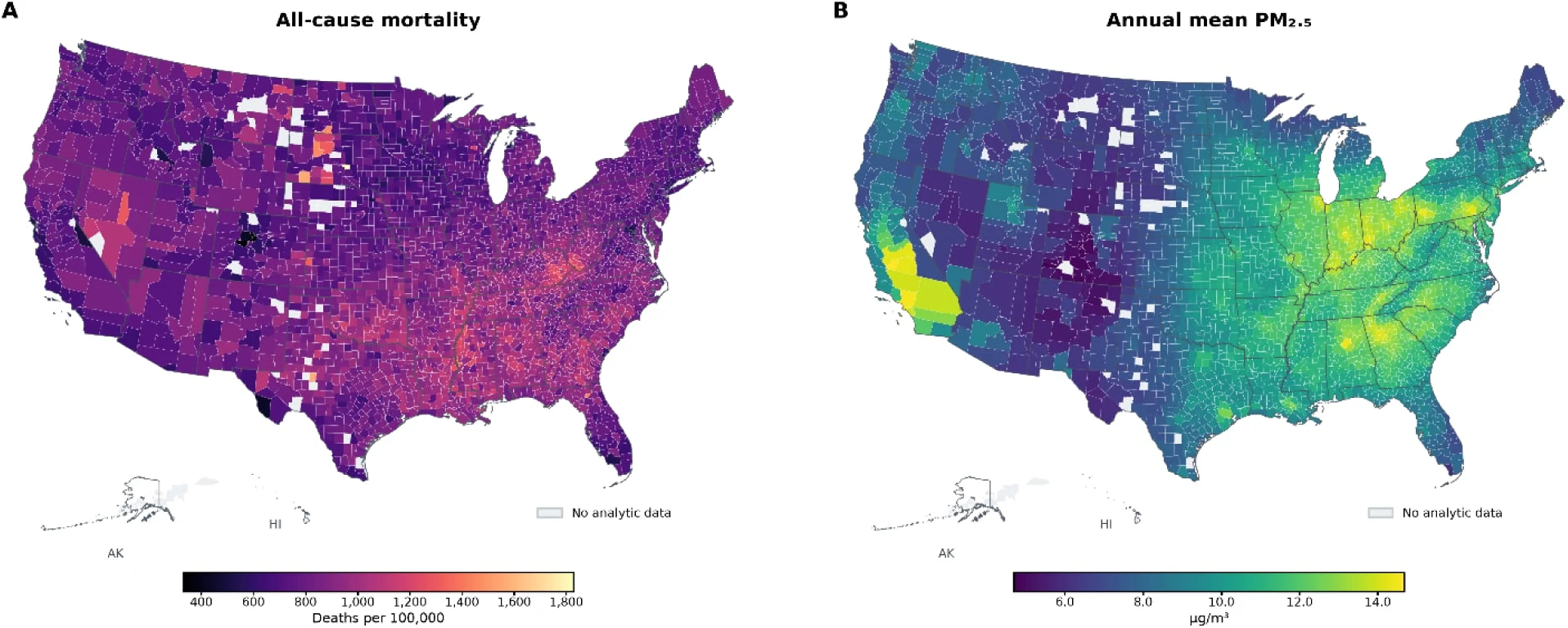
Long-term PM2.5 exposure is associated with increased mortality and is usually represented by annual mean concentration, which does not capture how concentrations are distributed across days. We tested whether the prespecified PM2.5 magnitude-rank index (PMRI), a summary of within-year daily concentration structure, improves mortality prediction beyond the annual mean. Daily modeled PM2.5 estimates were linked to age-adjusted mortality rates for 27,289 county-years from 3,064 U.S. counties during 2003-2011. PMRI is the largest k for which at least k days reached k {micro}g/m3. County-grouped 10-fold cross-validation compared models with annual mean alone versus annual mean plus PMRI, with additional geographic, temporal, cause-specific, and specification analyses. Annual mean PM2.5 had the highest standalone predictive performance. Adding PMRI increased county-held-out R{superscript 2} from 0.0802 to 0.1391 ({Delta}R{superscript 2} = 0.0589; 95% CI, 0.0499-0.0677) and reduced RMSE and MAE. Improvement persisted across geographic and temporal validations and all six cause-specific mortality outcomes. Within-year PM2.5 exposure structure therefore contains reproducible mortality-predictive information not captured by annual mean concentration.
From the paper
- Result
Pooled leave-one-year-out validation yielded ΔR² = 0.0589 (95% CI, 0.0386– 0.0808), nearly identical to the primary county-held-out estimate.
Quoted word for word from the full text on medRxiv.
The paper
Wayne State University
medRxiv, 22 Sep 2026, Open access, CC BY-NC, Preprint, not peer-reviewed