Missing proteins delayed muscle repair in middle-aged mice
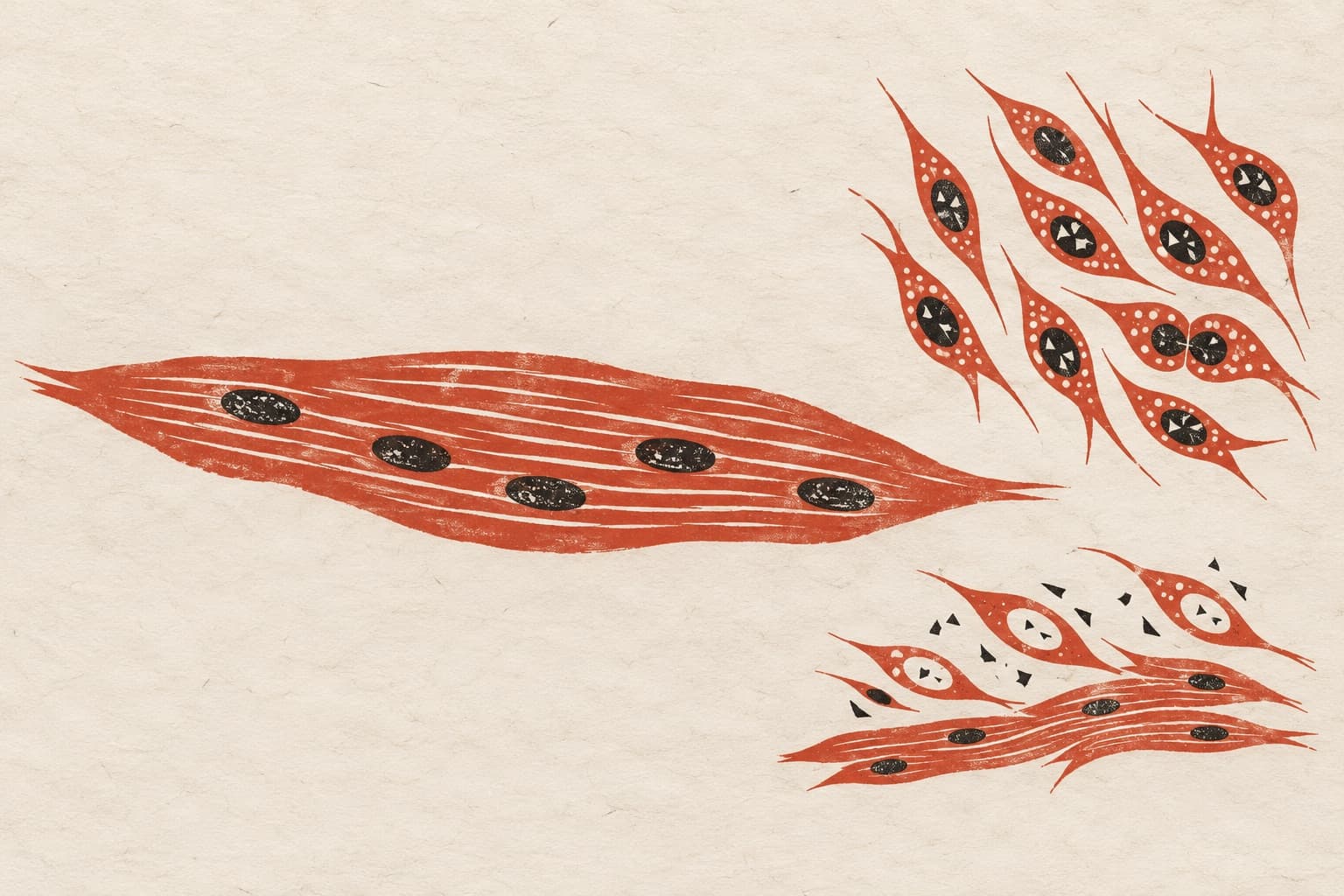
In an injury experiment, 12-month-old mice lacking three related proteins had smaller regenerating muscle fibers after seven days than mice with the proteins.
Edited by Boris Djordjevic · AgingResearch.News
Researchers conducted an experiment in 12-month-old and 4-month-old mice to test how a family of three proteins affected muscle regeneration after injury. They compared mice lacking all three proteins with age-matched mice that retained them, using barium chloride to injure muscle.
Seven days after injury, regenerating muscle fibers were smaller in the 12-month-old mice lacking the proteins. The researchers did not find this delay in the 4-month-old mice. Before injury, the older groups had similar numbers of resting satellite cells, stem cells that support muscle regeneration. After injury, the older mice lacking the proteins had more satellite cells at days three and five.
Why it matters
Muscle’s ability to regenerate declines with age. The authors suggested that these proteins help coordinate the timing of inflammation resolution and regeneration in aging muscle.
Caveats
This was an injury experiment in genetically altered mice, not a study in people or a test of a treatment.
The paper
Loss of LanC-like proteins delays post-injury regeneration of aging skeletal muscles
Carle Illinois College of Medicine
American Journal of Physiology Cell Physiology, Oct 20, 2026