RNA delivery favored human blood stem cells in mice
In humanized mice, antibody-free fat particles delivered more messenger RNA to human blood-forming stem and precursor cells than a comparison formulation.
Limit: The abstract did not report long-term outcomes after RNA delivery
Edited by Boris Djordjevic · AgingResearch.News
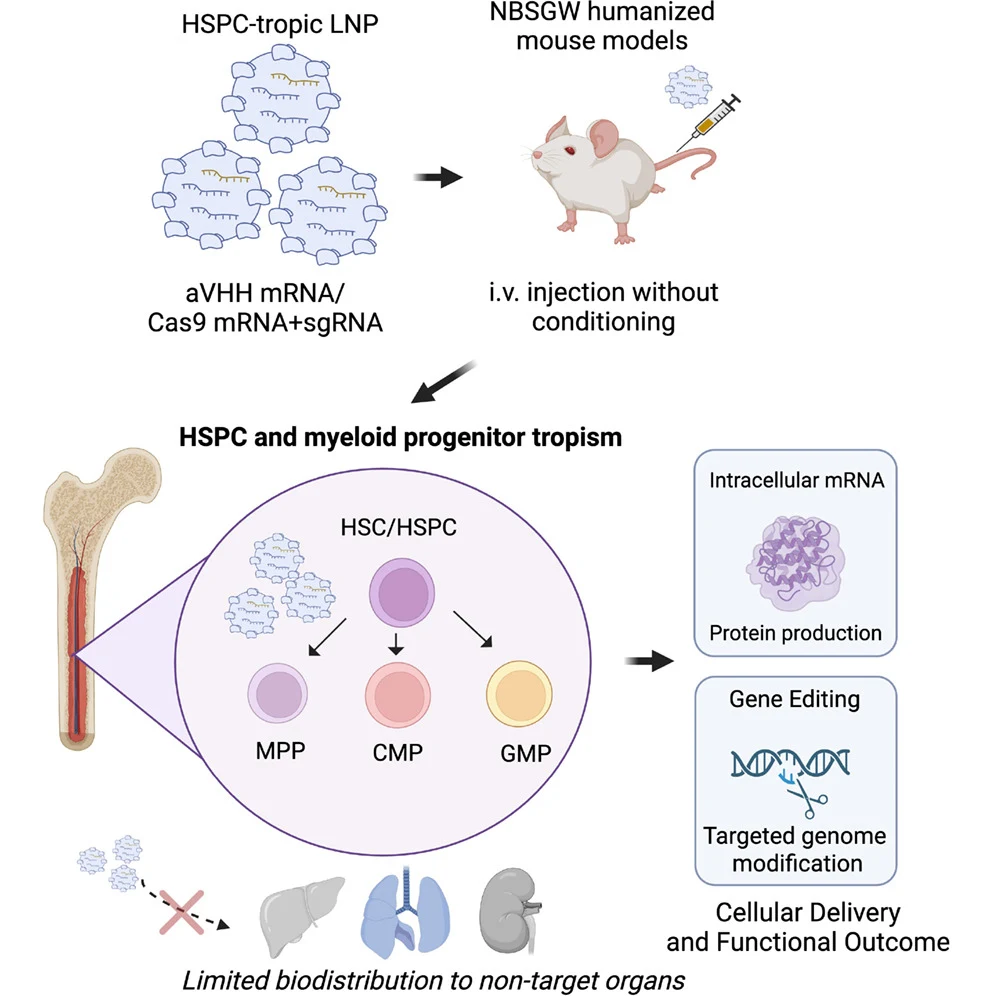
In an animal experiment, researchers tested fat-based RNA carriers in humanized NBSGW mice, which carry human blood-forming cells. The carriers delivered messenger RNA—instructions for making proteins—preferentially to human blood-forming stem and precursor cells and early myeloid progenitors, precursors of certain types of blood cells. The mice did not receive conditioning, a preparatory treatment for the bone marrow.
Compared with SM-102 particles, another fat-based carrier, the new particles delivered more messenger RNA to human blood-forming stem and precursor cells and substantially less to the liver. Analyses of gene activity found no broad disruption associated with delivery. The team also delivered gene-editing RNA to human blood-forming stem and precursor cells, enabling gene editing.
Why it matters
The work addresses a barrier to gene therapy: getting genetic instructions into blood-forming stem and precursor cells inside the body.
Caveats
The delivery findings came from a mouse model containing human cells, not from people. The abstract did not report sample sizes or long-term outcomes.
The paper
Winship Cancer Institute of Emory University
Molecular Therapy, Oct 23, 2026