Stomach dosing increased nanoparticle delivery in rodents
Delivery to the pancreas was an order of magnitude greater after dosing into stomach tissue than after intravenous administration.
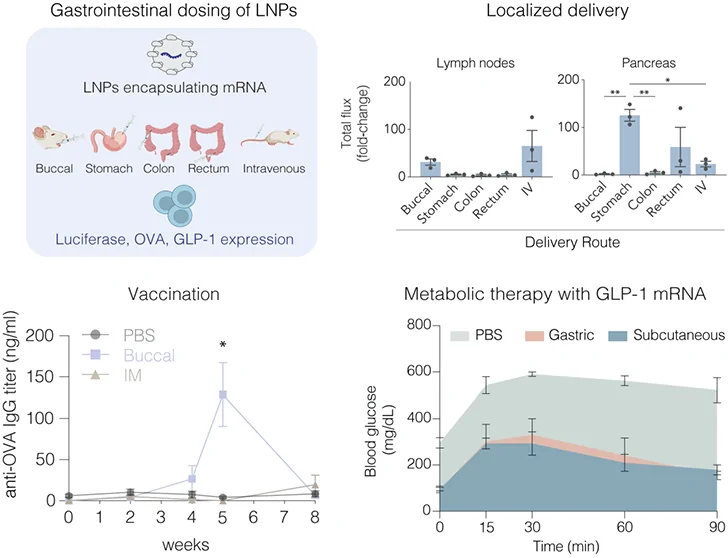
Limit: Quantification used a minimum of three biological replicates; PBS controls had a minimum of two
Edited by Boris Djordjevic · AgingResearch.News
In experiments in rodents, researchers tested whether delivering lipid nanoparticles—tiny fat-based carriers—beneath the digestive tract’s lining could change where they traveled. They tested sites in the cheek, stomach, small intestine, colon and rectum. Stomach dosing achieved an order of magnitude greater delivery to the pancreas than intravenous dosing.
The researchers also used the carriers to deliver messenger RNA, which carries instructions for making proteins. In mice, stomach dosing of RNA for glucagon-like peptide-1, a hormone involved in blood glucose regulation, improved blood glucose regulation compared with phosphate-buffered saline controls. The findings suggest that delivery into gastrointestinal tissues can change where these carriers go, expanding opportunities to deliver genetic instructions locally and throughout the body.
Why it matters
Blood glucose regulation is relevant to metabolic diseases associated with aging. The paper suggests that gastrointestinal delivery may expand therapeutic options for medicines based on genetic instructions.
Caveats
These were animal experiments using delivery beneath the digestive tract’s lining, not tests of a swallowed medicine or studies in people. The abstract did not report sample sizes or the size or duration of the blood glucose effect.
- Glucagon-like peptide-1 mRNA
- mRNA lipid nanoparticles
- GLP-1 and incretin signaling
- Immune response
- Blood glucose
- rodents
The paper
Georgia Institute of Technology
ACS Nano, Oct 13, 2026, Open access