Mechanical loading of bone extended lifespan in mice
Applying mechanical force along the shinbone extended lifespan by 9.4%, or 79.5 days, in mice aged 20–24 months.
Limit: Details of the lifespan comparison are missing from the abstract
Edited by Boris Djordjevic · AgingResearch.News
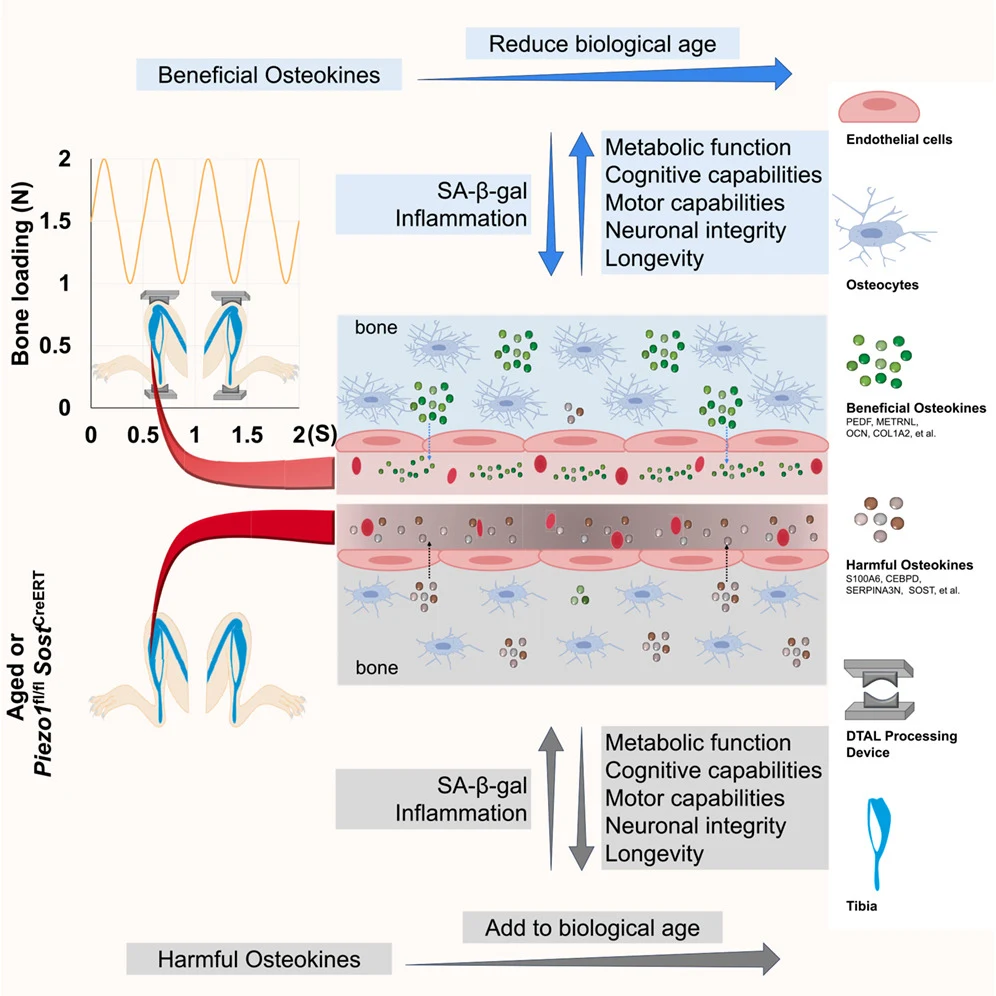
Experiments in mice tested whether bone’s ability to sense physical force affected whole-body aging. Researchers applied force along the shinbone in mice aged 20–24 months, using a procedure called dynamic tibial axial loading. This extended lifespan and healthspan, the period of life spent in good health.
The loading also reversed signs of immune aging in bone marrow. It increased protective and anti-aging factors while reducing factors that promote aging and inflammation. In separate experiments, deleting Piezo1, a force-sensing channel in bone cells called osteocytes, reduced their ability to sense force and accelerated whole-body aging.
Why it matters
Bone’s ability to sense force offers a possible link between physical activity and whole-body aging, a question relevant to people with limited mobility.
Caveats
These experiments do not establish that bone loading extends human lifespan. The abstract does not report sample sizes, the loading schedule or details of the lifespan comparison.
The paper
Dynamic force sensing by bone delays aging and extends lifespan
The Third Affiliated Hospital of Southern Medical University
Cell Metabolism, Oct 23, 2026
