Standard exercise improved function most in older inpatients
Conventional exercise improved physical function by 1.04 points versus usual care; virtual reality–enhanced exercise showed no clear advantage over usual care.
Limit: Exercise dose and duration were not reported
Edited by Boris Djordjevic · AgingResearch.News
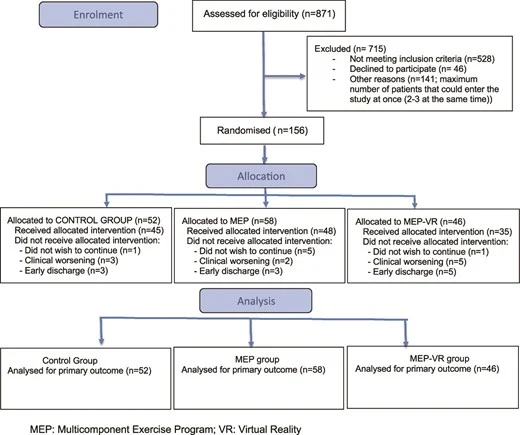
In a randomized trial, 156 hospitalized adults aged 75 or older received conventional exercise, exercise enhanced with immersive virtual reality, or usual care. Their average age was 86.4. Researchers measured physical function with the Short Physical Performance Battery, a set of physical performance tests.
Conventional exercise produced a 1.04-point greater improvement than usual care. The virtual reality program’s difference was 0.13 points, with a range of likely values that included no difference. The virtual reality program produced 0.91 points less improvement than conventional exercise. Both exercise groups improved cognitive test scores more than usual care: by 1.90 points with virtual reality and 1.23 points without it. The difference between exercise groups was not clear. Adherence was high, and no serious adverse events related to virtual reality occurred.
Why it matters
Hospital stays can trigger functional decline in older adults. This trial addresses whether immersive technology adds value to exercise programs intended to limit that decline.
Caveats
The trial involved only hospitalized adults aged 75 or older in an acute geriatric ward, limiting its relevance to younger people or other settings. The abstract did not report exercise dose or duration.
- Virtual reality
- Multicomponent exercise
- Multicomponent exercise with virtual reality
- Short Physical Performance Battery
- Barthel index
- Humans
The paper
University Hospital of Navarra (HUN)
Age and Ageing, Aug 3, 2026