Raising gene activity reduces brain protein deposits in flies
Female flies producing human amyloid protein had a median lifespan of 47.5 days with increased Wwox gene activity, versus 29 days in controls.
Limit: Only 5–7 brains per group were examined for deposits
Edited by Boris Djordjevic · AgingResearch.News
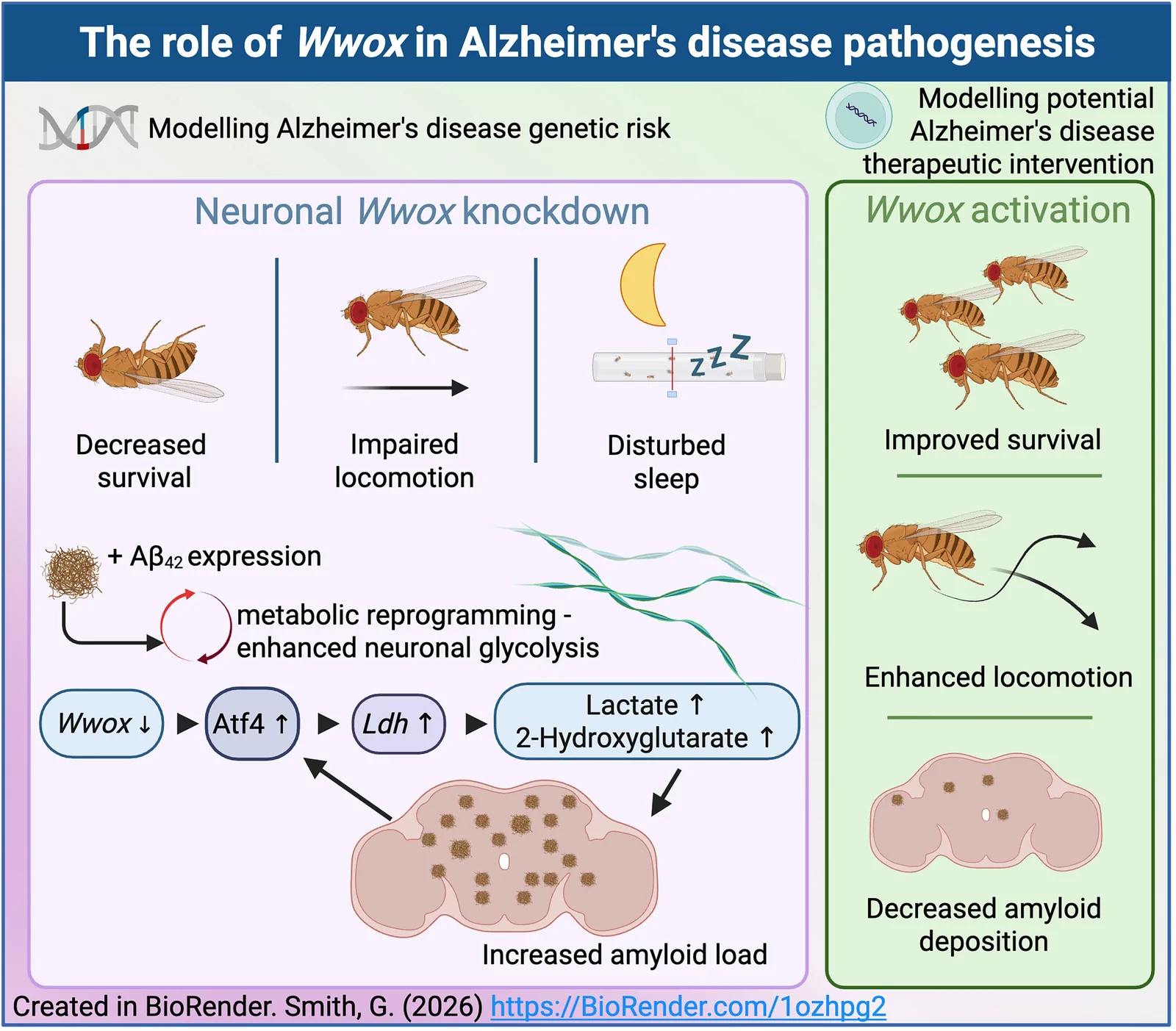
In experiments in Drosophila melanogaster fruit flies, researchers altered Wwox, the fly version of a human gene linked to Alzheimer’s disease risk. They studied female flies engineered to produce amyloid-beta 42, a human protein that forms deposits in the brain.
Reducing Wwox activity in nerve cells shortened lifespan, worsened climbing ability and increased soluble amyloid-beta 42. It also increased activity of the gene for lactate dehydrogenase, an enzyme that helps produce lactate, and raised lactate levels. Genetically reducing this enzyme improved climbing in these flies. Increasing Wwox activity instead reduced amyloid buildup, improved survival and climbing, and reversed amyloid-related changes in gene activity. Median lifespan reached 47.5 days, versus 29 days in control flies producing amyloid. Increasing Wwox activity did not significantly change survival in flies without amyloid.
Why it matters
Amyloid buildup is a feature of Alzheimer’s disease. The work points to nerve-cell metabolism as a possible link between genetic risk and amyloid-related damage, suggesting a potential direction for treatment research.
Caveats
These were genetic experiments in flies, not tests of a drug in people. The lifespan and climbing experiments used females and do not establish effects in male flies.
The paper
Alzheimer's disease risk gene Wwox controls amyloid pathology through metabolic reprogramming
UK Dementia Research Institute
Brain Communications, Oct 9, 2026, Open access