Blood protein linked to dementia risk beyond key markers
An observational study of 259 people with cognitive difficulties linked higher blood protein levels to later dementia and death beyond some established Alzheimer’s markers.
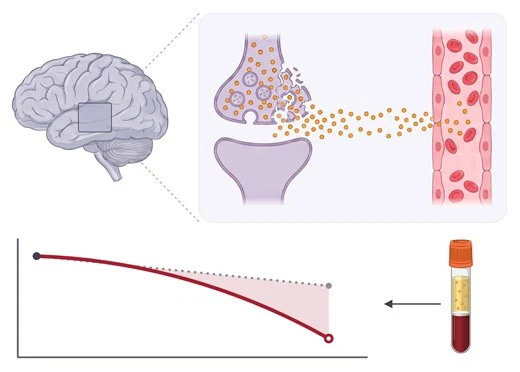
259 non-demented individuals, independent replication
Limit: The dementia association did not survive adjustment for continuous pTau181 normalized to CSF Aβ40
Edited by Boris Djordjevic · AgingResearch.News
The observational study included 259 people without dementia who reported cognitive difficulties or had mild cognitive impairment at one memory clinic. Researchers measured β-synuclein, a protein studied as a blood marker of problems at nerve-cell connections. They assessed dementia onset in 185 participants over a median 4.1 years and death in 258 over a median 7.0 years.
For each standard-deviation rise—a step based on how much blood levels varied—the hazard ratio was 1.40 for dementia and 1.33 for death. Hazard ratios compare event rates over time. These links changed little after accounting for spinal-fluid markers of amyloid and tau, proteins associated with Alzheimer’s disease. Higher β-synuclein was also linked to faster cognitive decline, but that link weakened substantially after accounting for tau.
Why it matters
Problems at nerve-cell connections occur early in Alzheimer’s disease, an age-related cause of dementia. A blood marker of these problems may complement established markers when estimating future outcomes.
Caveats
The observational design cannot show cause and effect, and participants came from one memory clinic.
The paper
Serum β-synuclein predicts dementia conversion and mortality beyond amyloid-β and phospho-tau
Universitätsklinikum Erlangen; Luther University
Brain, Oct 21, 2026