German cohort offers a resource for eye health research
Eye assessments from 48,460 adults aged 19–74 provided a population-based resource that could support artificial intelligence research.
Our read
AI & data- Studied:
- Cohort study of 48,460 participants undergoing ophthalmic assessment, against UKB ophthalmic cohort (Multicenter)
- What changed:
- High-quality retinal images were more common in NAKO than UKB: 68.2% against 48.7%
- The catch:
- Only 40.8% of images were gradable in the oldest age group
- Why it’s aging research:
- It builds or tests a tool for aging research.
Editor of record: Boris Djordjevic · AgingResearch.News
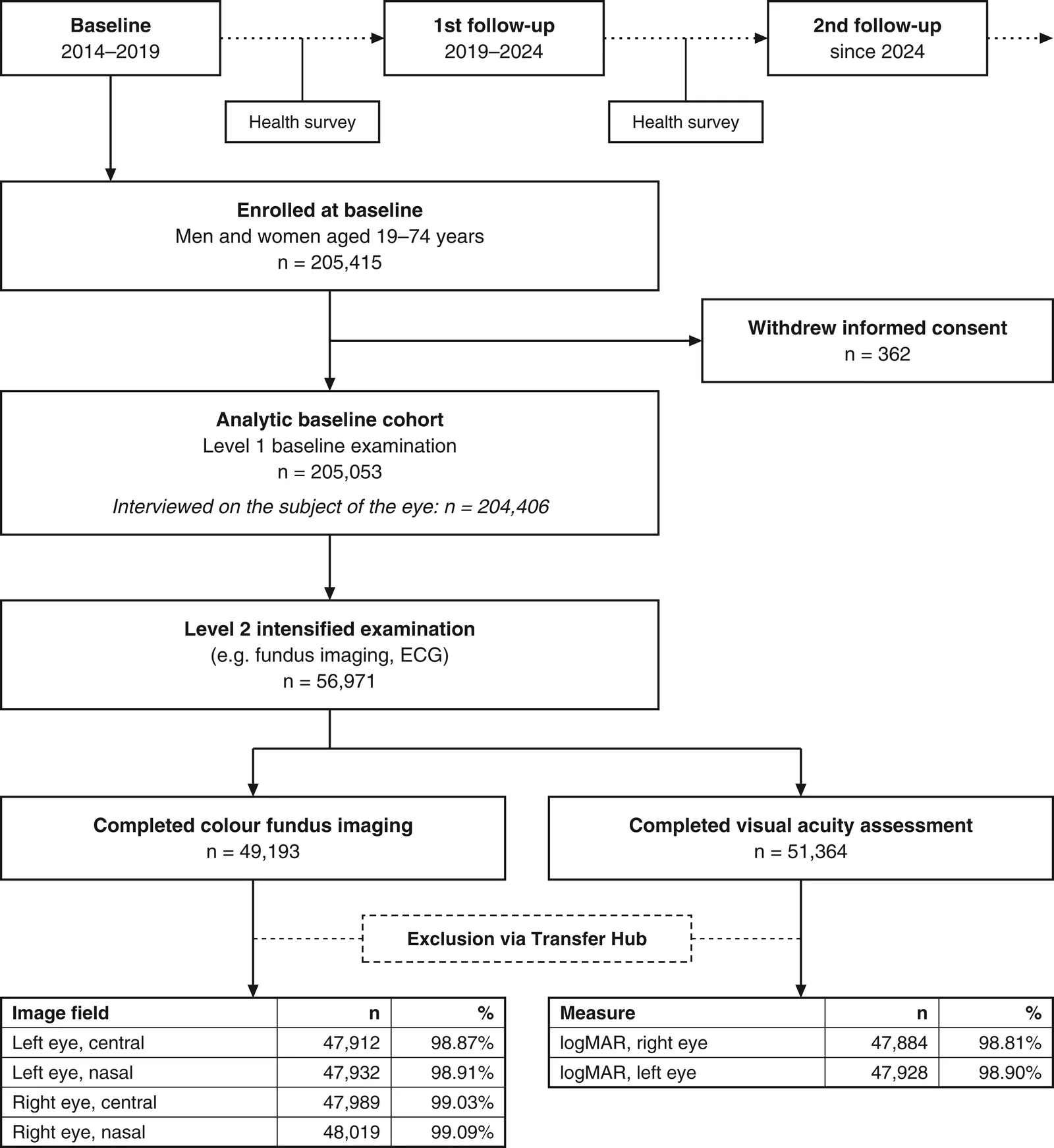
Researchers analyzed baseline eye examinations from 48,460 adults aged 19–74 in the German National Cohort, an observational study. Participants had an average age of 48.9 years, and 52.7% were male. The assessments included tests of vision sharpness, color photographs of the back of the eye and a brief eye health history. Researchers also collected general health measurements and questionnaire responses.
Four artificial intelligence models classified 68.2% of the eye images as suitable for assessment. Measurements of eye structures differed systematically across age groups. The researchers also trained artificial intelligence models to predict age, sex and blood pressure from the images. They concluded that the data could support the development and testing of artificial intelligence tools for eye health research.
Why it matters
Combining eye images with age and general health measurements could help researchers investigate how eye health relates to aging.
Caveats
This baseline observational analysis compared age groups rather than tracking how individuals’ eyes changed over time. The findings concern adults aged 19–74 in Germany.
From the paper
- Participants
The data set consisted of 48 460 participants who had taken part in the baseline ophthalmology module and had ≥1 fundus image for ≥1 eye and a visual acuity examination, as provided by the NAKO TransferHub.
- Limitation
However, its large-scale application in population-based cohorts remains limited.
Quoted word for word from the full text on PubMed Central.
The paper
Tübingen AI Center
Ophthalmology Science, Sep 11, 2026, Open access
Comments
Be the first to comment.