Association between elevated lipoprotein (a) and venous thromboembolism: A systematic review and meta-analysis
Abstract
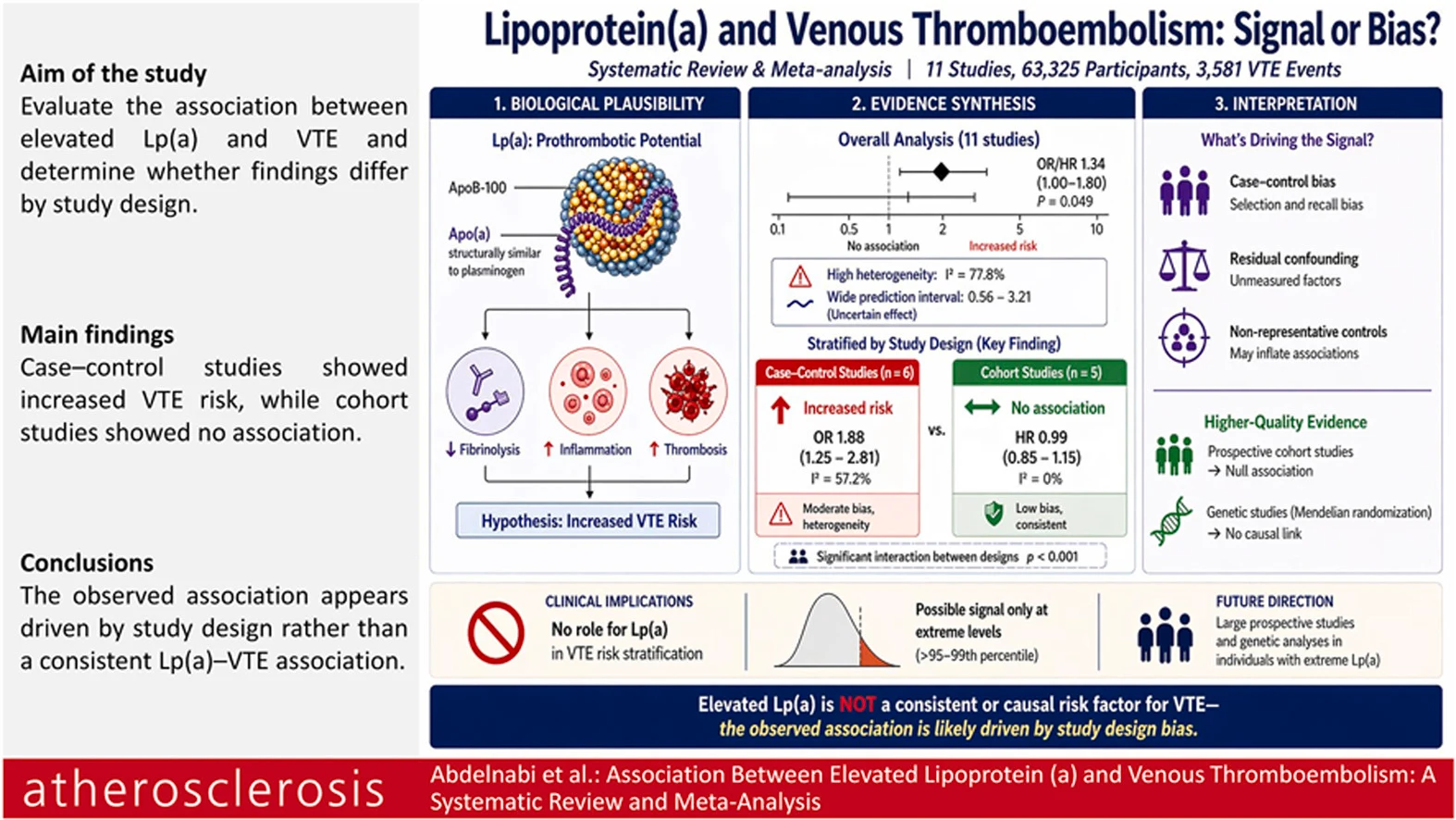
BACKGROUND: Elevated lipoprotein(a) [Lp(a)] is an established cardiovascular risk factor linked to atherogenesis, inflammation, and thrombosis; however, its association with venous thromboembolism (VTE) remains uncertain, with inconsistent findings across observational studies. AIMS: To systematically evaluate the association between elevated Lp(a) levels and VTE risk and to examine differences by study design. METHODS: PubMed/MEDLINE, Embase, Scopus, Web of Science, and Cochrane Library were searched from inception through January 2026 for observational studies assessing Lp(a) and VTE. Effect estimates (odds ratios [ORs] or hazard ratios [HRs]) were pooled using DerSimonian-Laird random-effects models with Hartung-Knapp adjustment. Heterogeneity was assessed using I² and τ². Risk of bias was evaluated with ROBINS-E, publication bias with funnel plots, Egger's and Begg's tests, and certainty of evidence using GRADE. The primary outcome was VTE; secondary outcomes included deep vein thrombosis (DVT), pulmonary embolism (PE), and recurrent VTE. RESULTS: Eleven studies (6 case-control, 5 cohort; 63,325 participants; 3581 VTE events) were included. Elevated Lp(a) was associated with a borderline increased VTE risk (pooled OR/HR 1.34 [95% CI 1.00-1.80]; P = 0.049), with high heterogeneity (I² = 77.8%) and a wide prediction interval (0.56-3.21). In stratified analyses, case-control studies showed a significant association (OR 1.88 [1.25-2.81]; I² = 57.2%), whereas cohort studies showed no association (HR 0.99 [0.85-1.15]; I² = 0%), with significant between-group differences (p < 0.0001). CONCLUSIONS: The association between elevated Lp(a) and VTE appears limited to case-control studies and is not supported by prospective cohort data, suggesting potential bias or residual confounding. Further large-scale and genetic studies are warranted to clarify this relationship.
- Lipoprotein
- Venous thromboembolism
- Deep vein thrombosis
- Pulmonary embolism
- Recurrent venous thromboembolism
- Humans
The paper
Mayo Clinic
Atherosclerosis, Oct 14, 2026
doi.org/10.1016/j.atherosclerosis.2026.121922PubMed 42892134
