Physical activity, sedentary behavior, sleep quality and the biological aging clocks
Abstract
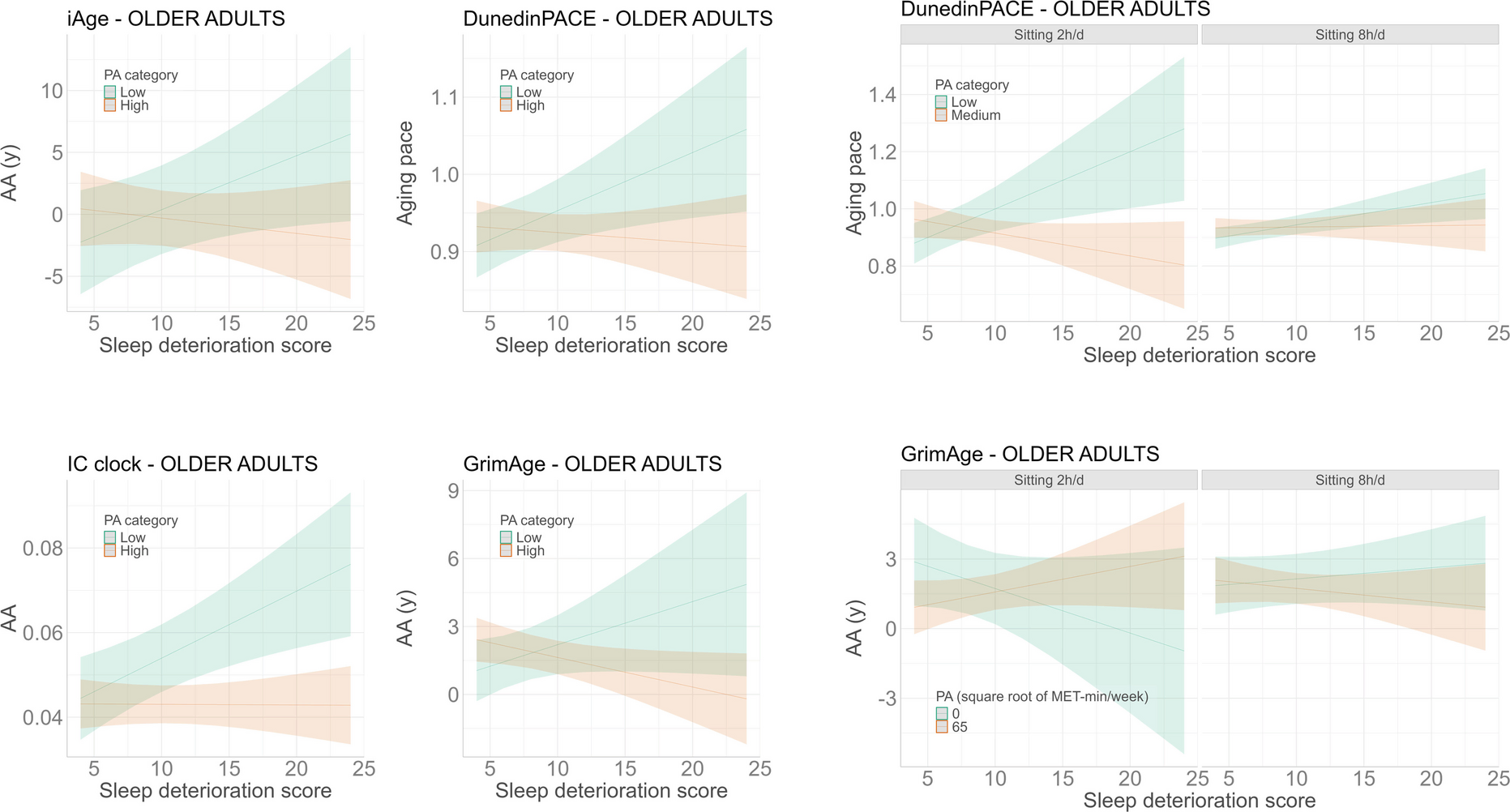
Physical activity (PA), sedentary behavior, and sleep quality are known lifestyle factors modulating the rate of aging but less is known about their putative interactions. We investigated the cross-sectional independent and interactive associations of these lifestyle factors with various biological aging clocks in adults of large age range. Eight hundred and ninety adults recruited from the INSPIRE-t cohort, aged 20 to 102 years old with a measure of at least one biological clock among PhenoAge, GrimAge, DunedinPACE, iAge, and intrinsic capacity (IC) clock, were included in the present study. PA levels, sitting time, and sleep deterioration were estimated using questionnaires. The associations of age acceleration/aging rate with each lifestyle factor and their interactions were explored through robust regressions adjusted for age, sex, education, and comorbidities. Main-term analyses showed that higher levels of PA were associated with reduced age acceleration for IC in women. Interaction analyses indicated that, in older adults, the adverse association of sleep deterioration with age acceleration/rate was attenuated with higher levels of PA for GrimAge, iAge, DunedinPACE, and IC clock or with a balanced combination of PA and sitting time for DunedinPACE and GrimAge. In the total population and in men, the detrimental association between sitting time and GrimAge was attenuated, or even reversed, with higher levels of PA, especially in individuals with good sleep quality. Our findings encourage increasing PA levels and limiting sedentary behavior or having an optimal combination of both in addition to maximizing sleep quality for preventing biological aging.
The paper
Centre Hospitalier Universitaire de Toulouse
GeroScience, Oct 17, 2026