Association between ambient temperature and thrombosis-related signaling lipids: Implications for early cardiovascular risk
Dose-response
Abstract
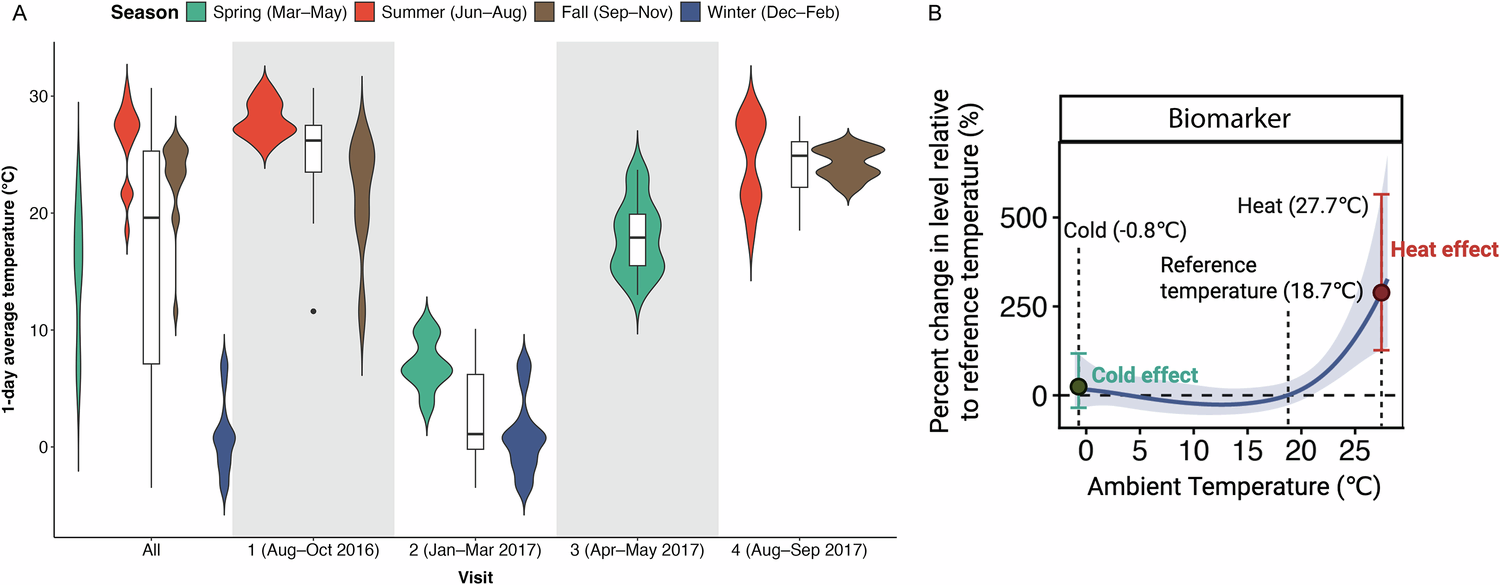
BACKGROUND: Nonoptimal temperatures significantly contribute to cardiovascular mortality, a burden expected to increase with climate change. Sensitive biomarkers for early cardiovascular risks remain scarce. OBJECTIVE: We examined how thrombosis-related signaling lipids respond to ambient temperature, analyzing dose-response and lag patterns over a 30-day period, and assessed whether lipid changes mediate the association between temperature and thrombosis biomarkers using mediation analyses. METHODS: We conducted a prospective panel study of 112 participants (aged 42-80) in Beijing (2016-2017), each completing an average of 3.4 visits. Targeted lipidomics quantified 12 thrombosis-related signaling lipids, including thromboxane (Tx) B2, three lyso-platelet-activating factors (LysoPAFs), seven lysophosphatidic acids (LPAs), and sphingosine-1-phosphate (S1P). Ambient temperature data were obtained from the China National Meteorological Information Centre. Associations between cumulative temperature exposures (up to 30 days) and lipids were analyzed using generalized additive mixed models. Mediation analyses assessed whether lipid changes mediated temperature effects on soluble CD40 ligand (sCD40L), a sensitive biomarker for thrombotic disease. RESULTS: Cold exposure was associated with significant decreases in TxB2, two LysoPAFs, and most LPAs (11-88% lower, median 45%, at a 30-day cumulative temperature of -0.8 °C vs. 18.7 °C). Heat exposure significantly increased all thrombosis-related lipids except LPA 20:3 (26% to 2,484% higher, median 65%, at a 30-day cumulative temperature of 27.7 °C vs. 18.7 °C), along with sCD40L (304% higher). Lipid effects were significant from 1-30 days of cumulative exposure, whereas heat-related sCD40L increases emerged after 6 days. LPA 18:0/18:1/20:4/22:6 and S1P mediated 12-32% of the heat-sCD40L association. SIGNIFICANCE: Higher ambient temperatures are associated with increased thrombosis-related lipids, which may act as early indicators of cardiovascular risks from heat exposure. IMPACT: This study quantified thrombosis-related signaling lipids across major lipid classes, i.e. eicosanoids (oxylipins), sphingolipids, and lysophospholipid, in a longitudinal panel study. Heat exposure significantly increased these signaling lipids, which responded to heat earlier than soluble CD40 ligand (sCD40L), a sensitive thrombotic biomarker. Mediation analysis revealed that these lipids mediate up to 32% of the heat-related thrombotic response. These findings suggest that thrombosis-related signaling lipids may serve as early indicators of heat-related cardiovascular risk, with implications for biomarker-based screening and climate change adaptation strategies.
- Ambient temperature
- Lipid and ceramide metabolism
- Thrombosis
- Thrombosis-related signaling lipids
- Eicosanoids
- Humans
The paper
College of Environmental Sciences and Engineering
Journal of Exposure Science & Environmental Epidemiology, 16 Oct 2026