Risk-weighted apoB and lipoprotein-associated coronary risk across ethnic groups
Abstract
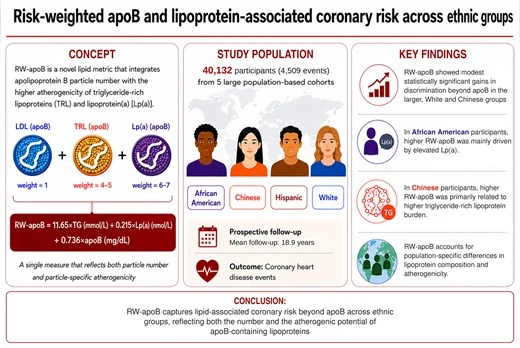
AIMS: Apolipoprotein B (apoB) reflects the number of circulating atherogenic lipoproteins but does not account for differences in particle atherogenicity. Risk-weighted apoB (RW-apoB), which incorporates triglyceride-rich lipoproteins and lipoprotein(a) (Lp(a)), may better capture lipoprotein-driven coronary risk, but its performance across diverse populations remains uncertain. We assessed whether the prespecified triglyceride - and Lp(a)-weighted information captured by RW-apoB was associated with coronary events beyond apoB and compared the discrimination of RW-apoB and measured apoB across ethnicities. METHODS: We analyzed 40,132 participants with 4,509 coronary events from ARIC, CARDIA, MESA, the Framingham Offspring Study, and China Kadoorie Biobank. RW-apoB was calculated using a prespecified equation. Mutually adjusted Cox estimates were pooled within ethnic groups using random-effects meta-analysis. Separate single-marker models compared discrimination. Sensitivity analyses included age and sex adjustment, standardized exposures, hard-events, truncated follow-up, and CKB-specific logistic regression. RESULTS: Mean RW-apoB exceeded apoB by approximately 8 mg/dL in African American and Chinese participants, reflecting higher lipoprotein(a) and triglycerides, respectively. RW-apoB was associated with coronary events conditional on apoB in White, African American, Chinese, and Hispanic participants: hazard ratios per 10 mg/dL were 1.11 (95% CI 1.05-1.18), 1.11 (1.08-1.15), 1.08 (1.05-1.11), and 1.10 (1.01-1.21), respectively. C-indices for RW-apoB versus apoB were 0.630 versus 0.617 in White (P<0.001), 0.606 versus 0.595 in African American (P=0.085), 0.567 versus 0.554 in Chinese (P=0.014), and 0.540 versus 0.535 in Hispanic participants (P=0.756). CONCLUSION: RW-apoB captured lipoprotein-associated risk beyond measured apoB, with discrimination gains statistically demonstrable in the larger White and Chinese groups.
The paper
Cardiology Department; University of Gothenburg
European Journal of Preventive Cardiology, 17 Oct 2026