Modifying effects of Folate, Vitamin B₁₂ Status on associations between metals exposure and mild cognitive impairment incidence: A prospective cohort study of adults living along the Yangtze River, China
Abstract
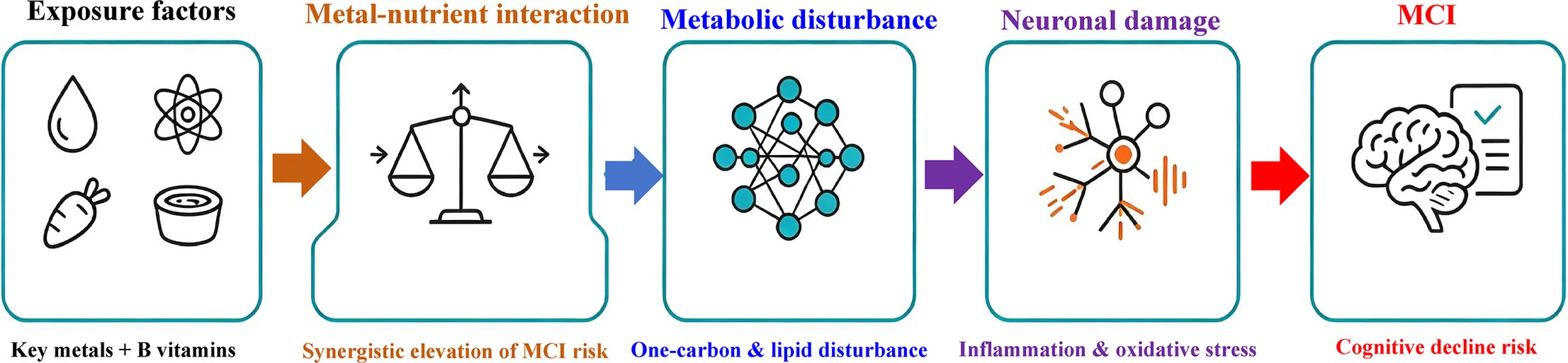
Mixed exposure to multiple metals mimics real human pollutant exposure patterns, yet its link to cognitive impairment remains incompletely understood. However, the modifying effect of B vitamins on this metals-cognition association remains unclear. This study measured 29 plasma metals, dietary intake and serum concentrations of vitamin B₁₂ (VB₁₂) and folic acid (FA), to explore metal mixture effects on mild cognitive impairment (MCI) and vitamin modification among Anhui Yangtze River residents. A total of 308 participants were diagnosed with MCI. Five metals (magnesium, chromium, molybdenum, rubidium, arsenic) showed positive associations with MCI in single-metal models. Mixture analyses showed a quartile rise in metal mixture corresponded to 7% higher MCI odds [OR=1.07, 95% CI: 0.95, 1.20], with no statistically significant association observed. Bayesian Kernel Machine Regression confirmed higher MCI risk for participants with metal mixture concentrations above P50. Serum FA and VB₁₂ weakly correlated with their dietary intakes, and higher FA intake was linked to elevated MCI risk [OR (95%CI) = 1.52 (1.11-2.08)]. Compared with participants in the low-metal + low-FA subgroup, participants in the groups of high magnesium/high-FA (OR=1.76, 1.25-2.48) or high rubidium/high-FA (OR=1.58, 1.13-2.22) exhibited elevated MCI risk. In the high FA intake group, each quartile increase of metal mixture raised MCI odds by 13% (95% CI: 1.01, 1.26). Collectively, we observed significant positive multiplicative interactions between plasma magnesium, rubidium and high dietary FA, which might be associated with elevated MCI risk. These findings might suggest that MCI prevention should integrate environmental metal exposure and individual dietary nutritional status.
The paper
Anhui Medical University
Environmental Pollution, 16 Oct 2026