Artificial intelligence-enhanced electrocardiography for predicting mortality and major adverse cardiovascular events: A systematic review and narrative synthesis
Abstract
Cardiovascular disease (CVD) remains the leading cause of death worldwide. While clinical scores provide modest predictive accuracy, the electrocardiogram (ECG) is rarely leveraged for prognosis. Artificial intelligence (AI) and deep learning now enable extraction of high-dimensional features from ECG waveforms for predicting cardiovascular outcomes. Our objective was to systematically evaluate the prognostic performance of AI-enabled ECG models for predicting all-cause mortality, cardiovascular mortality, and major adverse cardiovascular events (MACE). We searched PubMed, Cochrane CENTRAL, IEEE Xplore, and Google Scholar through November 2025 for studies using AI/ML models with 12-lead or single-lead ECGs to predict all-cause mortality, cardiovascular mortality, or MACE in adults (≥18 years old). Eligible studies included adults (≥18 years) using ECG as primary input. Two reviewers independently screened and extracted data. Narrative synthesis was conducted due to heterogeneity. Thirteen studies were included (~5.9 million patients). Eleven reported all-cause mortality (8 short-term: 30-day to 1-year), four reported cardiovascular mortality, and eight assessed MACE (4 composite MACE, 4 individual components). Models predominantly used convolutional neural networks [CNNs] on raw ECG waveforms. C-statistics ranged 0.70-0.89 for mortality prediction. Definitions and follow-up durations varied, limiting direct comparison. AI-ECG models demonstrate strong potential for predicting mortality and cardiovascular events with consistent performance and scalability. However, prospective validation and standardization are essential before clinical implementation.
From the paper
- Studies
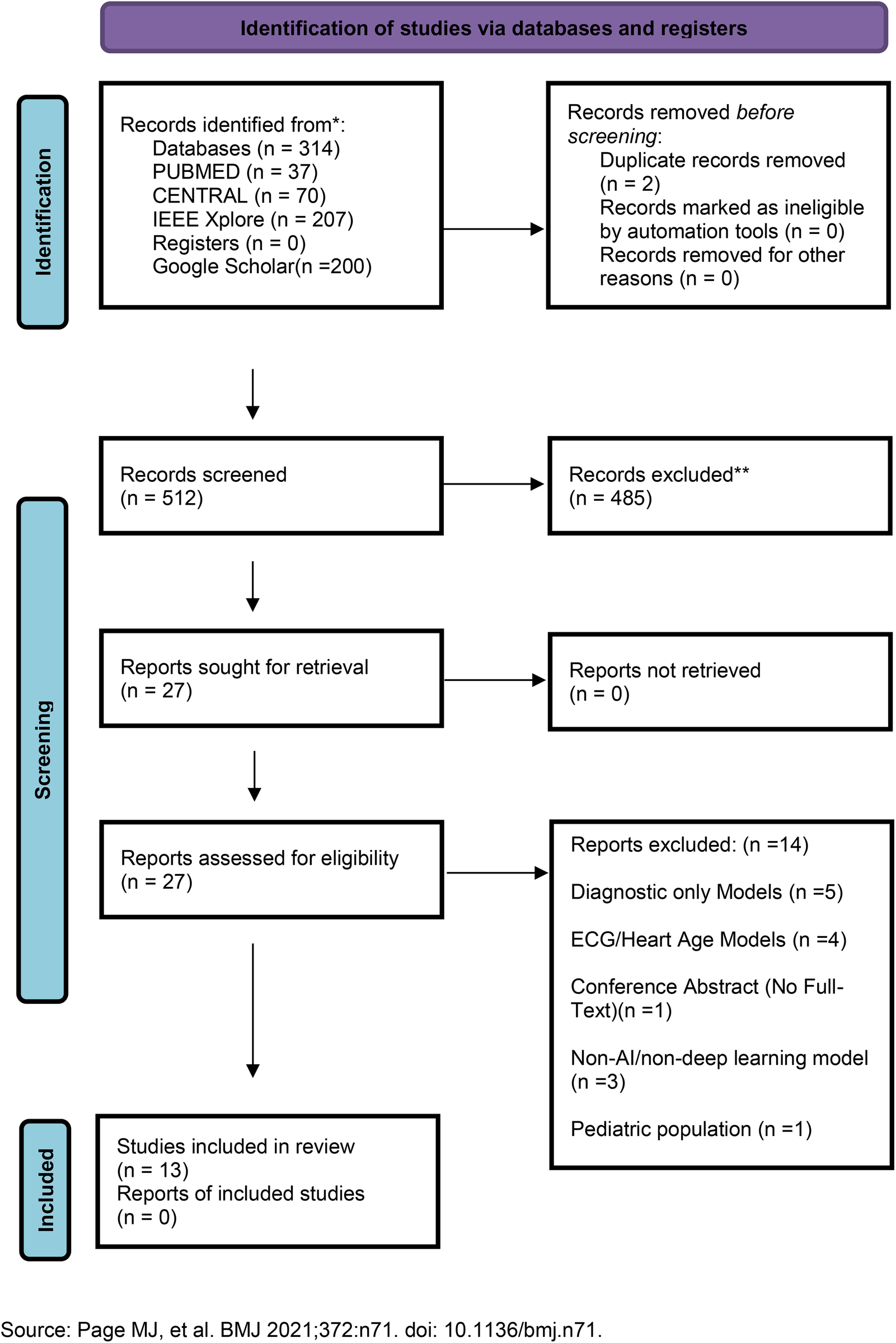
A total of 13 studies met inclusion criteria and were included in the final synthesis.
- Result
In the total holdout test set, the model predicted 1-year all-cause mortality with an overall AUC of 0.88 and a hazard ratio of 8.1 (95% CI 7.9–8.2).
- Limitation
Substantial outcome heterogeneity — in MACE definitions, follow-up durations, model objectives, and reported metrics — precluded meta-analytic pooling and limits direct cross-study comparisons.
Quoted word for word from the full text on journals.plos.org.