Gene Observability Limits Comparative Genomic Inference of Vertebrate Lifespan Evolution
Abstract
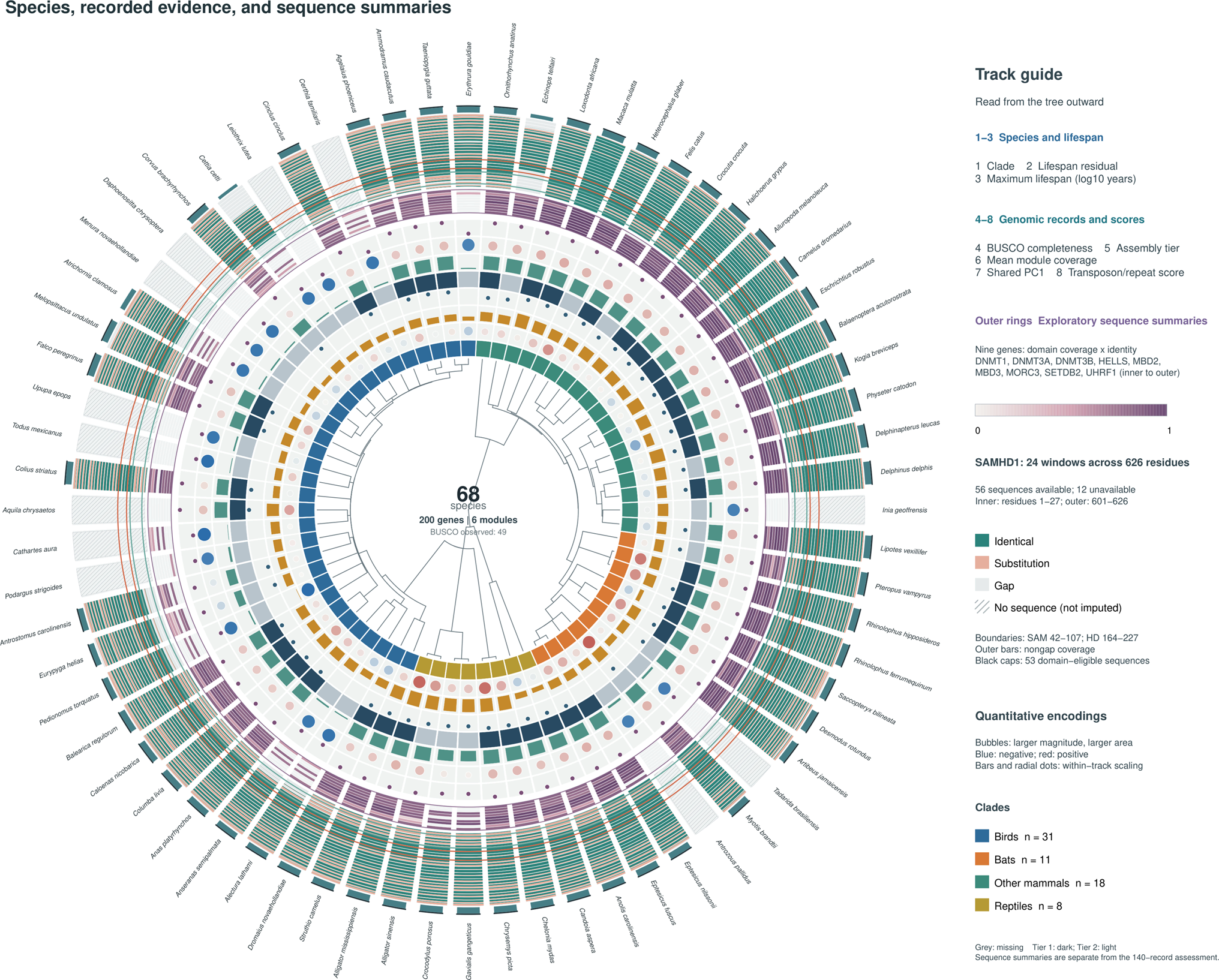
Genes missing from a comparative matrix may be absent from the annotation rather than from the genome. We examined how incomplete gene records affect the interpretation of associations between gene representation and maximum lifespan in 68 amniotes. We grouped 200 genome maintenance genes into six modules and calculated the confidence-weighted fraction recovered in each species. Separate phylogenetic generalized least squares models found positive associations between all six scores and lifespan after accounting for body mass and clade. A separate principal component analysis showed that one component explained 99.01% of variation in the standardized scores, indicating redundancy among predictors. For the transposon/repeat module, adding two research-effort proxies reduced the score coefficient in the lifespan model. Genome completeness analyses, limited to 49 species, yielded less precise estimates. In simulations, we masked gene records in 31 genomes and generated responses with known score effects. Random masking weakened an imposed association. When research effort affected both the response and gene recovery, regressions omitting effort frequently detected a score association despite no direct score effect in the generating model. Including the generating effort variable reduced this detection rate to approximately 5%. Sequence comparisons for 140 avian species-gene combinations distinguished supported ortholog assignments from ambiguous or unresolved records. These results show that incomplete records can weaken or distort gene-score associations, depending on how records are lost. In this panel, the empirical lifespan associations cannot be separated into biological and observation components. Accounting for gene recovery and verifying ortholog identity are therefore necessary for biological interpretation.
- Transposable element activity
- Genome maintenance gene recovery scores
- Transposon/repeat module recovery score
- amniotes
The paper
Hebei University of Technology
Journal of Molecular Evolution, 16 Oct 2026


