H₂FPEF Score and Charlson Comorbidity Index as Independent Predictors of Cardiovascular Outcomes in Elderly Patients Undergoing Geriatric Rehabilitation
1 year
Abstract
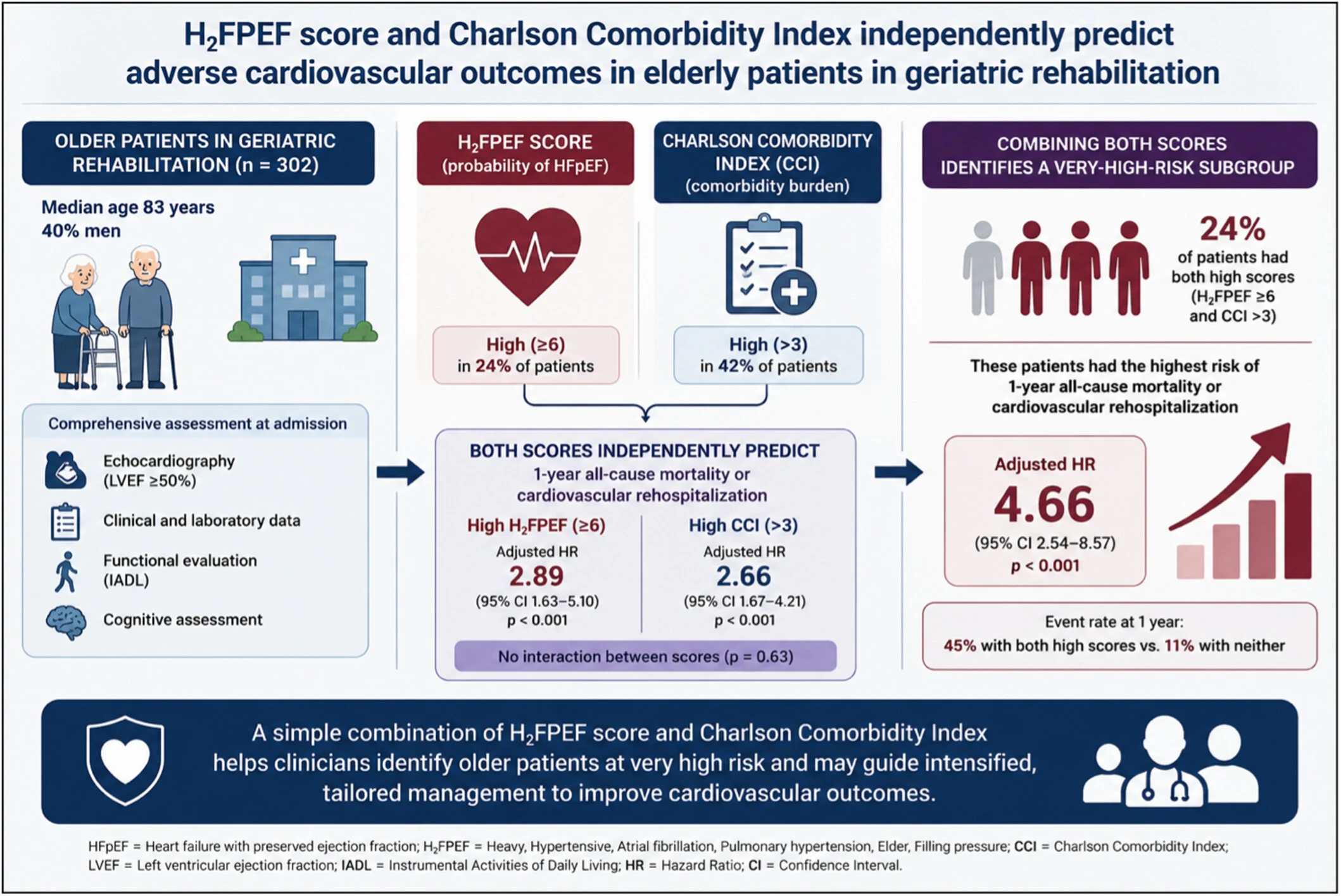
BACKGROUND: Heart failure with preserved ejection fraction (HFpEF) is difficult to diagnose in older adults. The H₂FPEF score estimates the likelihood of HFpEF and has been associated with adverse prognosis, but its performance has not been evaluated in geriatric inpatients with a high comorbidity burden. HYPOTHESIS: We hypothesized that the H₂FPEF score predicts adverse outcomes in geriatric inpatients independently of comorbidity burden. METHODS: This prospective cohort included consecutive patients admitted to a geriatric rehabilitation unit. All patients underwent functional and echocardiographic assessment at admission. The ability of the H₂FPEF score, the Charlson comorbidity index (CCI), and their combination to predict 1-year all-cause mortality (ACM) or cardiovascular rehospitalization (CR) was evaluated. RESULTS: Among 302 patients (median age 83 years, 40% men), 24% had a H₂FPEF score ≥ 6 indicating high HFpEF probability and 42% had a CCI > 3 indicating high comorbidity burden. The H₂FPEF score correlated with CCI (β = 0.27, p < 0.01) and functional disability (lower Instrumental Activities of Daily Living score; β = -0.17, p = 0.003), but not with cognitive impairment. Both a high H₂FPEF score and high CCI were associated with a higher risk of the combined outcome of 1-year ACM or CR (adjusted HR 2.89 [95% CI 1.63-5.10], p < 0.001 and adjusted HR 2.66 [95% CI 1.67-4.21], p < 0.001, respectively), with no interaction between them (p = 0.63). Patients with both high-risk scores had the highest risk (adjusted HR 4.66 [95% CI 2.54-8.57], p < 0.001). CONCLUSIONS: In geriatric inpatients, a high H₂FPEF score is common and independently identifies patients at increased risk of adverse cardiovascular outcomes at 1 year.
From the paper
- Participants
A total of 1022 patients were screened for the study, and 302 patients were finally included for analysis after applying the exclusion criteria (Figure 1).
- Result
Patients with both high-risk scores had the highest risk (adjusted HR 4.66 [95% CI 2.54–8.57], p < 0.001).
- Limitation
First, it was a single-center study in a university clinic, which may limit the generalizability of our findings.
Quoted word for word from the full text on onlinelibrary.wiley.com.
- Charlson Comorbidity Index
- Heart failure with preserved ejection fraction
- Cognitive impairment
- Combined H2FPEF score and Charlson comorbidity index
- H2FPEF score
- Humans
The paper
University Hospital of Lausanne (CHUV) and University of Lausanne (Unil)
Clinical Cardiology, 1 Oct 2026