Changes in Mood and Tryptophan Metabolism Following a 12-Week Endurance Exercise Combined with Time-Restricted Eating in Healthy Adults
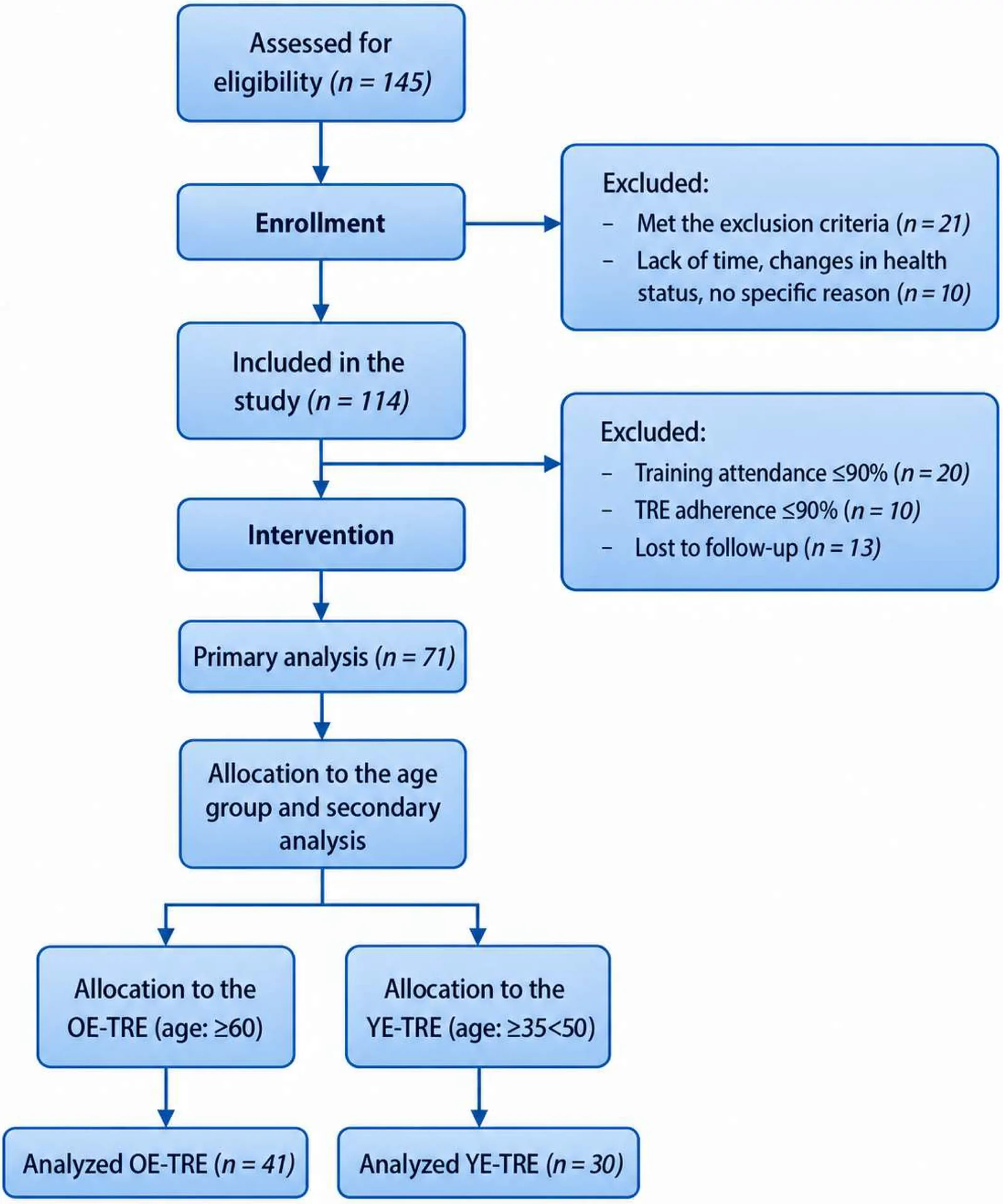
12 weeks, registered NCT05229835
Abstract
Background: The interplay between time-restricted eating (TRE), endurance exercise, mood, and tryptophan (TRP) metabolism has not been thoroughly examined. This study evaluated whether changes in psychological well-being co-occurred with changes in serum kynurenine metabolites during a combined TRE and exercise intervention and performed exploratory analyses of kynurenine metabolism. Methods: Seventy-one healthy adults participated in a 12-week endurance training program combined with a 10 h TRE window. Assessments included the State-Trait Anxiety Inventory, Mood Adjective Checklist, body composition, inflammatory markers, and serum kynurenine profiling, conducted at baseline and post-intervention. The pre-specified analysis was performed in the entire cohort, whereas subsequent analyses stratified by age and changes in anxiety were conducted post hoc and should be considered exploratory. Results: The pre-specified analysis of the entire cohort did not reveal statistically significant or clinically meaningful changes in psychological well-being, kynurenine metabolites, or inflammatory biomarkers. In exploratory post hoc analyses, participants were stratified into older (OE-TRE) and younger (YE-TRE) groups. Both groups showed significantly lower body mass and BMI at the second measurement. In the OE-TRE group, serum anthranilic acid (AA) levels increased (Δ = +7.85 nmol/L), while in the YE-TRE group, a decrease was observed (Δ = -2.62 nmol/L). In a separate exploratory post hoc analysis, participants with complete psychological assessment data were stratified according to the direction of change in anxiety scores. Among these participants, 66.7% showed lower anxiety scores in the second measurement, and this anxiety-defined subgroup also showed lower serum 3-hydroxykynurenine (3-HK) concentrations. This observation was confined to the exploratory subgroup analysis and should not be interpreted as a general reduction in 3-HK in the study cohort. The OE-TRE group also showed an increase in the xanthurenic acid (XANA) + picolinic acid (PA) to 3-HK ratio and a reduction in TNF-α. Notably, differences between groups in the 3-hydroxyanthranilic acid (3-HAA)/3-HK and XANA + PA/3-HK ratios observed at baseline were no longer present at the second measurement. In the exploratory subgroup of participants whose 3-HAA concentrations increased over time, soluble gp130 (sgp130) concentrations were lower at the second measurement. Conclusions: The pre-specified whole-cohort analysis did not demonstrate statistically significant or clinically meaningful changes in the primary psychological and biochemical outcomes. Exploratory post hoc analyses suggest that changes in psychological well-being and peripheral kynurenine metabolism may co-occur during a combined TRE and endurance exercise intervention. The observed decrease in 3-HK was restricted to an anxiety-defined exploratory subgroup and was not observed in the study cohort as a whole. These findings are associative and hypothesis-generating and do not establish an intervention effect or causality. The trial was registered as a clinical trial (NCT05229835, date of first registration: 8 February 2022).
- Endurance exercise
- Endurance exercise combined with time-restricted feeding
- Inflammation
- Tryptophan–kynurenine metabolism
- Anxiety
- Humans
The paper
Gdańsk Medical University
Nutrients, 22 Sep 2026, Open access