Twenty-Five Years of Colorectal Cancer Screening in the Czech Republic: National Registry Trends in Program Performance and Cancer Burden
Abstract
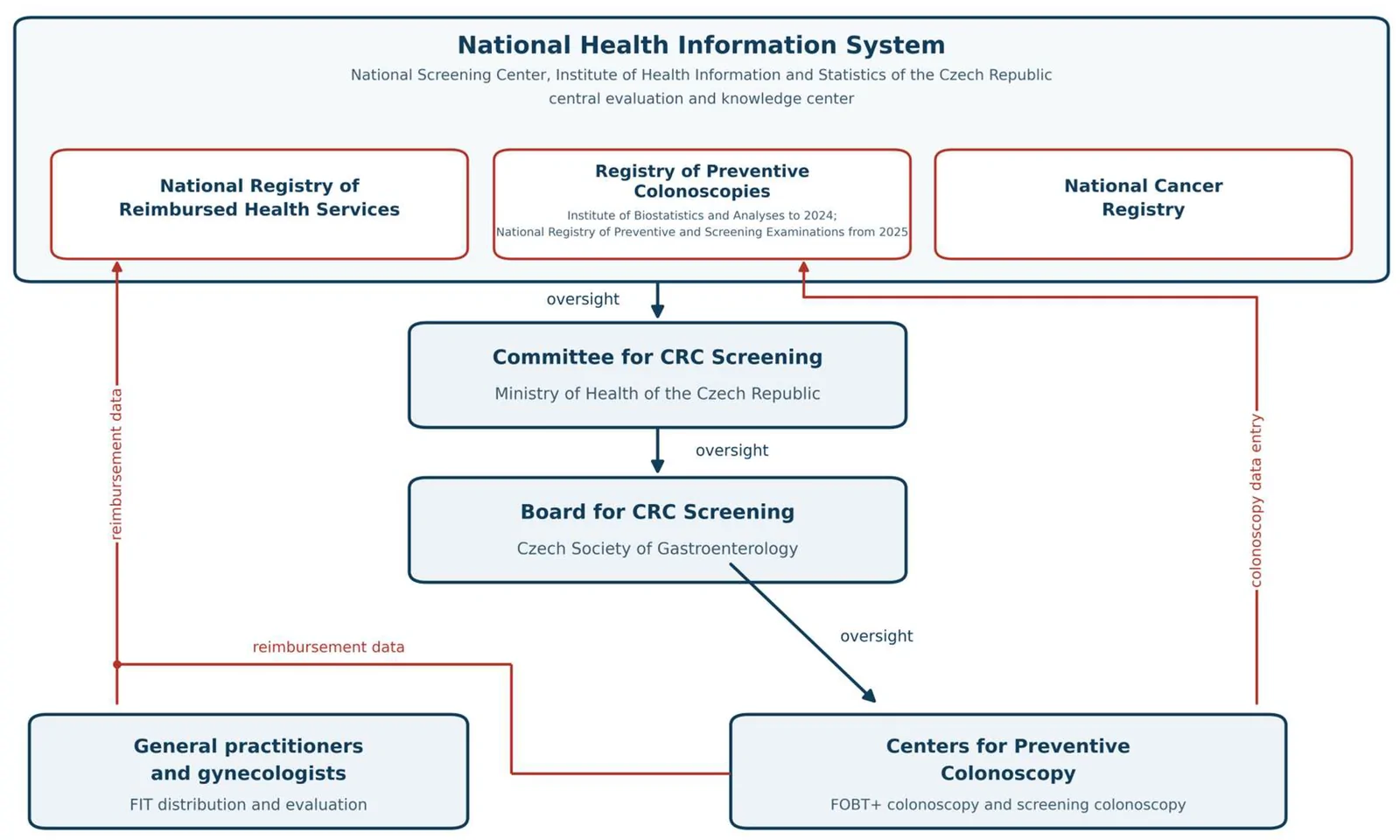
Background/Objectives: Colorectal cancer (CRC) incidence and mortality in the Czech Republic ranked among the highest worldwide for decades. The performance of the national screening program over 25 years is reported alongside concurrent population trends. Methods: In this retrospective population-based analysis, registry and health-insurance data on program indicators for 2006-2025 were analyzed by calendar year and screening pathway, together with national incidence and mortality for 1977-2024. Introduced in 2000 with guaiac fecal occult blood testing, the program added screening colonoscopy in 2009, completed the transition to fecal immunochemical testing (FIT) by 2014, and has used quantitative FIT only since 2020. The target age was 50 and over, redefined as 45-74 from 2026. Results: Among 653,825 preventive colonoscopies, at least one adenoma was detected in 251,974 examinations and cancer, including carcinoma in situ, in 16,575. The positive predictive value for adenoma after a positive fecal test rose from 29.6% to 48.3%, and the adenoma detection rate at screening colonoscopy from 25.3% to 32.6%. Cancer detection fell from 6.3% to 2.8% and from 1.8% to 0.5%, respectively. Coverage by screening modalities was 33.7%, and 41.0% including examinations outside the program. Six-month compliance with colonoscopy after a positive FIT was 58.0%. This figure counts colonoscopy under any procedure code and therefore measures whether colonoscopy was performed rather than whether it was reported under the dedicated pathway code. Of all patients with a positive FIT, 37.6% underwent colonoscopy reported under the dedicated FOBT+ colonoscopy code, a subset of the overall 58.0%. Waiting time for FOBT+ colonoscopy was 80 days on average. Age-standardized incidence and mortality were 31.7% and 50.0% lower in 2022-2024 than in 1998-2000. The declines were not uniform across age: the incidence decline was most pronounced at ages 75 and older, whereas the mortality decline was concentrated at ages 50 to 74. Conclusions: Sustained organized screening coincided with a substantial decline in one of the world's highest CRC burdens, although its earlier part preceded program expansion. Coverage and completion of FOBT+ colonoscopy remain the principal implementation challenges.