Cognitive Impairment in Asthma: Emerging Evidence, Clinical Consequences, and Future Directions
Abstract
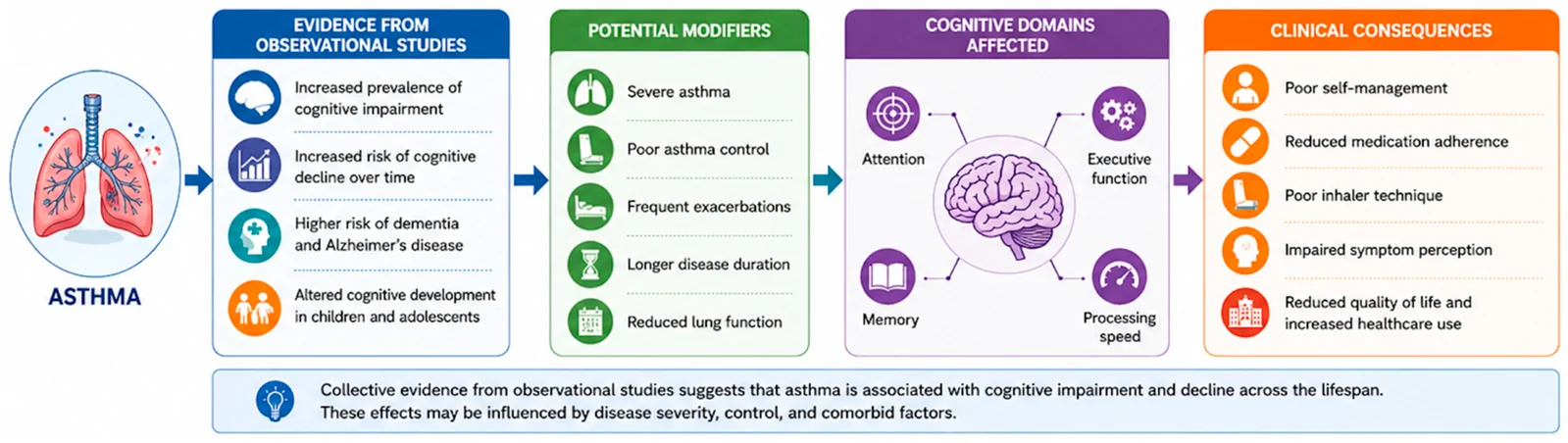
Asthma is increasingly recognised as a systemic inflammatory disease with effects extending beyond the respiratory system. Emerging evidence suggests that cognitive impairment may represent an under-recognised extrapulmonary manifestation with important implications for disease management and long-term neurological health. This narrative review critically synthesises current evidence regarding the epidemiology, clinical consequences, and potential mechanisms linking asthma with cognitive dysfunction. Observational and longitudinal studies indicate that asthma is associated with an increased risk of cognitive impairment, cognitive decline, and dementia. However, substantial heterogeneity in study design, cognitive assessment, asthma phenotyping, and adjustment for confounding factors limits causal inference. Cognitive deficits predominantly involve attention, executive function, memory, and, less consistently, processing speed, potentially compromising medication adherence, inhaler technique, symptom perception, and self-management. Current evidence supports a multifactorial pathophysiological model in which chronic systemic inflammation, oxidative stress, intermittent hypoxaemia, sleep disturbance, corticosteroid exposure, and psychological comorbidity interact to promote endothelial dysfunction, blood-brain barrier disruption, microglial activation, neuroinflammation, mitochondrial dysfunction, and impaired synaptic plasticity. These mechanisms may be particularly relevant in children with early-onset asthma, older adults, and patients with severe or poorly controlled disease, although direct mechanistic evidence remains limited. Future research should prioritise well-phenotyped longitudinal cohorts that integrate comprehensive cognitive assessment with neuroimaging, inflammatory biomarkers, and objective measures of disease control to establish temporal relationships, identify high-risk populations, and determine whether cognitive dysfunction is a modifiable component of asthma burden. Recognition of cognition as a clinically relevant outcome may ultimately improve risk stratification and support more personalised, holistic approaches to asthma care.
From the paper
- Result
The authors reported a pooled prevalence of cognitive impairment of 16.3% among individuals with asthma and found that asthma was associated with a significantly increased risk of cognitive impairment compared with individuals without asthma (HR = 1.47, 95% CI: 1.09–1.84).
- Limitation
Interpretation of the current evidence remains limited by substantial methodological heterogeneity.
Limitations, 9.1. Heterogeneity in Study Design and Populations
Quoted word for word from the full text on mdpi.com.
The paper
King Faisal University
Journal of Clinical Medicine, 8 Oct 2026, Open access


