Changes in Metabolic Syndrome and Its Components Across the Pre-Pandemic, Pandemic, and Recovery Periods Among Korean Adults
Abstract
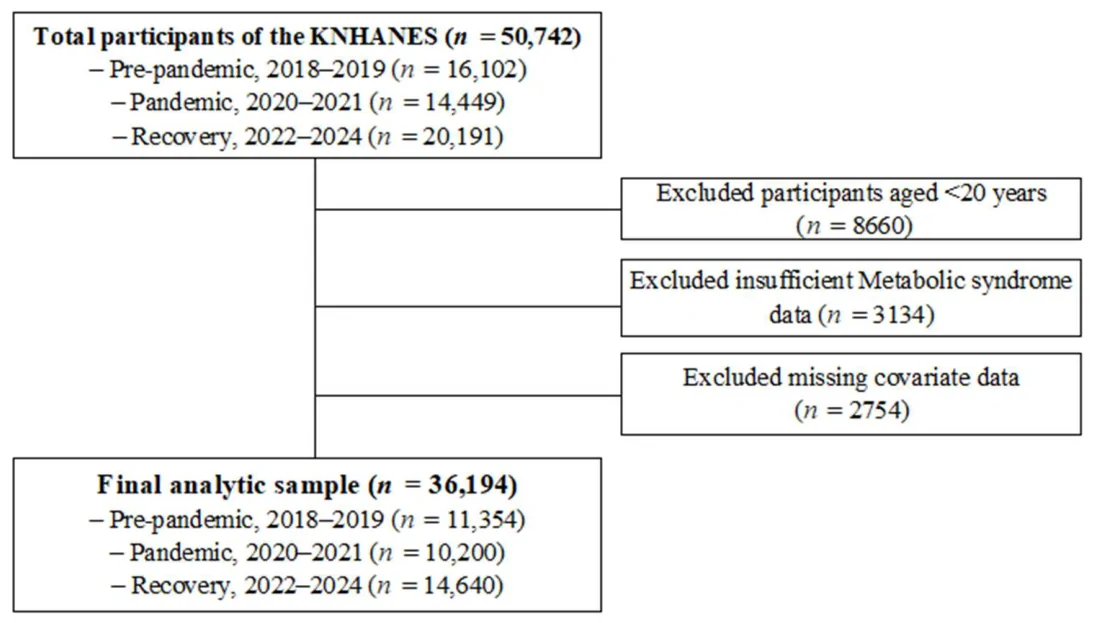
Background/Objectives: Korean studies reported adverse metabolic changes during the COVID-19 pandemic, but subsequent patterns remain unclear. This study examined metabolic syndrome (MetS) and its components across pre-pandemic, pandemic, and recovery periods among Korean adults. Methods: We analyzed 36,194 adults aged ≥20 years from the 2018-2024 Korea National Health and Nutrition Examination Survey: 11,354 pre-pandemic (2018-2019), 10,200 pandemic (2020-2021), and 14,640 recovery (2022-2024). MetS was defined as ≥3 of five components. Complex-sample analyses and multivariable logistic regression were performed. Sensitivity analysis excluded reduced high-density lipoprotein cholesterol (HDL-C). Results: Weighted MetS prevalence was 29.1%, 30.5%, and 26.4% across the pre-pandemic, pandemic, and recovery periods, respectively. Individual MetS components showed divergent patterns. Abdominal obesity increased during the pandemic and remained elevated during recovery, whereas reduced HDL-C declined markedly during recovery. Compared with the pre-pandemic period, the fully adjusted odds of MetS were not significantly higher during the pandemic (OR, 1.077; 95% CI, 0.999-1.161) but were lower during recovery (OR, 0.845; 95% CI, 0.790-0.903). After excluding reduced HDL-C, the recovery association was attenuated (OR, 0.924; 95% CI, 0.857-0.997). Conclusions: MetS prevalence decreased during recovery, but individual components showed divergent trajectories, with abdominal obesity remaining elevated. Attenuation after excluding reduced HDL-C suggests that lower MetS prevalence should not be interpreted as uniform metabolic recovery.
The paper
Korea National University of Transportation; Kookmin University
Journal of Clinical Medicine, 27 Sep 2026, Open access