Evaluating procollagen type III N-terminal propeptide (P3NP) as a biomarker of sarcopenia in women with type 2 diabetes: a cross-sectional study
Abstract
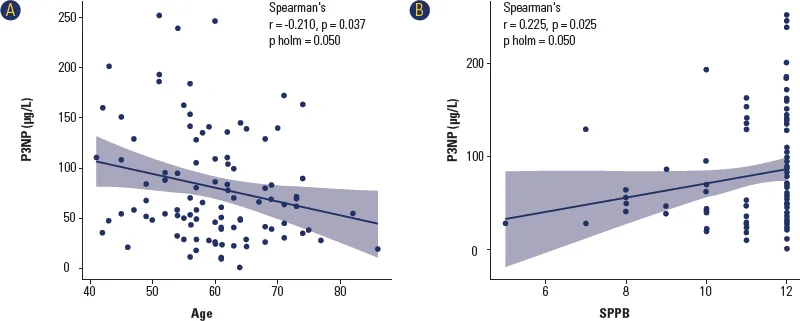
OBJECTIVE: To determine whether circulating procollagen type III N-terminal propeptide (P3NP) improves the diagnosis of dual-energy X-ray absorptiometry (DXA)-defined sarcopenia in women with type 2 diabetes mellitus (T2DM). SUBJECTS AND METHODS: This cross-sectional study enrolled 99 women with T2DM who underwent standardized clinical assessment, handgrip strength testing, and whole-body DXA. Sarcopenia was defined using a DXA-derived fat-free mass index. Multivariable logistic regression models included age, body mass index, glycated hemoglobin (HbA1c), and estimated glomerular filtration rate, with and without log-transformed, z-standardized P3NP. Discriminatory performance was quantified by the area under the curve (AUC) with bootstrap 95% confidence intervals; sensitivity analyses excluded participants with an estimated glomerular filtration rate below 60. RESULTS: P3NP showed weak bivariate correlations with age (p = -0.210) and the Short Physical Performance Battery (p = 0.225). When incorporated into the clinical model, P3NP did not yield a clinically significant improvement (ΔAUC = 0.007). As a sole predictor, P3NP had poor discrimination (AUC 0.53) and was not independently associated with DXA-defined sarcopenia (odds ratio per 1-standard deviation, p > 0.05). Results were consistent after excluding participants with reduced kidney function and across interaction analyses; model calibration was adequate. P3NP absolute values were elevated, with 80.8% above the high threshold (>31 μg/L), and clinical/functional profiles were broadly similar P3NP strata. CONCLUSION: In women with T2DM, circulating P3NP was not an independent discriminator of DXA-defined sarcopenia and provided no clinically meaningful advantage over standard clinical predictors. Routine screening should continue to rely on assessments of muscle strength, function, and DXA-based body composition, while P3NP may be considered an adjunct marker of extracellular matrix remodeling.
- Procollagen type III N-terminal propeptide
- Sarcopenia
- Type 2 diabetes
- DXA-defined sarcopenia
- Body mass index
- Humans
The paper
Programa de Pós-Graduação em Ciências da Saúde
Archives of Endocrinology and Metabolism, 15 Oct 2026