Effects of dietary quality on type 2 diabetes risk and the mediating role of inflammatory markers
Abstract
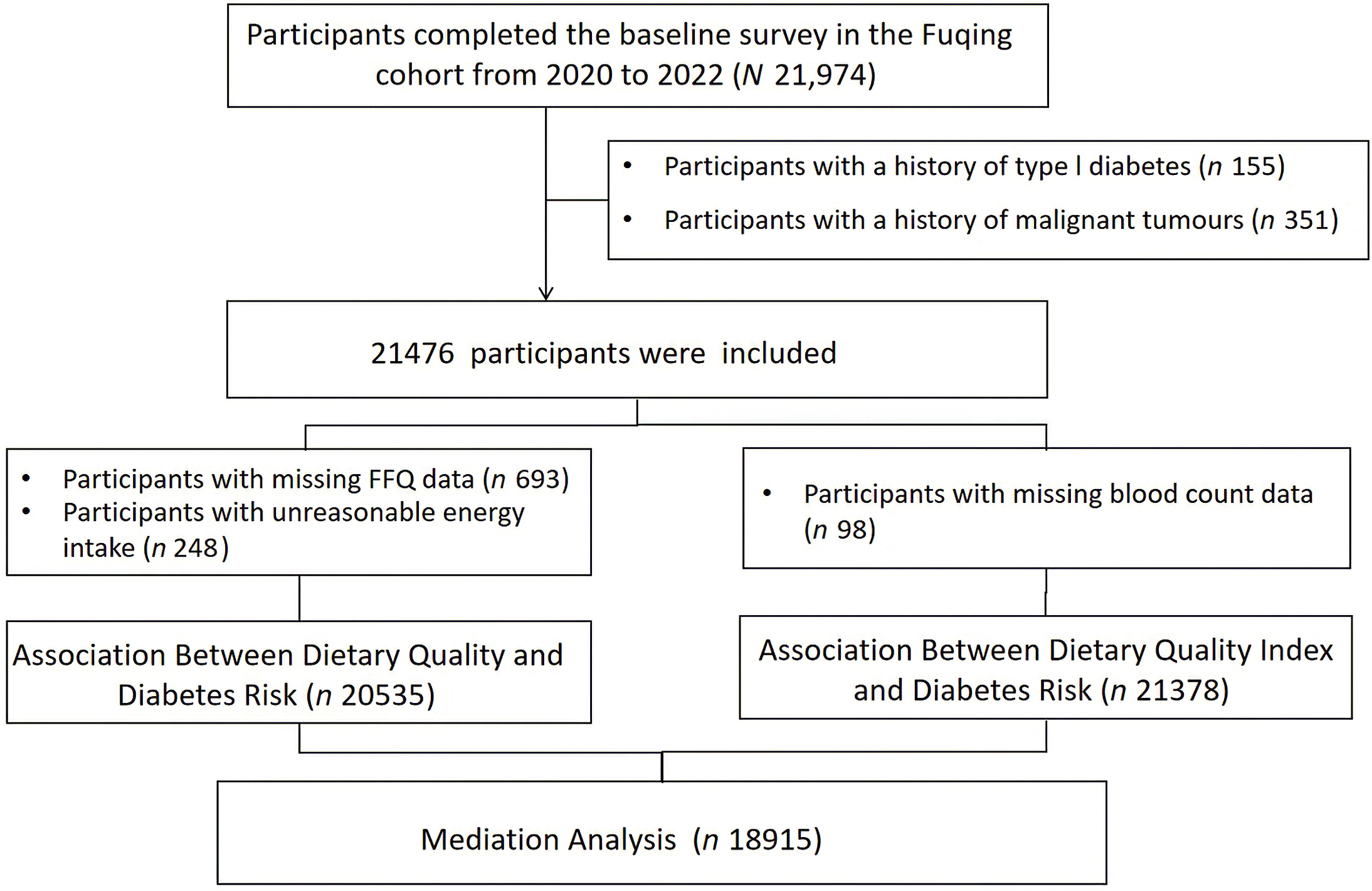
This study aimed to explore the association between multiple dietary quality indices and diabetes risk and investigate the potential role of systemic inflammatory markers in such relationships. Data were obtained from 21 476 participants in the Fuqing Cohort Study who completed a FFQ. Dietary quality was assessed using the Healthy Eating Index (HEI), Diet Quality Index (DQI) and Diet Balance Index (DBI). Logistic regression models were used to examine associations among dietary quality, inflammatory markers and glycemic status. Mediation models were employed to evaluate potential mediating effects of eleven systemic inflammatory markers. All three dietary indices were inversely associated with diabetes risk. Compared with participants in the lowest dietary quality category, the adjusted OR (95 % CI) of the highest dietary quality category were 0·863 (0·768, 0·970) for HEI, 0·719 (0·640, 0·807) for DQI and 0·852 (0·754, 0·961) for DBI. Single-mediator analyses showed potential indirect effects of the HEI on diabetes risk via total white blood cell count, neutrophil, monocyte counts, neutrophil-to-lymphocyte ratio and systemic immune-inflammation index, with mediated proportions of 10·67 %, 11·32 %, 4·05 %, 3·22 % and 3·26 %, respectively. In the parallel multiple mediation model including all mediators, a potential indirect effect (OR = 0·980; 95 % CI: 0·759, 0·963) was observed, with a mediated proportion of 8·83 %. Higher dietary quality, as assessed by the HEI, DQI and DBI, is inversely associated with hyperglycaemia risk and linked to lower levels of systemic inflammatory markers. The adverse association of poor dietary quality with diabetes risk may be partially mediated by systemic inflammatory factors.
From the paper
- Participants
A total of 21 476 participants were included in the study.
- Result
… the highest quartile of DQI was inversely associated with the risk of prediabetes (OR:0·885, 95 % CI: 0·802, 0·975) and diabetes (OR: 0·719, 95 % CI: 0·640, 0·807), while the highest quartile of HEI was inversely associated with diabetes risk (OR:0·863, 95 % CI: 0·768, 0·970).
Results, Association between dietary quality index and different glycemic status
- Limitation
First, the cross-sectional design cannot establish temporal sequence or causality among dietary quality, systemic inflammation and glycemic status.
Quoted word for word from the full text on cambridge.org.
The paper
Fujian Medical University
The British Journal of Nutrition, 15 Oct 2026