Risk stratification of Stage B heart failure with BNP levels of 35-100 pg/mL: development of the PHASE Index from the CHART-2 Study
Multicentre
Abstract
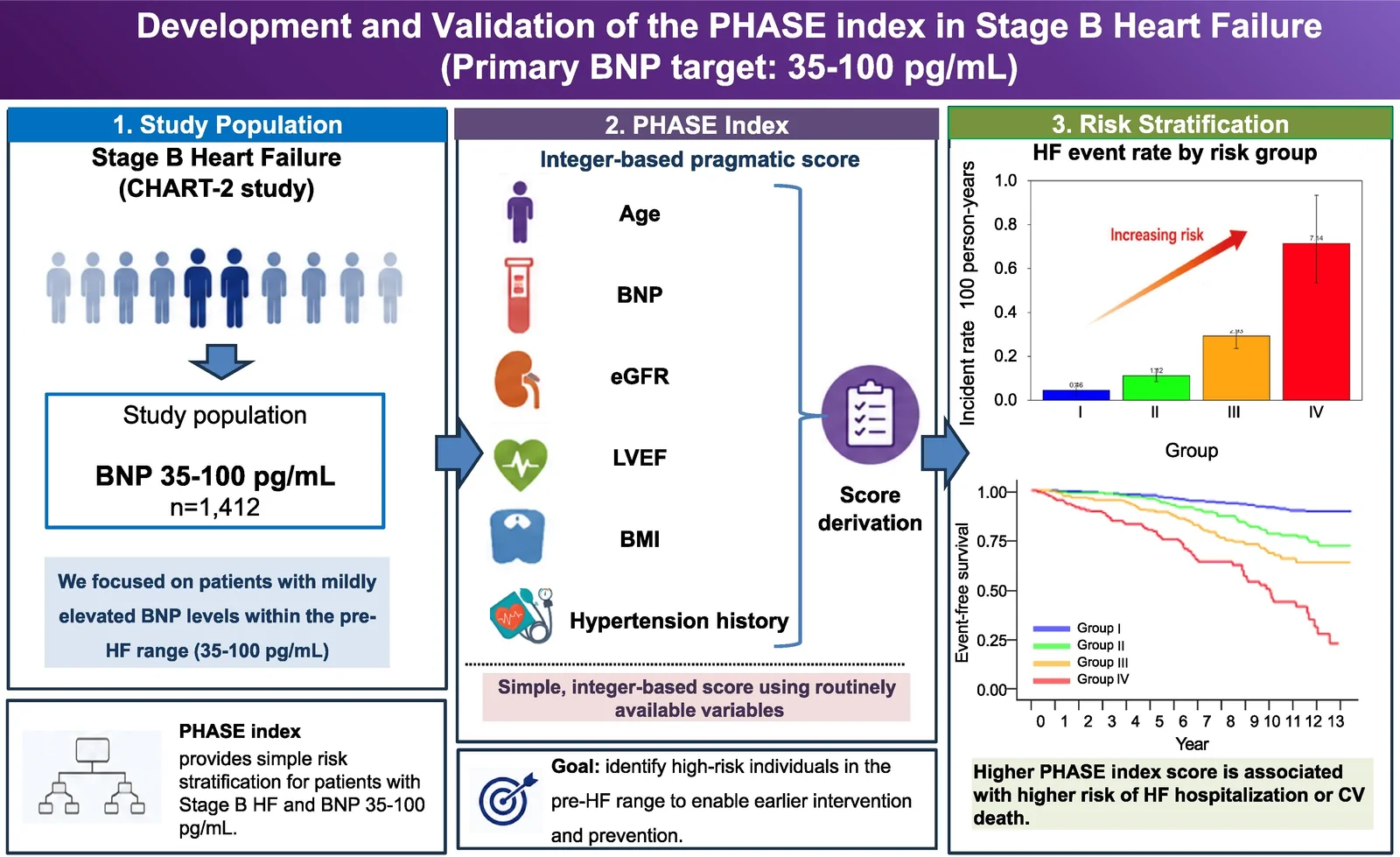
AIMS: B-type natriuretic peptide (BNP) levels of 35-100 pg/mL, common in preclinical heart failure (HF), are associated with heterogeneous prognosis and are influenced by age and renal function. We aimed to characterize risk heterogeneity in preclinical HF patients with BNP levels of 35-100 pg/mL and to develop a practical risk stratification model. METHODS AND RESULTS: Data from the Chronic Heart Failure Registry and Analysis in the Tohoku District-2 (CHART-2) Study, a prospective multicentre cohort with long-term follow-up, were analysed. Among patients with Stage B HF (n = 4074; age 67.6 ± 12.0 years), the predictability of BNP for 10-year HF-related events was evaluated across strata of age and estimated glomerular filtration rate (eGFR). In patients with BNP levels of 35-100 pg/mL, a composite risk score-the Pre-Heart Failure Assessment and Screening Evaluation (PHASE) Index-was developed using classification and regression tree analysis and multivariable Cox proportional hazards modelling. BNP discrimination varied significantly by age and eGFR (P < 0.05), indicating that a single BNP threshold is insufficient for risk stratification in preclinical HF. The PHASE Index, incorporating age, BNP, eGFR, left ventricular ejection fraction, body mass index, and hypertension, stratified patients with BNP levels of 35-100 pg/mL into four categories and demonstrated superior discrimination compared with BNP alone (c-index 0.723 vs. 0.587, P < 0.05). CONCLUSION: Patients with preclinical HF and BNP levels of 35-100 pg/mL exhibit substantial risk heterogeneity. The PHASE Index improves identification of high-risk individuals and provides a pragmatic tool for risk stratification beyond the conventional BNP threshold.
From the paper
- Participants
… a total of 10 209 consecutive patients with established HF or at risk for HF were enrolled and followed up for more than 10 years, as previously described.14–16
- Follow-up
HF-related events were assessed over a 10-year follow-up period.
- Limitation
First, although the CHART-2 study is a large-scale, prospective, multicentre registry with adjudicated outcomes and 10-year follow-up, our analyses were derived from a single dataset.
Quoted word for word from the full text on academic.oup.com.
The paper
Tohoku University
European Heart Journal Open, 5 Oct 2026, Open access


