Lifestyle, APOE ε4, amyloid burden, and race/ethnicity differences in cognition, mood, and anxiety among cognitively unimpaired older adults
Abstract
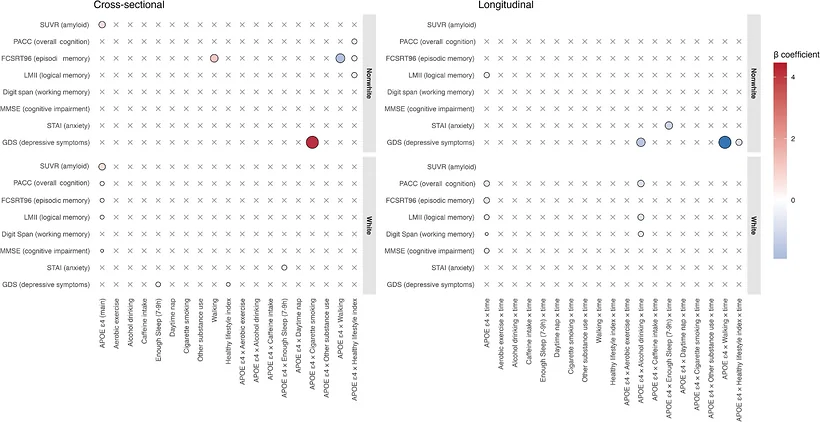
INTRODUCTION: We assessed whether lifestyle, race/ethnicity, and apolipoprotein E gene (APOE) ε4 were associated with cognition or mood/anxiety. METHODS: This secondary cohort analysis used data from the Anti-Amyloid Treatment in Asymptomatic Alzheimer's Disease (A4) Study and the Longitudinal Evaluation of Amyloid Risk and Neurodegeneration (LEARN) cohort. Cognitively unimpaired adults aged 65 to 85 years (n = 1705) reported baseline lifestyle behaviors (summed as healthy lifestyle index [HLI]). APOE ε4 carrier status and amyloid positron emission tomography were assessed at baseline, while cognitive, anxiety, and depressive outcomes were assessed longitudinally. Associations were tested using mixed-effects models. RESULTS: Among Non-Hispanic White participants, higher HLI was associated with fewer depressive symptoms, sufficient sleep was associated with smaller ε4-related increases in anxiety, and excessive alcohol use amplified ε4-related cognitive decline. Among participants from other racial/ethnic groups, walking and higher HLI were associated with more favorable anxiety/depression trajectories. DISCUSSION: Adequate sleep, limited alcohol, walking, and no smoking may support emotional and cognitive health.
From the paper
- Participants
The study included 2743 participants.
- Result
Each 1-SD higher HLI score corresponded to a 0.14-SD lower GDS score (β = −0.14; 95% CI: −0.21 to −0.07; q < 0.001), and getting enough sleep was associated with a 0.26-SD lower GDS score (β = −0.26; 95% CI: −0.42 to −0.11; q = 0.01).
- Limitation
The study participants of the A4/LEARN study were mostly highly educated and socially supported, and therefore the generalizability of our findings to broader and more socioeconomically diverse general populations is limited.
Quoted word for word from the full text on alz-journals.onlinelibrary.wiley.com.
The paper
University of Hawaiʻi at Mānoa
Alzheimer's & Dementia, 14 Oct 2026, Open access