Dynamic 18F-FDG PET characterizes age-related changes in fitted ventricular FDG kinetics in humans
Abstract
Ventricular cerebrospinal fluid (CSF) transport is an important component of intracranial solute movement and may contribute to glymphatic-associated transport pathways. However, clinically accessible methods for quantifying ventricular CSF tracer dynamics in humans remain limited. This study examined the potential of dynamic 18F-fluorodeoxyglucose (18F-FDG) positron emission tomography (PET) for quantifying ventricular CSF tracer kinetics as an indirect measure of CSF transport by evaluating its association with age and clinical factors. We analyzed baseline dynamic 18F-FDG PET data from participants with major depressive disorder enrolled in a prior clinical trial. Time-activity curves extracted from the lateral ventricles were modeled using a variant of the single-tissue compartment kinetic model to estimate kinetic parameters describing effective tracer entry into (K₁ ) and net removal (k₂ ) from the ventricular compartment. Associations with age and clinical factors were assessed using correlation and multiple linear regression analyses. Both K₁ (r = -0.700, p < 0.001) and k₂ (r = -0.712, p < 0.001) demonstrated strong negative correlations with age. In multivariable models adjusting for sex, ventricular volume, and depression severity, age remained a significant predictor of both parameters. Ventricular volume was also a significant predictor of both K₁ and k₂ , while k₂ additionally showed a significant association with depression severity. These findings suggest that dynamic 18F-FDG PET can characterize ventricular tracer kinetics without intrathecal contrast administration, revealing a robust age-dependent decline in both tracer entry and removal processes and supporting its potential utility for studying ventricular CSF transport dynamics in aging and disease.
From the paper
- Participants
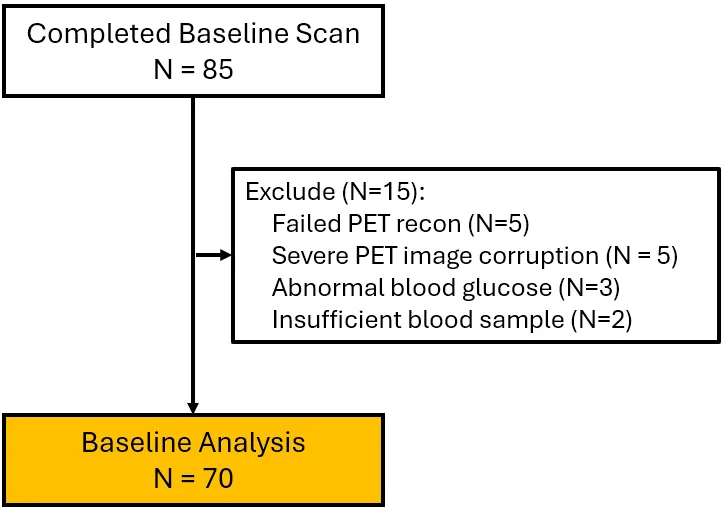
A total of 85 participants (age range 18.1–64.5 years, mean ± standard deviation [SD]: 30.3 ± 13.9; 56 females) underwent baseline 18F-FDG PET imaging.
- Limitation
First, this study is cross-sectional and, therefore, the observed associations with age do not directly reflect within-subject longitudinal changes.
Quoted word for word from the full text on direct.mit.edu.
- Imaging
- Modelling and theory
- Major depressive disorder
- Depression severity
- Ventricular tracer entry parameter K1
- Humans
The paper
Emory University; Georgia Institute of Technology
Imaging Neuroscience, 13 Oct 2026, Open access