Four-week supplementation with a blackcurrant formulation enhances cognitive performance, reduces mental fatigue and modulates peripheral monoamine metabolism in older adults: a randomized, double-blind, placebo-controlled, crossover study
Double-blind, placebo-controlled, registered ACTRN12621001590853
Abstract
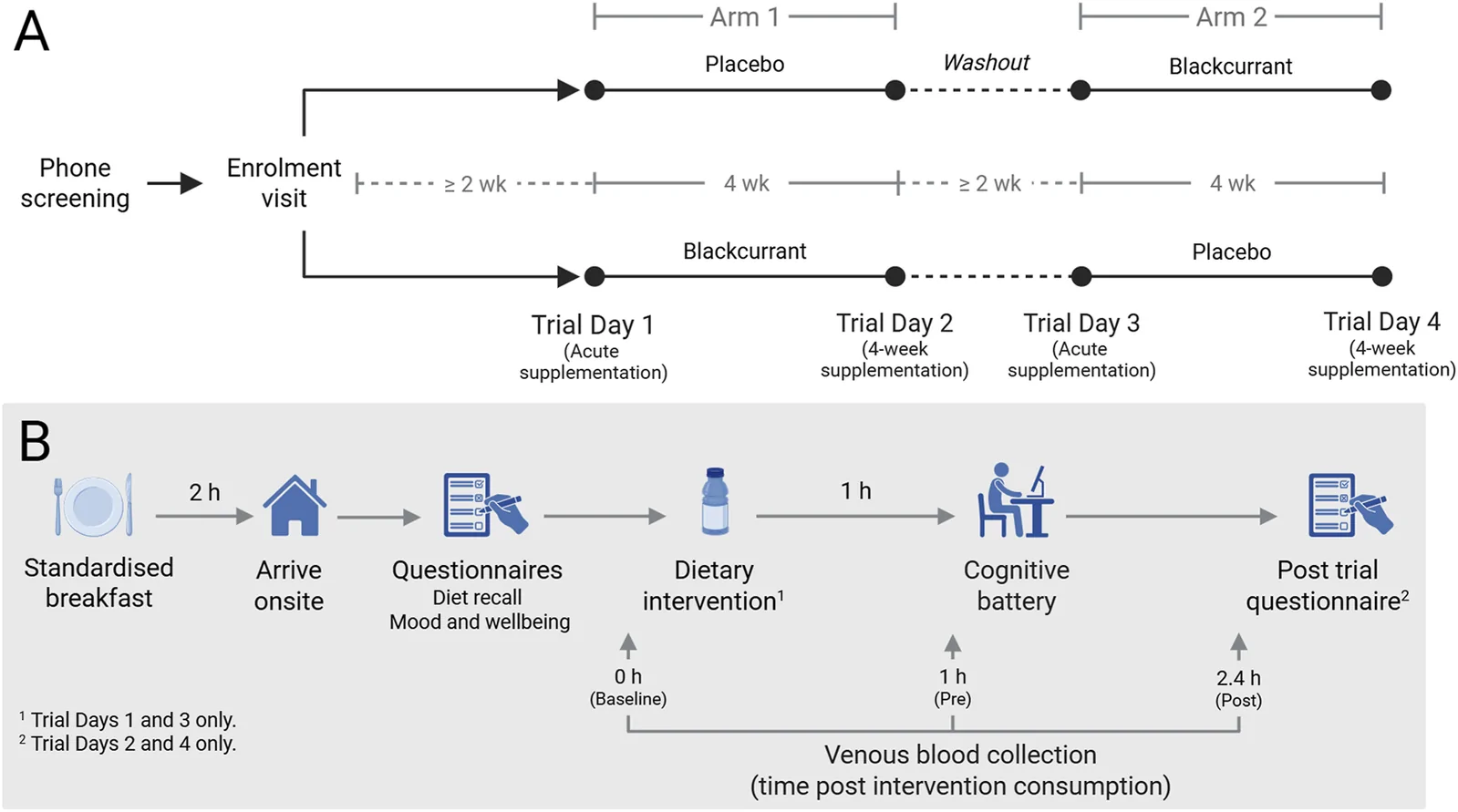
INTRODUCTION: Age-related cognitive decline is an increasing concern in older adults. While blackcurrants (Ribes nigrum) have shown promise in improving cognitive outcomes in younger adults, their efficacy in supporting cognitive function in older adults is largely unexplored. METHODS: In this randomized, placebo-controlled, double-blinded crossover study of healthy older adults (62 ± 1 years), 26 of the 30 participants enrolled completed the study per protocol. Participants consumed either a placebo or a flavonoid-rich blackcurrant formula (BCF, 7.8 mg anthocyanins/kg body weight freeze-dried blackcurrant, 200 mg L-theanine, and 100 mg pine bark extract) in a beverage format daily for 4 weeks, with interventions separated by a two-week washout period. For each intervention, cognitive and mood outcomes were assessed following a single dose (acute) and after 4 weeks' supplementation. Platelet MAO-B activity, circulating neurotransmitter concentrations, and anthocyanin, L-theanine and sarmentosin bioavailability were measured from venous blood samples drawn at baseline, 1 h, 2.4 h and 4 wk after intervention supplementation. RESULTS: A significant reduction in Rapid Visual Information Processing (RVIP) false alarms (p = 0.022) and a strong trend in reduced mental fatigue (p = 0.046, q = 0.067) were measured following 4 weeks of BCF supplementation. Reduction in biomarkers of MAO activity were measured following acute supplementation with BCF, but not placebo, with significant treatment × time interactions (q < 0.01) for platelet MAO-B activity, plasma 5-hydroxyindoleacetic acid and 3,5-dihydroxyphenylglycine concentrations. These changes corresponded with significant reductions (q < 0.05) in circulating neurotransmitter metabolites xanthurenic acid, 3-methoxy-4-hydroxyphenylglycol and vanillylmandelic acid. CONCLUSION: Findings from this study indicate that 4 weeks of BCF supplementation sustained attention in healthy older adults, extending evidence for BCF-related cognitive benefits across both younger and older populations. CLINICAL TRIAL REGISTRATION: https://anzctr.org.au/, identifier: ACTRN12621001590853.
The paper
Bioeconomy Science Institute
Frontiers in Pharmacology, 30 Sep 2026, Open access