Impact of a 12-week high-intensity interval training program on working memory in young adults with overweight or obesity
12 weeks
Abstract
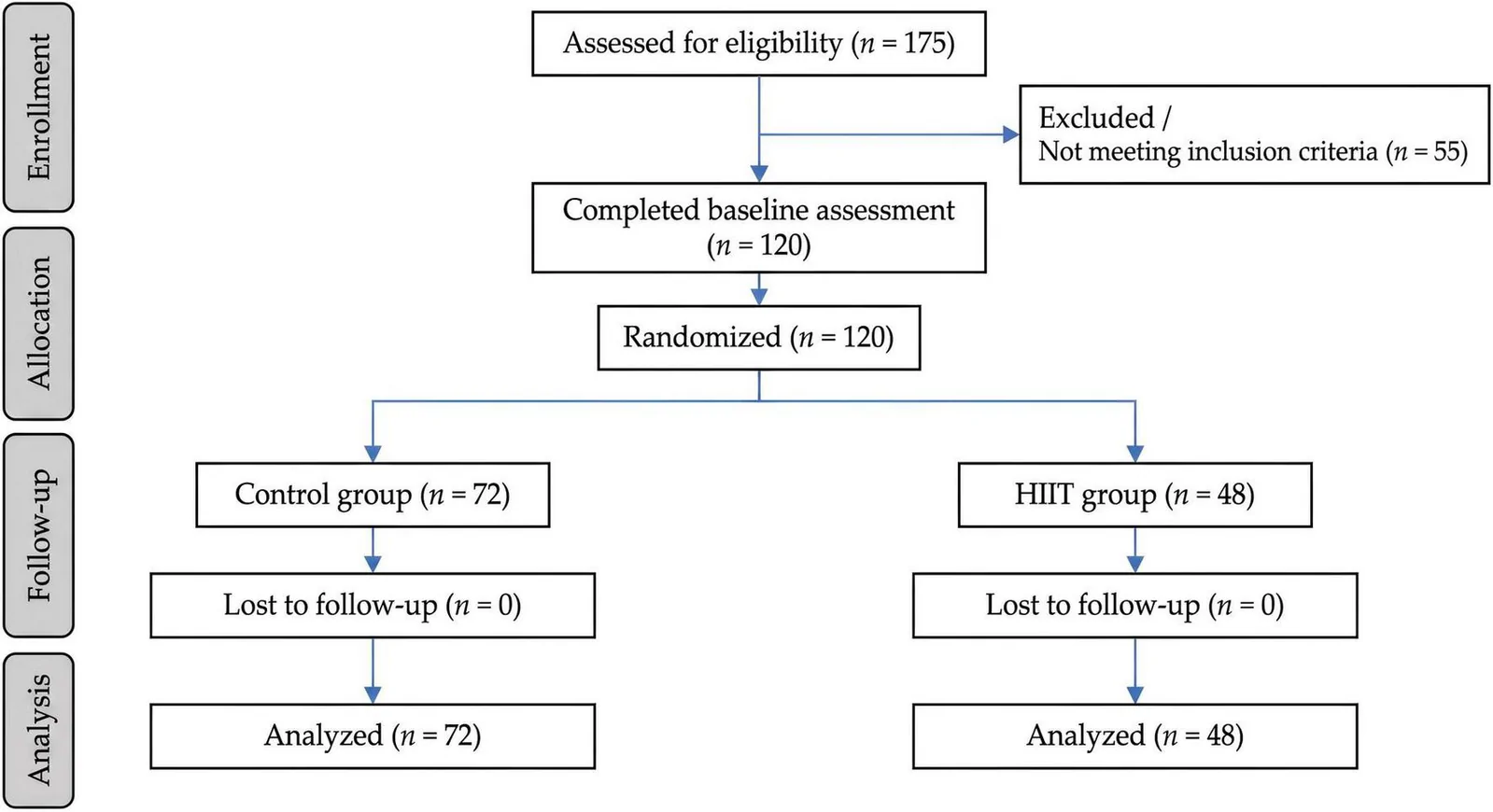
OBJECTIVE: To examine the association of a 12-week high-intensity interval training (HIIT) program with working-memory performance in young adults aged 18-25 years with overweight or obesity. METHODS: A total of 120 young adults with overweight or obesity were randomly allocated to an HIIT group (n = 48) or a control group (n = 72). The HIIT group completed a 12-week structured program, whereas the control group maintained usual daily activities. Working-memory updating was assessed using 1-back and 2-back tasks. Post-test body weight and maximal oxygen consumption (VO₂max) were analysed using baseline-adjusted analysis of covariance (ANCOVA), whereas body mass index (BMI) was analysed using repeated-measures ANCOVA. Reaction-time outcomes were analysed using a 2 × 2 × 2 mixed repeated-measures ANCOVA, with group as the between-subject factor and time and cognitive load as within-subject factors. Because marked baseline imbalance was observed for accuracy, 1-back and 2-back accuracy were analysed separately using baseline-adjusted post-test ANCOVA. Exploratory partial correlation analyses examined associations between changes in VO₂max and n-back performance separately within the HIIT and control groups. An additional exploratory linear regression model tested whether the association between VO₂max improvement and 2-back reaction-time improvement differed between groups. RESULTS: Baseline-adjusted ANCOVA showed lower post-test body weight in the HIIT group than in the control group [F(1,115) = 110.07, p < 0.001, η² = 0.256] and higher post-test VO₂max [F(1,115) = 300.86, p < 0.001, η² = 0.451]. Repeated-measures ANCOVA showed a significant group × time interaction for BMI [F(1,115) = 137.60, p < 0.001, η² = 0.545]. For reaction time, the 2 × 2 × 2 mixed repeated-measures ANCOVA showed a significant group × time interaction [F(1,115) = 31.95, p < 0.001, partial η² = 0.217] and a significant group × cognitive-load interaction [F(1,115) = 9.22, p = 0.003, partial η² = 0.074], whereas the group × time × cognitive-load interaction was not significant [F(1,115) = 2.15, p = 0.145, partial η² = 0.018]. After adjustment for baseline accuracy and other measured baseline covariates, no significant post-test group difference was observed in 1-back accuracy [F(1,114) = 0.91, p = 0.343] or 2-back accuracy [F(1,114) = 2.17, p = 0.143]. In exploratory analyses, VO₂max improvement was associated with 2-back reaction-time improvement in the HIIT group (r = 0.391, p = 0.009) but not in the control group (r = -0.101, p = 0.411). However, the group × VO₂max-improvement interaction did not reach conventional statistical significance (β = 388.57, 95% CI: -7.68 to 784.82, p = 0.055). CONCLUSION: Participation in the 12-week HIIT program was associated with lower adjusted post-test body weight, higher adjusted post-test VO₂max, a greater reduction in BMI, and more favorable reaction-time performance averaged across n-back loads. No adjusted post-test between-group difference in accuracy was observed. The non-significant group × time × cognitive-load interaction does not support a cognitive-load-specific effect. Although the VO₂max-2-back reaction-time association was observed in the HIIT group but not in the control group, the non-significant interaction model did not conclusively establish training specificity. Dietary intake, habitual physical activity, sedentary behavior, complete individual-level exercise intensity, and formal assessor blinding were not available; therefore, the observed differences cannot be attributed exclusively to HIIT.
The paper
Yangzhou University
Frontiers in Nutrition, 30 Sep 2026, Open access