Self-reported chewing or swallowing problems and episodic memory performance in older Americans: a longitudinal cohort study
Abstract
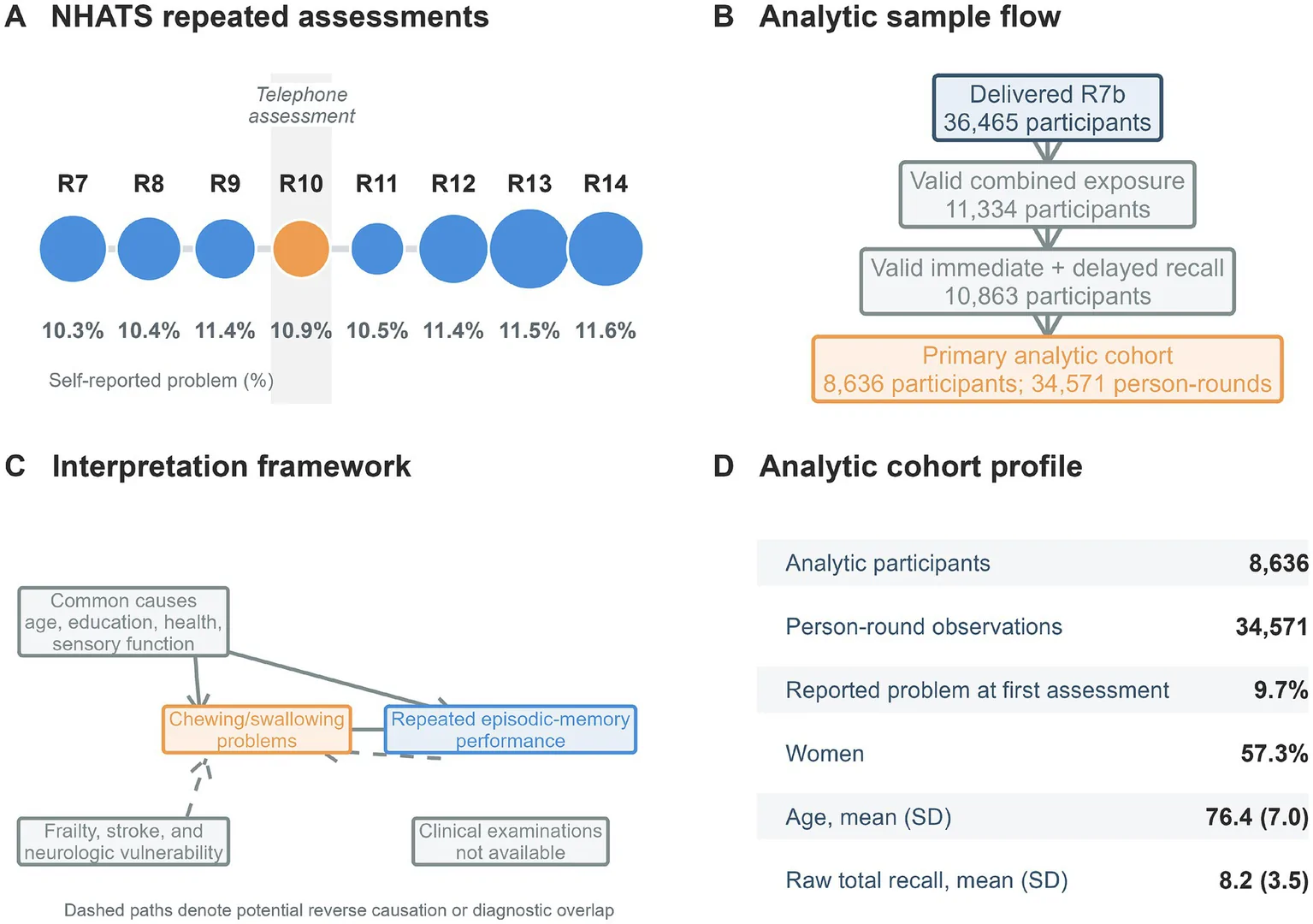
BACKGROUND: Impaired mastication is a plausible modifiable risk factor for dementia, but long-term longitudinal evidence using functional metrics instead of tooth counts is limited. This study investigated the association between self-reported chewing/swallowing problems and cognitive decline trajectories in older adults. METHODS: We analyzed repeated NHATS rounds 7-14. The primary analytic sample comprised 8,636 participants contributing 34,571 person-round observations with valid exposure and immediate plus delayed 10-word recall. Raw total recall (0-20) was the primary outcome. Linear mixed models used rounds since each participant's first complete analytic assessment, time-varying exposure, random intercepts and random slopes, and adjustment for age, sex, race/ethnicity, education, comorbidity count, depressive symptoms, hearing impairment, and vision impairment. RESULTS: At the first complete analytic assessment, 842 participants (9.7%) reported chewing or swallowing problems. In the primary model, the exposure-by-time interaction was -0.035 recall points per follow-up round (95% CI, -0.075 to 0.005; p = 0.086). The contemporaneous exposure coefficient at follow-up round 0 was 0.034 points (95% CI, -0.106 to 0.173; p = 0.638). Results were similar when participants with one assessment were excluded and when the outcome was modeled as immediate recall, delayed recall, or standardized against a common reference. CONCLUSION: In this analytic NHATS sample, self-reported chewing or swallowing problems were not independently associated with a statistically significant difference in episodic-memory trajectory after sensory and other prespecified adjustment. The item may warrant oral, swallowing, functional, or neurological assessment, but it is not a specific marker of masticatory dysfunction or cognitive risk.
- Chewing problems
- Swallowing problems
- Delayed 10-word recall
- Immediate 10-word recall
- Total 10-word recall
- Humans
The paper
Xi'an Jiaotong University
Frontiers in Aging Neuroscience, 30 Sep 2026, Open access