Short sleep duration and incident self-reported severe periodontitis among Japanese adults: a nationwide prospective cohort study
Abstract
BACKGROUND: Periodontitis is a chronic inflammatory condition influenced by behavioral, systemic and socioeconomic factors, and its prevalence increases with age. Although cross-sectional studies suggest an association between short sleep duration and periodontitis, longitudinal evidence remains limited. This study aimed to examine the association between sleep duration and self-reported incident severe periodontitis using data from a nationwide prospective cohort. METHODS: We conducted a prospective cohort study using longitudinal data from the 2023-2025 waves of the Japan COVID-19 and Society Internet Survey. Participants without self-reported severe periodontitis at baseline were followed for self-reported incident severe periodontitis. Short sleep duration was defined as <6 h per night. Cox proportional hazards models were used as the primary analysis, and generalized estimating equations were used as a secondary analysis. RESULTS: Among 33,000 respondents to the 2023 survey, 8,144 individuals without self-reported severe periodontitis at baseline and with follow-up data were included in the study population. Short sleep duration was reported by 22.7% of participants and was associated with a higher risk of self-reported incident severe periodontitis (hazard ratio = 1.28, 95% confidence interval [CI]: 1.13-1.46). This association was consistent in the secondary analysis using repeated measures (odds ratio = 1.26, 95% CI: 1.09-1.46). Older age, lower income, diabetes, dyslipidaemia, depression and smoking were also associated with an increased risk. CONCLUSION: Short sleep duration may be a modifiable risk factor for self-reported incident severe periodontitis in the general population. The present findings highlight the potential importance of sleep for the prevention of periodontitis.
From the paper
- Participants
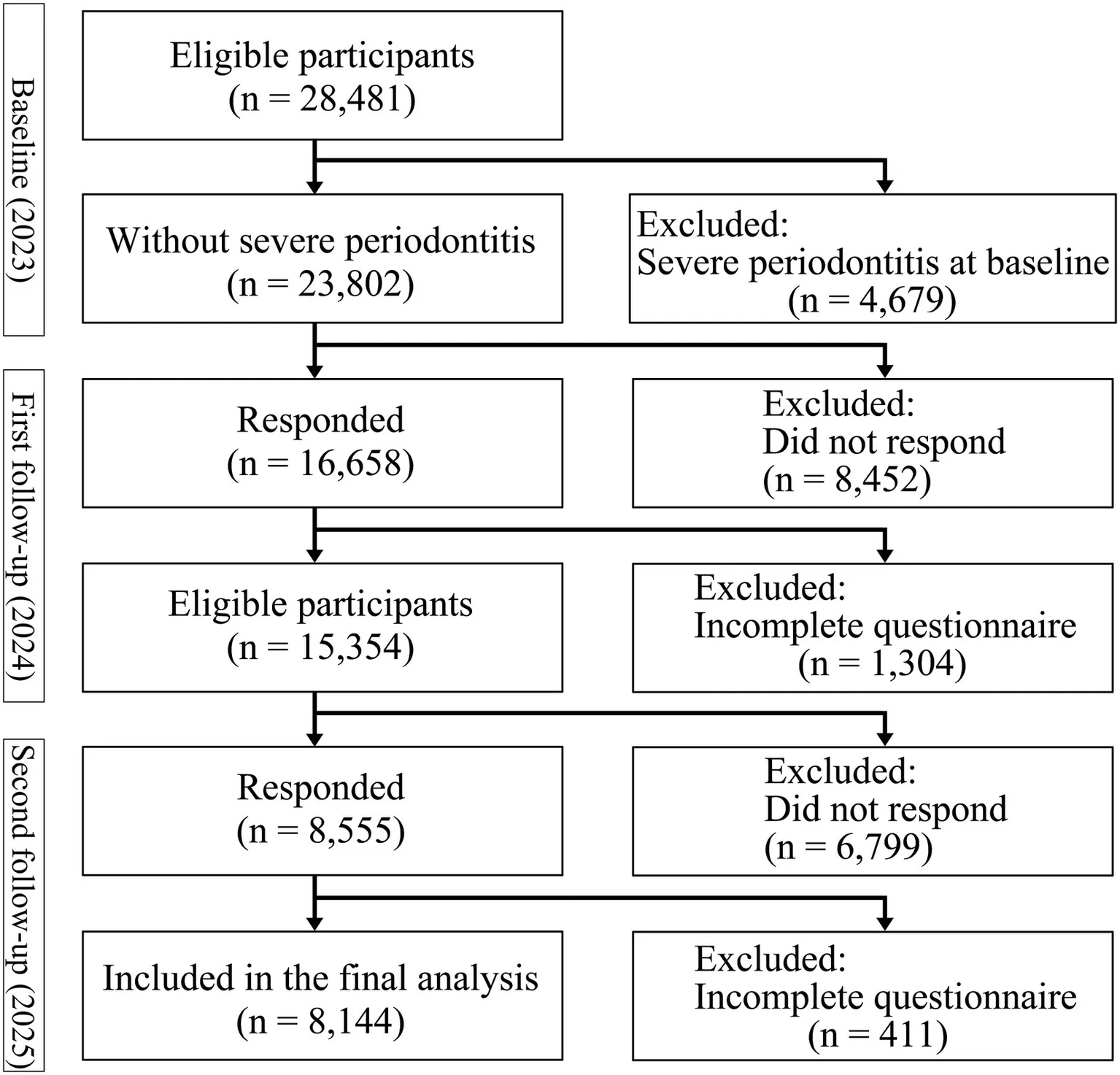
We conducted a Cox proportional hazards analysis among 8,144 individuals without severe periodontitis at baseline in 2023, with the first self-reported incident severe periodontitis during the 2023–2025 follow-up period as the outcome ( Table 2 ); 6,688 individuals were included in the analysis.
- Follow-up
Participants without self-reported severe periodontitis at baseline (2023) were followed for up to 2 years until the first self-reported incident severe periodontitis or censoring.
- Result
Sleeping <6 h was associated with a higher risk of self-reported incident severe periodontitis compared with sleeping ≥6 h (HR = 1.28, 95% CI: 1.13–1.46, p < 0.001).
Quoted word for word from the full text on frontiersin.org.
The paper
Okayama University
Frontiers in Public Health, 30 Sep 2026, Open access


