Evening high-intensity interval exercise attenuates the next-morning decline in flow-mediated dilation in healthy young men
Abstract
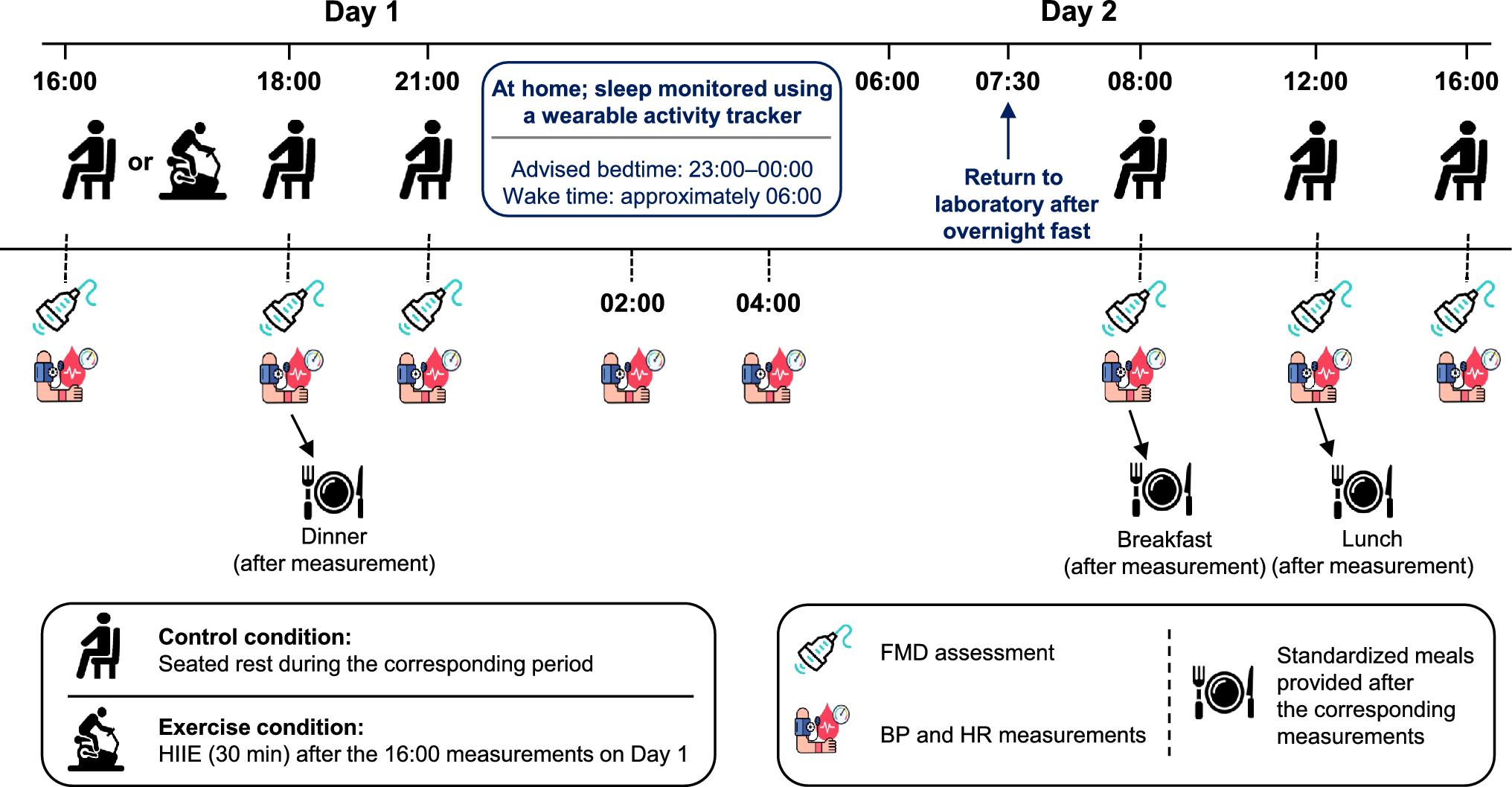
PURPOSE: Vascular endothelial function (VEF), assessed by flow-mediated dilation (FMD), shows diurnal variation and is reduced in the early morning. Although exercise improves VEF, whether the vascular effects of evening high-intensity interval exercise (HIIE) persist into the following morning remains unclear. This study examined whether evening HIIE affects next-morning VEF. METHODS: Eleven healthy young men completed exercise and control conditions in a randomized crossover design. In the exercise condition, participants performed 30 min of late-afternoon HIIE. FMD, blood pressure, and heart rate were measured from the afternoon of Day 1 to the afternoon of Day 2. RESULTS: FMD increased following HIIE at 18:00 (6.5 ± 0.76% to 9.3 ± 0.93%, p < 0.05). In the control condition, FMD was lower at 08:00 than at 12:00 on Day 2 (4.7 ± 0.47% vs. 7.0 ± 0.79%, p < 0.05). At 08:00 on Day 2, FMD was higher in the exercise condition than in the control condition (7.6 ± 0.57% vs. 4.7 ± 0.47%, p < 0.05). Systolic blood pressure was lower in the exercise condition than in the control condition at 21:00 on Day 1 (114.6 ± 1.7 vs. 126.1 ± 1.8 mmHg) and 04:00 on Day 2 (88.7 ± 2.1 vs. 95.0 ± 1.2 mmHg) (p < 0.05). CONCLUSION: A single bout of HIIE attenuates the morning decline in endothelial function. These findings suggest that the vascular benefits of exercise extend beyond the immediate post-exercise period and may influence the diurnal pattern of endothelial function.
- High-intensity interval exercise
- Flow-mediated dilation
- Blood pressure
- Heart rate
- Systolic blood pressure
- Humans
The paper
Aichi Prefectural University; Prefectural University of Hiroshima
European Journal of Applied Physiology, 15 Oct 2026