Traditional Chinese mind-body training for bone mineral density in middle-aged and older women: A three-level dose-response Meta-analysis of randomized controlled trials
Dose-response
Abstract
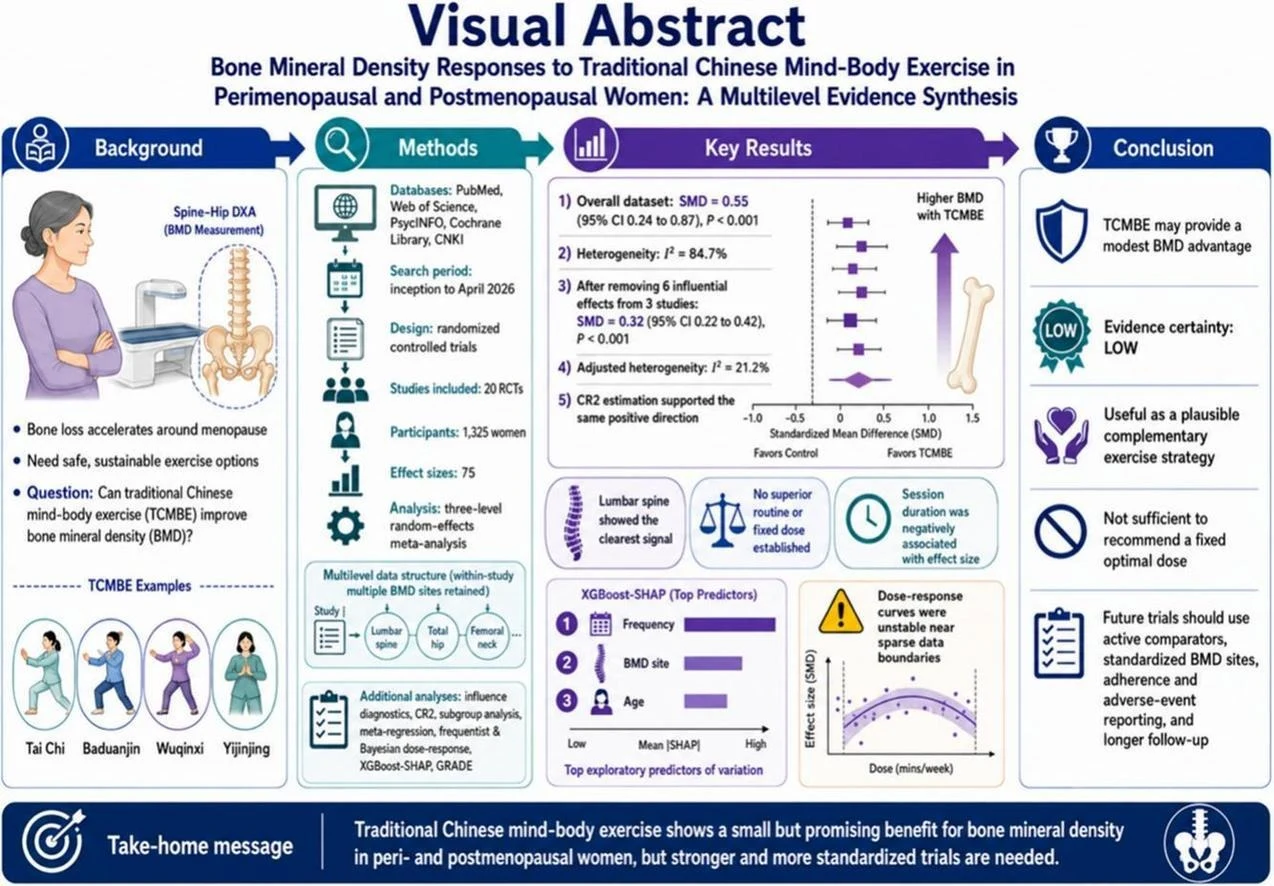
OBJECTIVE: This study systematically assessed the effect of Traditional Chinese mind-body training (TCMBT) on bone mineral density (BMD) in middle-aged and older women and examined whether the intervention effects varied by training dose. METHODS: PubMed, Web of Science, PsycINFO, the Cochrane Library, and China National Knowledge Infrastructure were searched from database inception to April 2026. Eligible studies were randomized controlled trials that evaluated the effects of TCMBT on BMD in middle-aged and older women. Study selection, data extraction, and risk-of-bias assessment were performed independently by two reviewers. Effect estimates were synthesized using a three-level random-effects model. The stability of the results was examined through influence diagnostics, leave-one-out sensitivity analysis, Egger's test, trim-and-fill analysis, subgroup analysis, linear meta-regression, and Bayesian dose-response modeling. RESULTS: Twenty randomized controlled trials (RCTs) were initially included in the systematic review and primary meta-analysis. Influence diagnostics based on standardized residuals and Cook's distance identified three highly influential RCTs; after excluding these studies, 17 RCTs remained in the final influence-adjusted meta-analysis. The initial pooled analysis showed that TCMBT significantly increased BMD in middle-aged and older women (standardized mean difference [SMD] = 0.55, 95% confidence interval [CI]: 0.24-0.87; P < 0.001), although heterogeneity was substantial (I² = 84.7%). After exclusion of the three highly influential studies, the pooled estimate was reduced but remained positive and statistically significant (SMD = 0.32, 95% CI: 0.22-0.42; P < 0.001). Dose-response analyses suggested potential nonlinear associations between training dose and BMD outcomes; however, these findings should be interpreted as exploratory signals rather than a validated or recommended exercise prescription. In the exploratory XGBoost-SHAP analysis, training frequency, BMD assessment site, and participant age contributed to predictions within the fitted model. This analysis represented in-sample descriptive exploration only, without cross-validation or held-out test data, and therefore cannot support generalizable out-of-sample predictive performance. SHAP values represent within-sample predictive contributions only and should not be interpreted as causal determinants or confirmed moderators of intervention effects. CONCLUSIONS: TCMBT appears to have a beneficial effect on BMD in middle-aged and older women, with the most apparent improvement observed at the lumbar spine. The dose-related findings are exploratory and require confirmation in high-quality RCTs before any specific training regimen can be recommended. The XGBoost-SHAP findings are hypothesis-generating only; because the analysis was conducted as an in-sample descriptive exploration without cross-validation or held-out test data, it cannot support generalizable out-of-sample predictive performance or causal inference.
The paper
North China Electric Power University; Beijing Sport University
Experimental Gerontology, 14 Oct 2026