Questionnaire model may aid cardiovascular risk screening
In an independent cohort, the model scored 0.6869 for distinguishing future cases from non-cases, but its precision was too low for diagnosis.
Independent replication
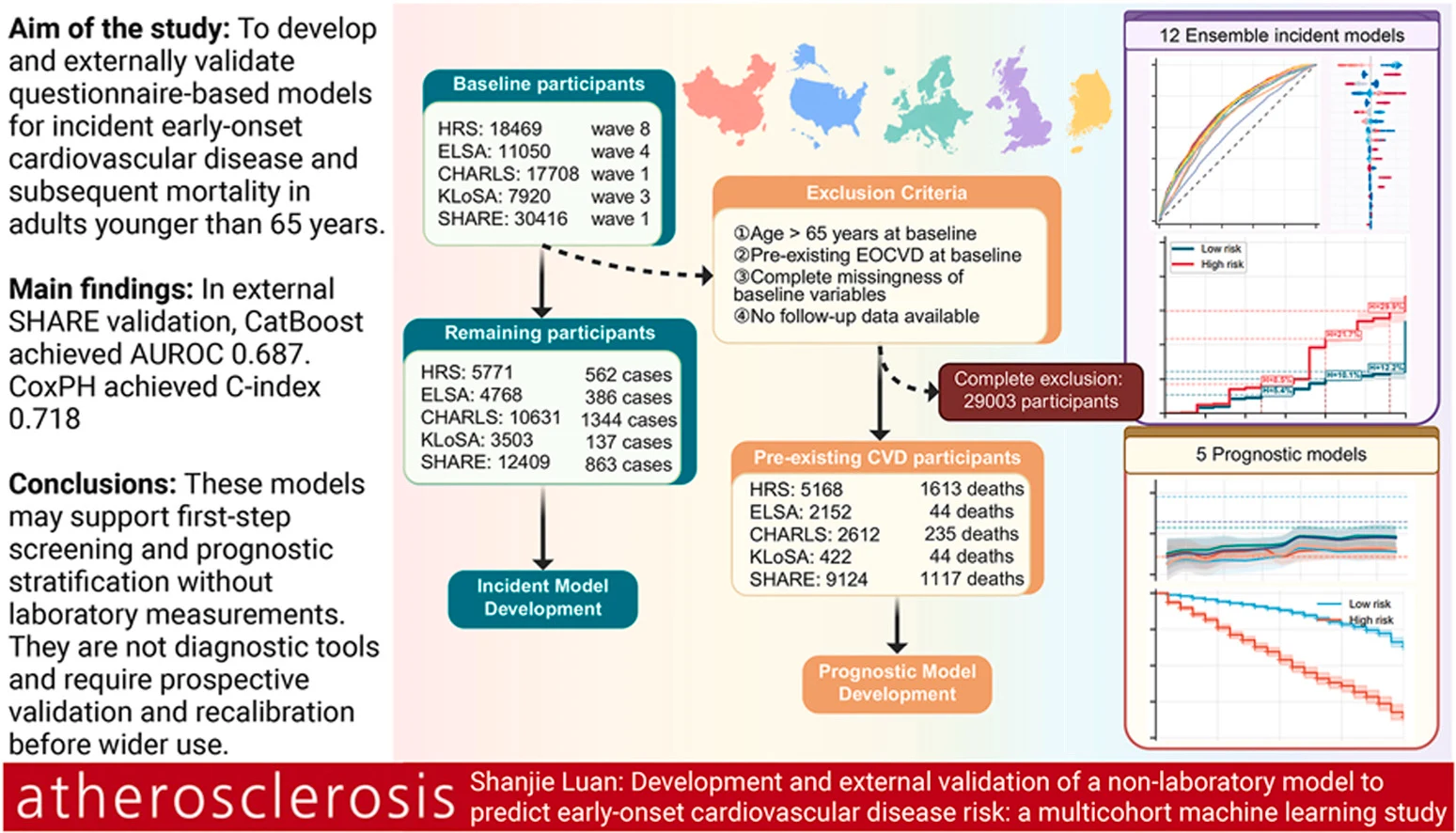
In an observational study, researchers analysed 37,082 adults younger than 65 without cardiovascular disease at baseline to develop and test a model predicting new cases. Cardiovascular disease affects the heart or blood vessels. They used 18 questionnaire-based or routinely obtainable predictors, without laboratory or imaging measurements.
In an independent cohort, the model scored 0.6869 on a measure of how well it distinguished future cases from non-cases. Its precision—the share of people flagged who developed disease—was 0.1105, too low for diagnostic use. A separate analysis included 19,478 adults younger than 65 who already had early-onset cardiovascular disease. Its model predicted survival, scoring 0.7175 on a measure of how well it ranked survival times in a test dataset.
Why it matters
For cardiovascular disease arising before age 65, questionnaire-based risk assessment may support a first screening step where laboratory testing is not immediately available.
Caveats
Testing on existing observational data did not establish performance in prospective use; prospective validation and recalibration are required before use in under-resourced populations. The study covered adults younger than 65, and reported diagnoses may have depended on earlier clinical testing.
- Machine learning
- Early-onset cardiovascular disease
- Incident early-onset cardiovascular disease
- P-EOCVD
- Humans
The paper
Shandong University
Atherosclerosis, 10 Oct 2026
doi.org/10.1016/j.atherosclerosis.2026.121920PubMed 42874486