An aggregation-induced emission fluorescent microsphere-based intelligent lateral flow immunosensor for rapid and quantitative detection of prostate-specific antigen
Abstract
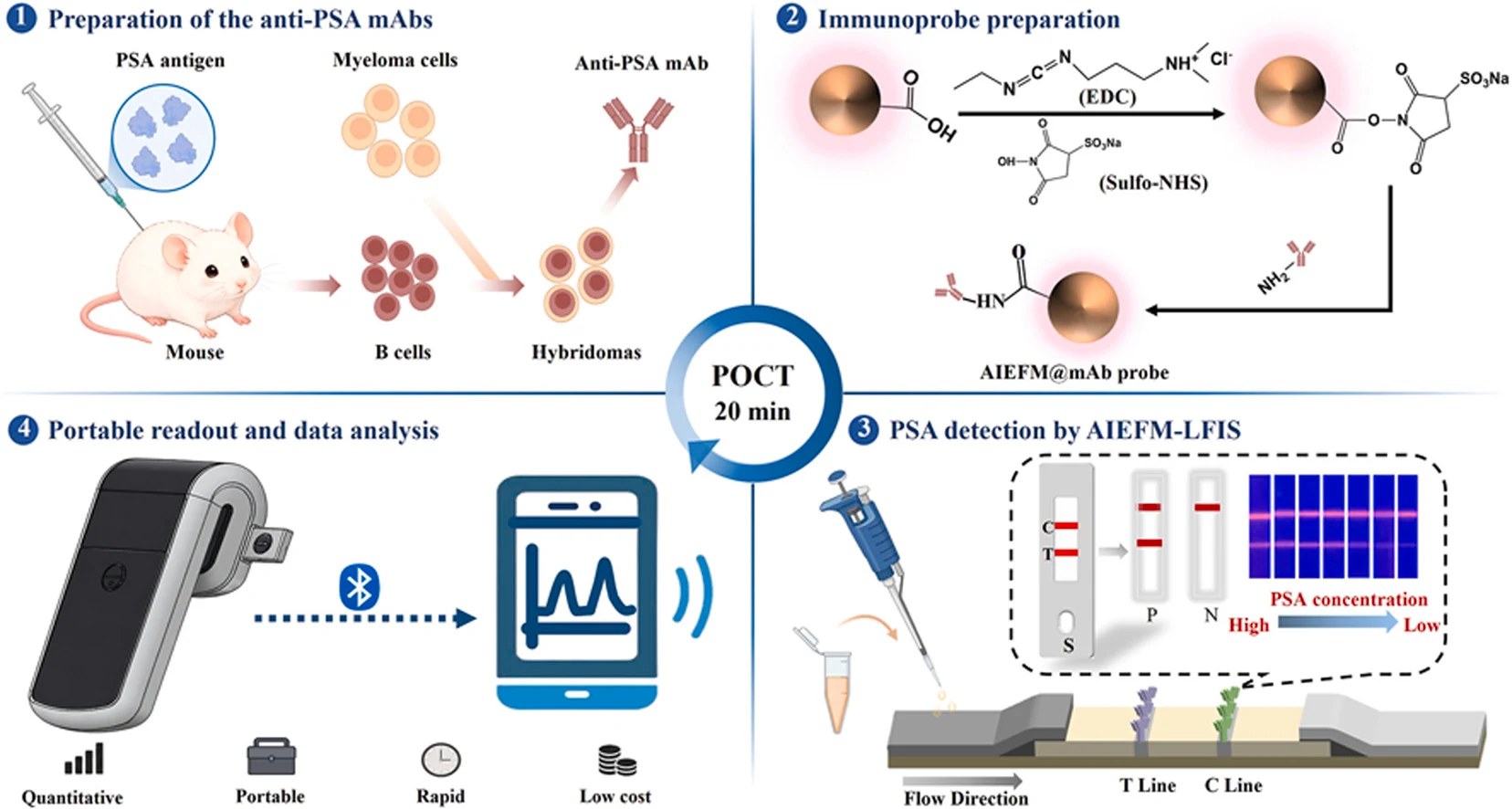
Prostate-specific antigen (PSA) is an important biomarker for prostate cancer (PCa) screening, but conventional detection methods rely on sophisticated instruments and centralized laboratories. Herein, we developed an aggregation-induced emission fluorescent microsphere-based lateral flow immunoassay strip (AIEFM-LFIS) for rapid and quantitative detection of PSA. Highly specific anti-PSA monoclonal antibodies were prepared by hybridoma technology and conjugated with AIEFMs to construct fluorescent immunoprobes, which were further integrated with a portable LumiS-1 Pro reader for quantitative signal acquisition and smartphone-based data transmission. Under optimized conditions, PSA could be detected within 20 min over a detection range of 0.5-62.5 ng/mL, with a limit of detection of 0.28 ng/mL. Clinical evaluation of 40 serum samples showed a sensitivity of 96.2%, a specificity of 100%, and a consistency of 97.5% with chemiluminescence immunoassay. Owing to its high sensitivity, portability, intelligent quantitative readout, and low cost, the developed platform provides a promising tool for decentralized PSA testing and preliminary PCa screening in primary healthcare and resource-limited settings.
The paper
ZheJiang Academy of Agricultural Sciences; University of Shanghai for Science and Technology
Talanta, 12 Oct 2026