Association between the hemoglobin albumin lymphocyte and platelet score and chronic kidney disease: Insights from patient data and animal models
Abstract
OBJECTIVES: The hemoglobin, albumin, lymphocytes and platelets (HALP) score, a novel nutritional and inflammatory biomarker, has been used in various chronic disease studies. However, the relationship between the HALP score and chronic kidney disease (CKD) remains poorly elucidated. This study aimed to explore the association between the HALP score and CKD. METHODS: Our analysis encompassed 25,181 adult participants drawn from NHANES cycles spanning 2009-2018. Weighted multivariable logistic regression and generalized additive models (GAMs) were employed to evaluate the independent associations between the HALP score and three outcomes: CKD, albuminuria, and low-estimated glomerular filtration rate (eGFR). CKD was defined as albuminuria (urinary albumin-to-creatinine ratio ≥ 30 mg/g) or low-eGFR (eGFR < 60 mL/min/1.73m2). Threshold effects were examined using two-piecewise linear regression. Subgroup and sensitivity analyses were performed to assess robustness. Receiver operating characteristic (ROC) curve analyses were applied to compare the discriminative capacity of the HALP score with the prognostic nutritional index (PNI), systemic immune-inflammation index (SII), lymphocyte-to-monocyte ratio (LMR), and platelet-to-lymphocyte ratio (PLR). A 5/6 nephrectomy rat model of CKD was established to evaluate the HALP values and their components. RESULTS: After adjustment for multiple confounders, higher HALP scores were inversely associated with prevalent CKD (OR = 0.97, 95% CI: 0.94-0.99) and albuminuria (OR = 0.97, 95% CI: 0.93-0.99). However, the association between the HALP score and low-eGFR was no longer statistically significant in Model 3. Non-linear analyses revealed a threshold pattern, with higher HALP scores inversely associated with prevalent CKD up to an inflection point of 52.43 (OR = 0.97, 95% CI: 0.95-0.99), beyond which no significant association was observed. For albuminuria, the corresponding inflection point was 49.82. Subgroup and interaction analyses indicated no meaningful effect modification by age, sex, BMI, hypertension, or diabetes. Sensitivity analyses confirmed the robustness of the results. ROC analysis demonstrated that the HALP score had modestly higher AUCs for CKD and albuminuria compared with PNI, SII, LMR, and PLR. In the animal experiment, CKD rats exhibited significantly lower calculated HALP values, which were inversely correlated with serum creatinine (Scr), blood urea nitrogen (BUN), and urinary albumin-to-creatinine ratio (UACR), further supporting the biological plausibility of the HALP-CKD association. CONCLUSION: In this cross-sectional study, lower HALP scores are independently associated with a higher prevalence of CKD and albuminuria. As an affordable and readily measurable composite index, a low HALP score may represent a complementary marker of prevalent CKD, while its clinical utility requires prospective validation.
From the paper
- Participants
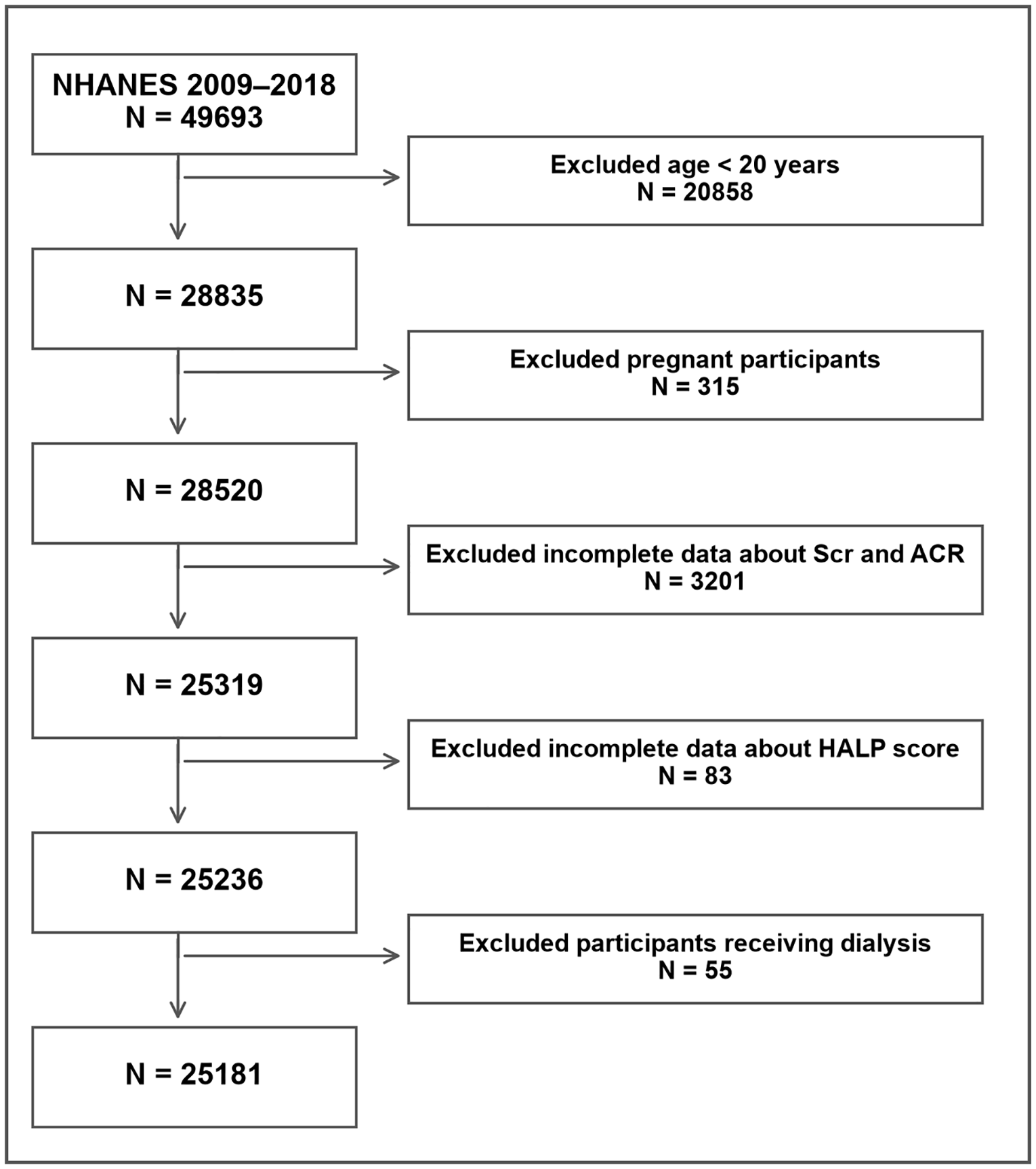
A total of 25,181 individuals participated, with a mean age of 50.79 ± 14.60 years, comprising 48.95% males and 51.05% females.
- Result
After adjustment for multiple confounders, higher HALP scores were inversely associated with prevalent CKD (OR = 0.97, 95% CI: 0.94–0.99) and albuminuria (OR = 0.97, 95% CI: 0.93–0.99).
- Limitation
First, the cross-sectional observational design of the NHANES dataset precludes causal inference regarding the association between the HALP score and CKD.
Quoted word for word from the full text on journals.plos.org.
The paper
Hebei University of Chinese Medicine
PLOS One, 14 Oct 2026