Link Between the Cardiometabolic Index and Stroke Risk Across Different Glucose Metabolic Status in Chinese Middle-Aged and Older Adults: A Longitudinal Cohort Study
Abstract
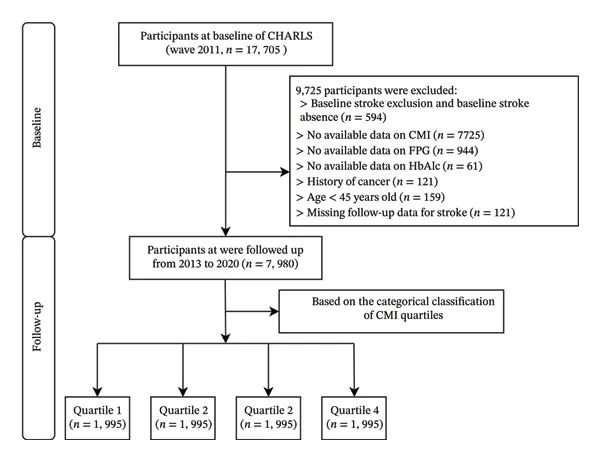
BACKGROUND: The cardiometabolic index (CMI) encompasses central obesity and atherogenic dyslipidemia, two metabolic abnormalities that are closely associated with insulin resistance and issues in glucose metabolism. However, whether the association between CMI and incident stroke differs across glucose metabolic states remains unclear. METHODS: Utilizing data from the China Health and Retirement Longitudinal Study (CHARLS), we carried out a cohort study with 7980 individuals aged 45 years and above who were free of stroke. We explored the associations between the initial CMI and stroke incidents across various glucose metabolism status through Cox proportional hazards models, restricted cubic spline analyses, Kaplan-Meier survival analysis, subgroup and sensitivity analyses, and receiver operating characteristic analysis. RESULTS: Incident stroke risk was independently associated with both log (CMI) and CMI quartiles, increasing with higher values and quartiles. The fully adjusted model showed that each 1-unit rise in log (CMI) was associated with an increased risk of stroke (HR = 1.13, 95% CI 1.00-1.28; p = 0.044). Compared to Q1, Q4 had a higher risk of stroke (HR = 1.52; 95% CI 1.11-2.08; p = 0.008). Moreover, for individuals with diabetes mellitus (DM), a higher CMI was associated with a greater likelihood of stroke, with Q4 presenting an increased risk (HR = 1.49, 95% CI: 1.02-2.31, p = 0.019) when compared to Q1. By contrast, no significant association was observed among individuals with prediabetes or normal glucose regulation. The findings' robustness was further corroborated by conducting subgroup and sensitivity analyses. In those with DM, the CMI had a moderate level of accuracy in predicting new stroke cases, with an area under the receiver operating characteristic curve of 0.675. CONCLUSIONS: A higher baseline CMI was associated with an increased risk of incident stroke, with a more apparent association among individuals with DM. These findings suggest that the vascular relevance of the CMI may vary according to the underlying glucose metabolic status and support its potential role as a marker of cardiometabolic dysfunction. Further research is essential to shed light on the metabolic pathways involved in these associations and to establish the clinical value of CMI.
From the paper
- Participants
Meanwhile, the NGR group, which included 943 individuals, reported 77 strokes.
Results, 3.3. Relationship Between CMI and Stroke Risk Across Different Glucose Metabolic States
- Result
The fully adjusted model showed that each 1-unit rise in log (CMI) was associated with an increased risk of stroke (HR = 1.13, 95% CI 1.00–1.28; p = 0.044).
Quoted word for word from the full text on onlinelibrary.wiley.com.
The paper
Shanxi Medical University; Taizhou Municipal Hospital
International Journal of Endocrinology, 13 Oct 2026, Open access