Regression, Persistence, and Progression of Cervical Precursor Lesions in Relation to High-Risk Human Papillomavirus Genotypes Over a 2-Year Follow-Up: A Prospective Cohort Study in Iran
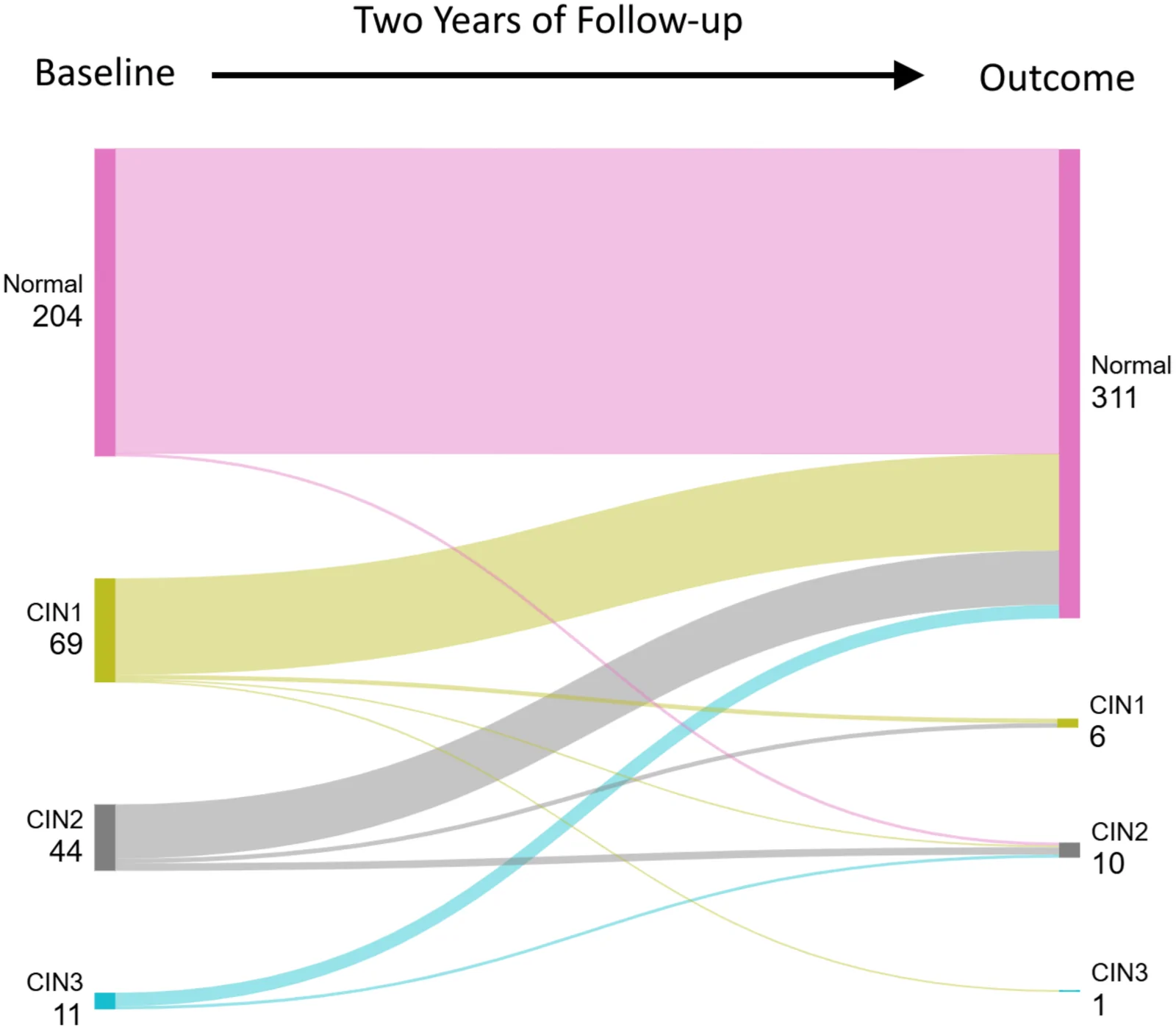
2 years
Abstract
PURPOSE: Cervical cancer remains a significant global health burden, especially in low- and middle-income countries where screening coverage is limited. Persistent infection with high-risk human papillomavirus (HR-HPV) is the primary cause of cervical cancer. This study evaluates the natural history of cervical precursor lesions in women with negative Pap smears but positive HR-HPV results, focusing on risk factors of lesion regression, persistence, and progression. PATIENTS AND METHODS: A prospective cohort study was conducted between December 2021 and April 2024 in Tehran, Iran. Women aged 30-65 years with HR-HPV infection and normal Pap smear results were enrolled. Participants underwent colposcopy-guided biopsy at baseline and after two years. Lesions were categorized as regressing, persisting, or progressing based on histopathological assessments. RESULTS: Among 328 participants, 94.8% showed lesion regression, while a small proportion experienced persistence (3.4%) or progression (1.8%). Higher baseline lesion severity was the strongest predictor of persistence/progression (CIN1: aOR = 9.818, CIN2+: aOR = 24.984, normal as reference, all p < 0.05). Age showed a significant association with increased risk (aOR = 1.106, p = 0.018), while education and HPV genotype were not significantly associated. CONCLUSIONS: In our study, baseline histological grade was the primary predictor of lesion persistence or progression. While HPV 16/18 are established high-risk factors, our findings suggest that in high-risk women within low-resource settings, the initial histological diagnosis may offer more immediate prognostic value for short-term outcomes than HPV genotyping alone. Larger, long-term studies are needed to confirm whether management strategies should be adjusted based on baseline pathology in these populations.
From the paper
- Participants
A total of 328 participants were included in the study, categorized into three groups based on HPV genotypes: HPV 16/18 (n=117), other high-risk HPV types (n=187), and co-infection with HPV 16/18 and other high-risk types (n=24).
- Result
Compared to participants with normal baseline pathology, those with CIN1 had a significantly higher risk (adjusted OR [aOR] = 9.818, 95% CI: 1.938, 49.721, p=0.006), while those with CIN2+ (aOR = 24.984, 95% CI: 5.032, 124.049, p<0.001) had even greater risks (Table 2).
Results, Risk Factors for Cervical Lesion Regression and Persistence/Progression
- Limitation
This was a single-center study with only two years of follow-up, which may limit the generalizability of our findings.
Quoted word for word from the full text on dovepress.com.
- High-risk human papillomavirus infection
- Cervical precursor lesions
- Cervical intraepithelial neoplasia grade 1
- Cervical intraepithelial neoplasia grade 2 or higher
- Baseline histological grade
- Humans
The paper
Tehran University of Medical Sciences
International Journal of Women's Health, 9 Oct 2026, Open access