Diabetes Status and the Association Between a Coronary Artery Disease Polygenic Risk Score and Incident Coronary Artery Disease in an Iranian Prospective Cohort
Abstract
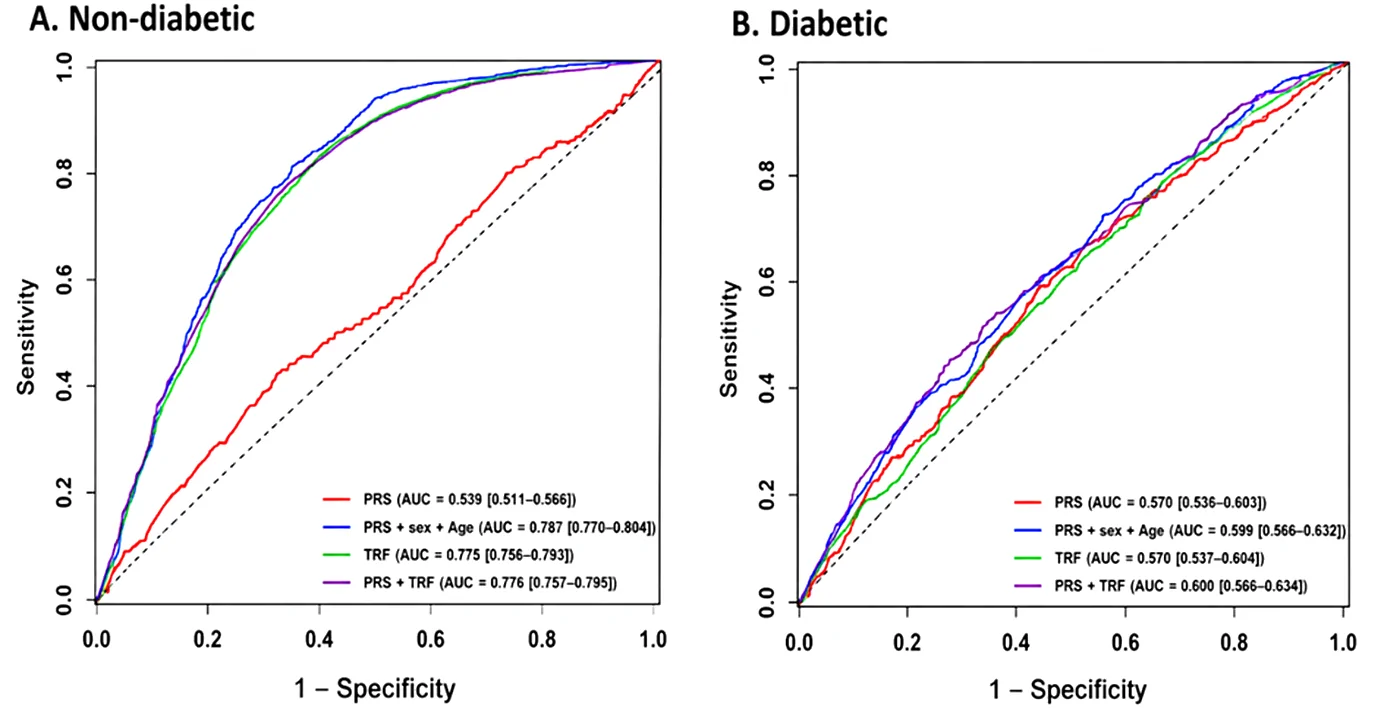
BACKGROUND: Polygenic risk scores (PRSs) for coronary artery disease (CAD) may provide a quantitative assessment of inherited susceptibility that extends beyond conventional clinical risk factors. However, the relationship between CAD PRS and the incidence of CAD may differ across various cardiometabolic risk groups. This study aimed to evaluate whether baseline diabetes status influences the association between CAD PRS and the incidence of CAD. METHODS: This cohort comprised 5,139 adults from the Tehran Cardiometabolic Genetic Study (TCGS) who were free of CAD at baseline. The CAD PRS was constructed using a maximum clumping-and-thresholding approach based on external CAD genome-wide association summary statistics. Associations between the PRS and cumulative incident CAD were assessed according to diabetes status using logistic regression. Model discrimination and prediction error were evaluated using the area under the curve (AUC) and the Brier score. RESULTS: Among 5,139 participants, 1,171 had diabetes while 3,968 did not; incident CAD occurred in 334 diabetic and 427 non-diabetic participants. After adjusting for traditional risk factors, each 1-SD increase in the PRS was associated with higher odds of incident CAD in diabetic participants (OR, 1.36; 95% CI, 1.20-1.55) and non-diabetic participants (OR, 1.27; 95% CI, 1.14-1.41). A significant interaction between PRS quintiles and diabetes status was observed (P = 0.017). The model incorporating the PRS alongside traditional risk factors demonstrated greater discrimination in non-diabetic compared to diabetic participants (AUC, 0.776 vs 0.600). CONCLUSION: CAD PRS was associated with incident CAD across diabetes-defined strata; however, its predictive relevance varied according to baseline diabetes status. These findings support the use of PRS as a marker of inherited susceptibility rather than as evidence for clinical risk reclassification or as a stand-alone predictive tool.
- Human genetics
- Diabetes mellitus
- Coronary artery disease
- Coronary artery disease polygenic risk score
- Incident coronary artery disease
- Humans
The paper
Research Institute for Endocrine Sciences; Shahid Beheshti University
Medical Journal of the Islamic Republic of Iran, Aug 19, 2026

