The CKM-GDM multi-organ precision model: reframing gestational diabetes as an early cardiovascular-kidney-metabolic event in Southeast Asia
Abstract
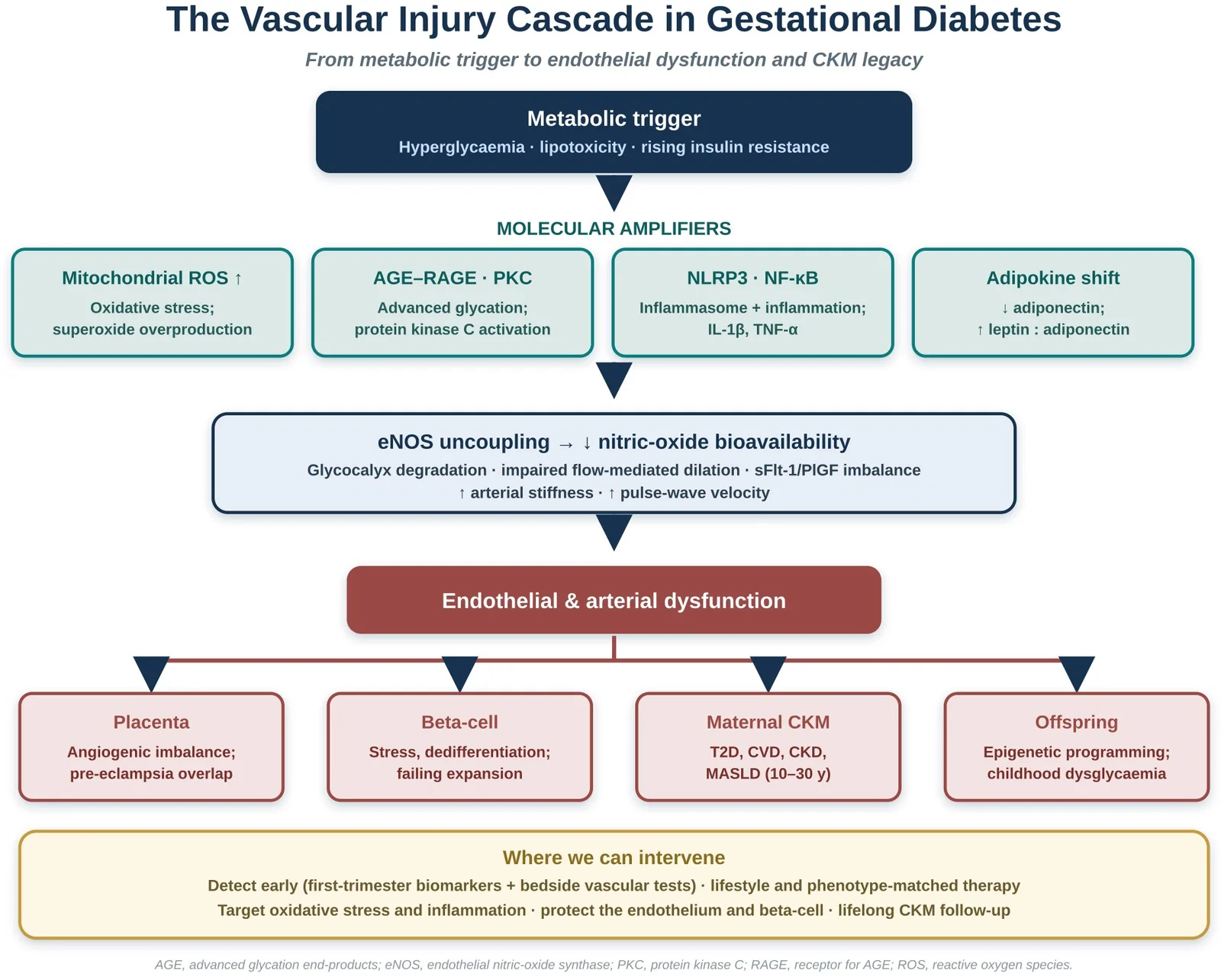
BACKGROUND: Gestational diabetes mellitus (GDM) is amongst the commonest complications of pregnancy and an early marker of lifetime cardiovascular-kidney-metabolic (CKM) risk. Its burden is heavy in Southeast Asia, where prevalence ranges from about 8% to nearly 30% and a lean phenotype - with marked over-representation of the insulin-secretion-limited subtype - diverges from Western cohorts, yet its definition, timing, and treatment remain contested. AIM: This clinically oriented narrative review synthesises the diagnostic landscape, the shift to early diagnosis, the vascular mechanism, and precision care, centred on Southeast Asia. KEY THEMES: Competing criteria (IADPSG one-step, WHO 2013, NICE, ADA two-step and the pragmatic Indian DIPSI test) identify different populations. The TOBOGM trial shows that early (pre-20-week) treatment improves outcomes, and first-trimester biomarkers-low adiponectin and sex-hormone-binding globulin, glycosylated fibronectin, atherogenic lipids, and multimarker or machine-learning panels including a non-fasting Asian-women panel-show potential to make early prediction feasible. Vascular and endothelial dysfunction (oxidative stress, eNOS uncoupling, sFlt-1/PlGF imbalance, and arterial stiffness) is proposed as the unifying early signal and a mechanistic bridge to later type 2 diabetes, cardiovascular disease, and chronic kidney disease. GDM is increasingly recognised as heterogeneous (insulin-resistant, insulin-deficient, and mixed subtypes), inviting subtype- and phenotype-guided precision diagnosis and treatment. CONCLUSION: We propose that GDM may be productively reframed as an early, vascular, and potentially precisely treatable CKM event-screened early, matched to phenotype and linked to lifelong follow-up, and fitted to the epidemiology, genetics, and health systems of Southeast Asia. This reframing is a testable hypothesis that requires prospective validation before routine adoption.
From the paper
- Limitation
It is narrative rather than systematic, so selection was purposive and no formal risk-of-bias or quantitative appraisal was performed.
Quoted word for word from the full text on frontiersin.org.
- Early treatment
- Nitric oxide–cGMP signalling
- Oxidative stress and ROS signalling
- Gestational diabetes mellitus
- Cardiovascular disease
- Humans
The paper
Panacea Multispeciality Hospital
Frontiers in Endocrinology, 29 Sep 2026, Open access