Curve walking gait analysis using depth camera and machine learning for detecting cognitive impairment
Abstract
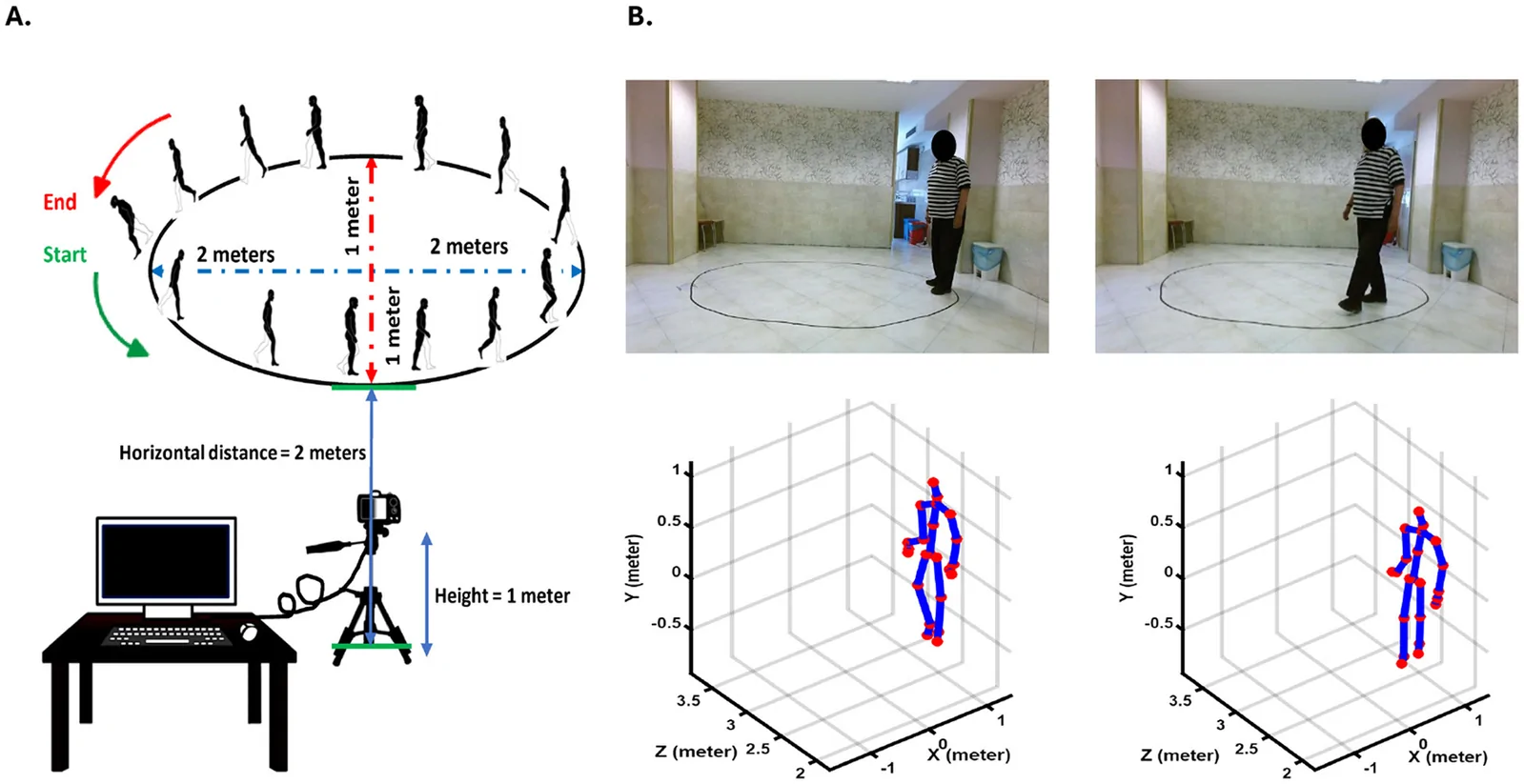
INTRODUCTION: Early detection of cognitive impairment (CI), including MCI and Alzheimer's disease (AD), remains limited by the invasiveness and cost of current diagnostic tools. While gait analysis is a promising alternative, most studies focus on straight-path walking, which may miss subtle motor-cognitive deficits. We hypothesized that curve walking-especially under dual-task (DT) conditions-would better expose early CI-related changes. Combined with machine learning, this approach offers a low-cost, non-invasive tool to distinguish healthy controls (HC), MCI, and AD. METHODS: Seventy-three older adults (HC, MCI due to Alzheimer's disease, and mild AD) performed curve walking along a 10-m oval path under single-task (ST) and DT conditions (counting backward from 100 by ones) while 3D body joint motion was captured using a Kinect v.2 depth camera. Comprehensive macro- and micro-level gait markers were extracted using signal processing and statistical analysis, followed by gait marker selection and machine learning-based classification of CI vs. HC and AD vs. MCI. RESULTS: Out of 156 extracted gait markers, statistical analysis identified 22 ST and 34 DT markers-including macro, micro-temporal, spatial, and symmetry markers-as selected significantly discriminative markers. CI participants showed slower, less stable gait, with greater variability and asymmetry, particularly under DT conditions. Machine learning models combining ST and DT markers achieved 89.04% accuracy for CI vs. HC and 93.02% for AD vs. MCI, confirming that curved walking under dual-task conditions provides richer discriminative gait information than single-task curved walking alone, and supporting curved dual-task gait analysis as a promising paradigm for early cognitive impairment detection and staging. DISCUSSION: Curve walking under cognitive load revealed subtle gait deficits linked to CI, enabling accurate, low-cost, and non-invasive detection and staging using depth camera data and machine learning-supporting its potential as a screening approach for supervised clinical and community settings, subject to validation in less-controlled environments.
- Curve walking
- Curve walking gait analysis
- Machine learning
- Cognitive impairment
- Alzheimer's disease
- Humans
The paper
Florida Atlantic University
Frontiers in Neurology, 29 Sep 2026, Open access